Episode Transcript
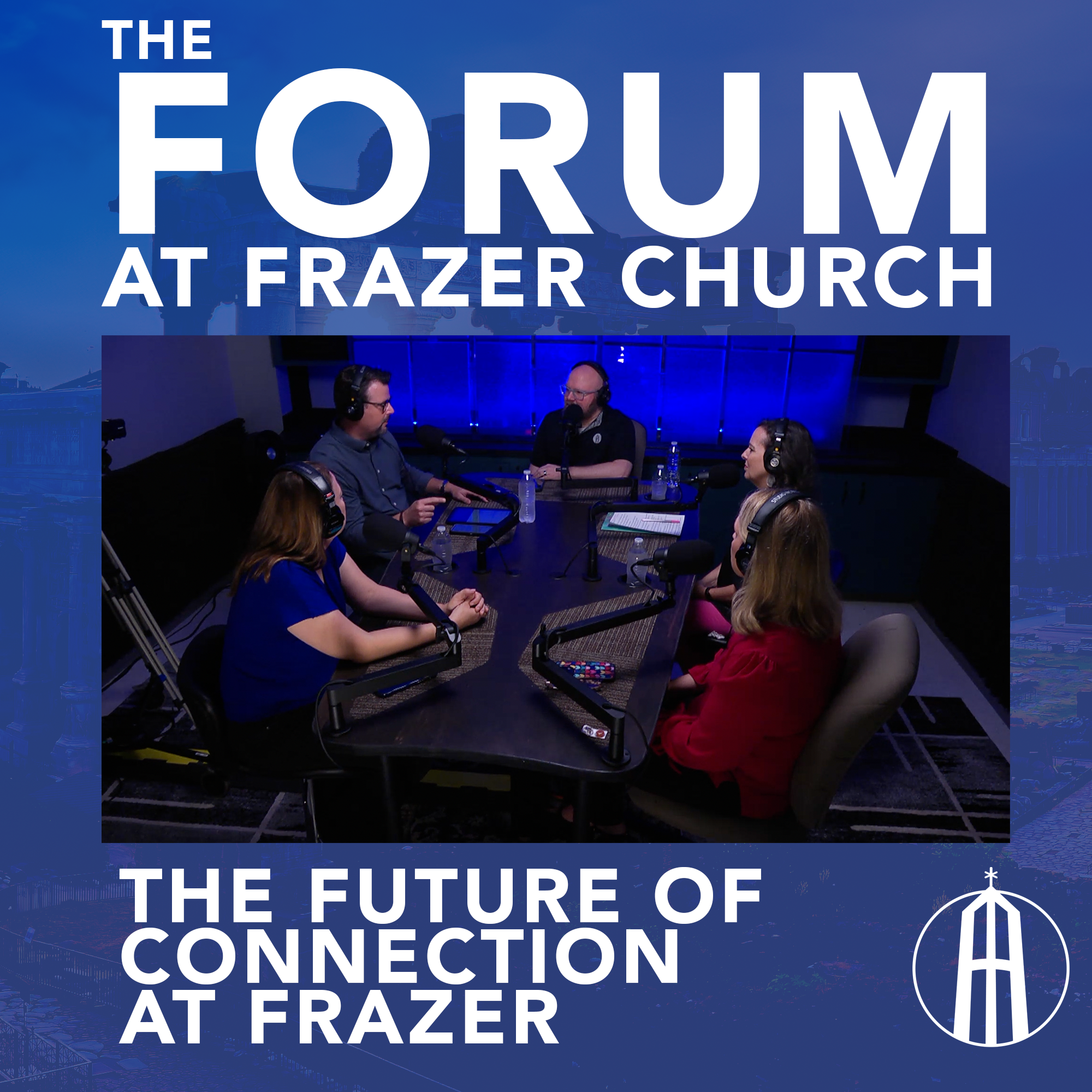
[00:00:04] Speaker A: Well, hello, Frazer family, and welcome once again to the Frazer Forum podcast. I'm Will Adams. I am the minister of story and media director here. I'm here with several important folks here. Of course, you know Chris Montgomery, our senior pastor, Cammie, who's been the children's minister here for many years.
We also have Katie and Sarah, who are on our children's ministry staff. We're going to be talking a little bit more about all of that here in a second.
Last week, we talked about the importance of connection in worship. We talked with Jordan, who is our music minister, and she kind of explained all of the importance of connection both with God and with each other in the context of worship. And today we want to talk a little bit more about fostering that community connection in several different areas of our church and really having a culture of that. And so, Chris, what does it mean to you? Because I know this is something you've talked about a lot lately. Why is it important for us to foster that kind of culture?
[00:01:07] Speaker B: Yeah, that's a good question. One of the things we said last time was that obviously the kingdom of God runs off of personal relationships. It's about a personal relationship with God, it's about a personal relationship with other people, and then it's about building a personal relationship, building bridges to the world around you for evangelism purposes. So, you know, obviously we want to exalt God, we want to know God, we want to be known by God in that intimate way. And so we do that in worship.
And then from there we do ministry to believers, which means you got to know them, right?
And then you want to build those bridges to the community so you can do mission and evangelism. So, you know, everything's running off relationships in the kingdom. But if you look at it where we are kind of contextually in time, and particularly in the west, there was a time in which, you know, the churches, there was this movement that happened where, as you know, denominations would supply content churches. So if you were a Methodist church, you got it from this publishing house. If you were a Baptist church, you got it from that publishing house. You know, those kind of things. And then you saw more parachurch ministry, started doing that, you know, as denominational affiliation was not as strong. And then you saw the rise of churches creating their own content, you know, somewhat like we're doing right now, you know.
And so one of the things that we are living in in today's society is a content rich environment.
You can get all kinds of resources in print form and video, audio, all that stuff. And that is good. That is good. We need to saturate the airways and the bookstores. We need to do all of that and not stop.
But whereas, you know, several years ago, the church was starving for content, therefore the creation of all these things, today in a post Covid world, particular people are starving for relationships and connection.
And so that's the thing that I think we're in this unique time in which the church is rediscovering that, you know, this thing really does work. When I know somebody's name, they know my name, I know what's going on in their life, they know what's going on in my life. And it's not invasive, not in that sense, but it's.
I know somebody and I'm known by somebody. And people are wanting that. I mean, even Christianity Today dropped an article, I think it was yesterday, maybe, you know, about the ums. They're not the Duns. You know, it's people who actually long for connection in a local church. They, they want that. They're just not sure how the, their reentry is, you know, going to be taken or how to, you know, how they should go about doing that. But our society is starving for that. And I think the, that's where the church is uniquely positioned because the kingdom runs on this, it runs on connection and relationships with other people.
[00:04:00] Speaker A: Yeah. You know, John Wesley famously said it was, it sounds like hyperbole, but he said, you can no more be a holy hermit than a holy adulterer.
[00:04:10] Speaker B: Yeah.
[00:04:11] Speaker A: And this was a guy who spent a lot of time alone writing and reading and everything. So he really definitely believed in the value of solitude. Obviously Jesus himself.
[00:04:21] Speaker C: Right.
[00:04:21] Speaker A: Spent a great deal of time in solitude. But we see also throughout scripture, throughout Christian history, the importance of people spending time together.
[00:04:31] Speaker B: Yeah.
[00:04:32] Speaker A: So having said that, I know you have a kind of important thing that you want to talk about from here.
[00:04:39] Speaker B: No. Yeah, yeah, maybe, maybe.
So to set that up, let me say this. You know, I do think we're at a unique point in the history of the church, in particular our context in the west where we rediscovering the power and the privilege and the responsibility to be a part of connecting people together.
That is what we do.
And I think we're seeing the fruits of that in many ways. And what we've got to do is we've got to get back to pioneering that.
I think a lot of times, you know, what you see in churches that have been established, obviously we're a legacy Church. We've been here since 1893 in some form or fashion, not physically in this location, but in existence. And part of what comes with that is that we all inherit a lot of stuff that's been given to us. And so, you know, every one of us in our positions, we've come into this position and it's like, here's a. Here's a ministry that's kind of built out fully formed in some. In some fashion now just go lead it, right? That kind of thing. And what we've got to do as a church is get back to not necessarily changing what we do as much as changing how we think about what we do. And we've got to get back to pioneering.
And so now pioneering is. Is nerve wracking, right? It's, you know, whenever you.
To especially, you know, if things seemed settled, they're moving along. You don't want to disrupt things and all.
But to get back to that kind of pioneer mentality is something I think the church is always kind of pushing itself to do. And the question is, are we going to be intentional in doing that or are we just going to kind of talk about those things? And they're just going to be, you know, kind of out there in the air. So that leads to, you know, where we are as a church and some strategic moves that we're making as a church around that. And a lot of that has to do with these people who are sitting in the room with us here today.
And it starts with Cami.
Cami, you've been over children's minister kids ministry for 11 and a half years now. 11 and a half years, yes. And that is a long time. And one of the beauties of that is you establish all these relationships. You, in 11 and a half years, you kind of. You get to. It's enough time to set everything up kind of the way that God's leading you and how it needs to work and how it needs to flourish.
But we're gonna change that.
[00:07:12] Speaker C: Okay.
Surprise.
[00:07:14] Speaker B: She said okay, like it's a surprise.
[00:07:17] Speaker A: She's just finding this out now.
[00:07:20] Speaker B: She is.
And so no part of the vision, what we've been looking at is how do we connect and engage with families, but also people in general on a much more focused level. And then how do we build a culture around that? Right. So it's not just doing the thing, but building a culture. And so because of that, Kami is going to become our new family connection minister.
[00:07:45] Speaker C: Yes.
[00:07:45] Speaker B: So excited about that.
And in part of that too, is not Just that we're outsourcing all of our connection to Cami. Right, right. A lot of times in church world, you think, oh, you hired the evangelism person to do all the evangelism or whatever. No, no, that's not it. It's about building culture around connection. And then particularly, what does that look like in our discipleship? Core discipleship areas of the church in those core areas. If you're wondering what that is, that's just. I'm defining that as what each church kind of has to have around kids, students, adult groups, and worship, which is the core of that. And so how we go about that. So first, let me just say congratulations on your new role.
[00:08:24] Speaker C: Thank you. Thank you. I'm very excited.
[00:08:26] Speaker B: Yeah. And you spent time. You know, we began talking about this, and you spent time in prayer, and, you know, you. And God got happy with all that. Do you want to say anything about any of that?
[00:08:37] Speaker C: Yes, very happy. I'm always happy with God, but sometimes we drag our feet when God wants us to move in a new direction. Because I love children. That's what I've done forever.
But. But more than children, I just love people. And God has just given me this where I just love to connect with people, you know? And so I'm so glad that we get to connect with children, but with families, with people all the way across the church, it just. I'm thrilled. I'm very humbled, but super excited for what's ahead. And just, you know, I. When I think about the greatest connector that I know, it's Jesus. I mean, he went into a village, and he saw some people, had some conversations. People just started following him and just. And he connected. I was like, okay, so, funny story. I just came to my mind this morning. When I was in the third grade, I had to write a paper about what I wanted to be when I grew up. And I wanted to be the queen, because I thought that would just be, you know, queen. And the. And the teacher, I'll never forget, this was the one that threw an eraser at me, because I always talked in her class, he wouldn't do that today. But she. She. She said, you can't do that if you're going to be a queen. You.
You know, in England, you can't be here in America. And I was just like. And she put it in the school newspaper, of all things. But so I was like, okay, I can't be a queen. So, okay, I'll be a mom, and I'll be a teacher, and. And I'VE done those things. But more than anything, I just. I want to be like Jesus. And because he connected so beautifully with people, I want to be able to do that, too. And what is so great about the team that we serve with in children's ministry is we've raised such a great team of folks that they are connected to one another. Like, we just got back from kids camp last week, and this year we've had more leaders than ever to go because they love it, because they're connected to one another, they're connected to our children, they're connected to the Lord. But this Sunday, we had a guest come in. I was walking them into the service and I saw two of our folks. Can I say their name? Sure, I can. Pete and Jamie Williams, two of our. Our wonderful fourth and fifth grade Sunday school teachers. They were walking into service and I said, pete, Jamie, meet my new friends. And it was so neat for them to go, hey. And when I made the connection where these people were from, Pete knew. He knew something about this place where he was working. And they're like, yeah, come on into service with us. And I was like, this is what it's all about. They were so excited to welcome them in. And I'm like, and that's what we want to be able to do with all of our folks, is to go, hey, I can connect to folks, but you can too. And it's so easy. And later, when I texted with Jamie and Pete, they're like, oh, it was so great. We had the best conversation. And they were. And they felt so happy to get to do that. So. But no, I love connecting with people, and I'm so excited for all the different ways that we're able to connect. You know, Chris, you mentioned just a few weeks ago, we were in a meeting and you said, there's so many people. People, they get up in the morning, on a Sunday morning, they put their makeup on, they fix their hair, they get dressed, they drive some drive from Pike Road, from Prattville. They come in, they sit on the pew, they hear great preaching, they hear great worship, and they leave.
[00:11:21] Speaker B: Yeah.
[00:11:21] Speaker C: And I just. And it's just. It's just been bothering me so much. I'm like, why would you go through the effort to come if you're not going to connect with people? Get in a sunny school, get in a small group. And so I'm really excited about what. What God is stirring within. Within me, but within our culture of how do we get folks to plug in and to serve and to be a Part of small groups in Sunday school.
[00:11:41] Speaker B: Yeah. And there's this, you know, obviously churches give, you know, can put effort behind different things, you know, for different reasons. And what I love about how this conversation has gone so far has been around the genuine value of being connected to another human being.
[00:11:58] Speaker C: Yes.
[00:11:59] Speaker B: We in the church talk a lot about being connected to God and rightly so.
[00:12:04] Speaker A: Right.
[00:12:04] Speaker B: It starts there, but immediately people are connected to others. And you know, another Wesley quote about, you know, no holiness, but social holiness in that and being, you know, we're social beings. We need people around us to help us, you know, as we become more and more like Jesus. And so, you know, to.
What I love about the conversation so far is that that's where it's been. It hasn't been in just a let's generate some numbers kind of thing. It's been around this. Let's help people authentic, authentically connect and have real human connections where they can flourish as human beings as God intended.
And so thank you. I'm very excited about this new role. Now, I'll. I'll be the first one to admit I'm nervous. You know, I told them, I'm like, you know, hey, when you start messing with stuff and pioneering, you know, you go, wow, we'll see if this works. But I believe it will.
[00:12:57] Speaker C: It's gonna work because.
[00:12:59] Speaker B: Not just because you go in your rope, but because of these two right here.
[00:13:02] Speaker C: Yes, yes, yes.
[00:13:04] Speaker B: So Cammie's transition brings a little transition in Yalls world and what that's going to look like. While Cami is going to be the family connection minister, you guys are going to be co kids ministers.
[00:13:16] Speaker C: Yes.
[00:13:16] Speaker A: What?
[00:13:17] Speaker D: Yeah. Surprise.
[00:13:19] Speaker A: Everybody's finding out something. Wait, am I?
[00:13:22] Speaker C: Guess what? Will, you're next.
[00:13:23] Speaker A: Oh, you're next.
[00:13:24] Speaker B: Yeah, yeah.
[00:13:24] Speaker D: If only I'd brought confetti.
[00:13:26] Speaker B: Oh, yeah. Oh, no, no. Katie and confetti. Anyway, but this brings change in Yalls world and your leadership and all of that good stuff.
And so you guys have prayed about this as well. I know y' all had a lot of conversation. Rightly so.
And so tell us about where your heart mind is right now as you see this emerging and us going forward. And not only that, Kimmy alluded to this. You guys have been a huge part of building a culture of connection in kids ministry.
It is beautiful and it's something that we need church wide as well. So say whatever you want to about that.
[00:14:02] Speaker D: I will say being on a team with Kami Culpepper has been one of the greatest blessings.
She has certainly talked the talk, walk the walk. She does it all. And has been a wonderful example of cultivating those relationships and very, very thankful that we have had that up close, side by side relationship. And she has taught us extremely well, I believe, and we look forward to continuing that. I come from the elementary education background in the. The teacher world, and there's a saying that says kids don't need a sage on the stage. They need a guide by their side.
[00:14:43] Speaker A: That's right.
[00:14:44] Speaker D: And I look at that in the. In the. The lens. Look at that through the lens of the church and think our kids, they. We have wonderful teachers.
But to be a companion and to be that friend and build that relationship with them and their family.
[00:15:01] Speaker C: Yeah, we've.
[00:15:02] Speaker D: Kimmy has laid that foundation for us and such a great example, and we look forward to continuing that and to building those relationships and deepening those relationships.
[00:15:11] Speaker B: That's beautiful.
Beautiful.
[00:15:13] Speaker E: Well, I will tell you, we are inheriting great ministry.
There is some fear and trepidation that goes with that. Like, you don't want to mess up what's already working, but the Lord has been speaking Deuteronomy 31:8. On my heart. It's, you know, the Lord will go ahead of you. He will not leave you. He will not desert you. Do not be afraid. Don't lose hope. And so I know as long as I'm walking in his will, everything's gonna work out.
[00:15:38] Speaker D: Yeah.
[00:15:40] Speaker E: Like, Katie, we have a great team in place, so we're just going to be building upon what's already there. And then I'm excited to equip our children to also make those connections. And then once you make those connections, what's next?
[00:15:54] Speaker C: Right, right.
[00:15:55] Speaker B: They're the best evangelists.
[00:15:56] Speaker C: Yes.
[00:15:56] Speaker B: They are amazing.
[00:15:57] Speaker C: Yes. They're not afraid, you know, and along with our team as well, you know, Mellie Barsness is our nursery director. And from our little bitty, she is just. She is just amazing. And the year that she's been here, just before this podcast, we were out at the museum and Mellie said, can we take church outside the walls? I said, yes, we need to. And so we started last week and it was beautiful. And today we sweated, really. We listened. We listened. And. And these moms are coming that have little preschoolers that just want a place to connect.
Such great conversations this morning with those moms there. And I'm just so thankful that Melanie's like, yeah, we can do this. And she and her team are so creative. And they, you know, we were planting all, doing all kind of fun activities this morning. And so. So there's a lot of connection happening there with those five and under connections within the children's ministry, even our student ministry, all the way up to our senior adults. And I'm just super excited. No, Betty Henry is the one who was the first children's minister here at Frazer. She started our preschool, and she's always told me, she said, I always just say, lord, I'm available. And that's what I've been saying, lord, I'm available. Whatever you want, you know, I'm ready to do. And if we could get our church on board saying, we're available, we're here to connect with people and to be what he's made us to be, Frazer is just going to go far and beyond where we've ever been, and I'm super excited about that.
[00:17:11] Speaker B: One of the things that this ministry has done that not all of them do, all of them out there, is you really have lived into that second Timothy 2:2 principle about raising people up behind you and others and others, you know, because you have Betty Henry, you know, you have. You. You have what you have instilled in Katie and Sarah and then what they are doing now even now. You know, it is a beautiful thing to watch and see this multiple spiritual generational thing happen, you know, because that doesn't have age limits on it and stuff. It's this beautiful thing to watch it take place, and y' all get the unique privilege of doing it all the way down to the children. And it is just amazing. I know my. My children have benefited from it. I've seen it in others.
Had the president of a local college recently just say to me, you have no idea the impact that children's ministry has here.
And then he gave an example of what his daughter did recently. And I just look at all of that, and it just makes my heart happy.
I don't know what the script is. Will, where are we at now?
[00:18:20] Speaker A: Well, I was just gonna say that I know there's a lot of folks who may not know Katie and Sarah if they're not currently parents and right with. But I just want to add, like, I. I encourage everybody to get to know these lovely women there. I've known them both for a long time. I consider them friends, and I think I'm just very excited to see them stepping into this new role and what all that does.
The question that I have that I think will just be a good discussion for just a few minutes, and this really is for everybody, is you Know what are some practical ways that members of the Frazer family can help foster this culture of connection that we're talking about both at our church, at our church building. Sorry, we're using the right, as we talked about last week, but both within our community, but also just wherever they are out in life.
[00:19:15] Speaker C: Yeah, Sarah. Yeah.
[00:19:20] Speaker E: Well, I'm an introvert, so I have to force myself to speak to people. I mean, it's, it's stepping out of my comfort zone. So I think that's a big thing. You have to be willing to step out of your comfort zone.
Learning people's names, you know, I know faces, but learning their names is so important.
[00:19:35] Speaker B: Yes. Big time.
[00:19:36] Speaker C: And not on. So it takes. It's just the one on one, you. Sarah says she's an introvert. If you see her on stage, she's amazing. She captivates the whole room. But when you're meeting someone, that's all you have to connect with is just the one one. And it's like they're not going to bite, they're not going to hurt, you know, and it's just getting to know because folks just, they want to be known, they want to be valued and seen and it's just making that small connection.
[00:19:55] Speaker B: Yeah.
[00:19:56] Speaker D: Yeah. I love it. I think we can learn a lot from children. They just start with hello. Yeah. And I like your glitter shoes. I like your glitter lip gloss. Let's be friends, you know, just start, start, start with hello.
[00:20:08] Speaker B: That's right.
[00:20:09] Speaker C: Yeah, definitely, definitely. And so often we'll see folks at church, we'll think, this must be somebody new. Don't ever say, are you new here?
[00:20:17] Speaker A: No.
[00:20:17] Speaker C: Just go, hey, I'm Kimmy. I haven't had a chance to meet you yet. What was your name? And just talk to them. And folks are just, you know, invite. Scoot out of the pew and let folks come in or Frazer folks to scoot to the middle of the pew and not sit on the end so folks don't have to crawl over them, but make those connections. It's very simple. And I love that so often at church we're just hanging out in the atrium, you know, by the coffee shop, out by the slide, the tugboat. It's just taking that time to go up and talk to folks, you know, because folks, and especially Wednesday night, if you're ever here on a Wednesday night at 5, 5 o', clock, folks come straight from church or from work, they've got their supper or they get midweek meal with Marco and they just start connecting out there. And it's just so neat. One of those. But say, hey, come pull up a chair and join us right here. Because there's a lot of folks that are making really great connections out there. And that's by the sea area.
[00:21:00] Speaker B: That's right.
[00:21:00] Speaker C: Wednesday nights.
[00:21:01] Speaker B: Yeah. And the only thing, those are all wonderful things. And I just like, one of the things that I think we need to do is just slow down a little bit.
[00:21:10] Speaker C: Yes, yes.
[00:21:11] Speaker B: Just, I know you're going somewhere, I'm going to somewhere, everybody going somewhere, you know, but slow down a little bit. And sometimes it's just recognizing the person in front of you.
And I think in our culture, we tend to, in all cultures like this to some degree, you're looking for people who are like you.
And one of the things that has been the most tremendous blessing in my life was that as a very young person and a young Christian, God put a lot of old people in my life, you know, and they slowed down enough to get to know me. I got to get to know them, and they really poured into my life. And now that happens over time, but it starts with just slowing down a little bit, recognizing who's around you. And if, you know, if you don't have gray hair and they do, that's okay. You know, if you have gray hair and they don't, that's okay, you know, so we are very much a multi generational church and I think there, if we just put some intentionality behind that, that's important, but also too slowing down enough to recognize those people around you who are a part of your age and stage of life, you know, then, I mean, there's nothing more encouraging that if you're a parent and you talk to another parent, you realize you're not crazy. Oh, wow. We're all going through this, you know.
You know, I thought it was me, you know, or.
But like those things are so helpful. But if we don't slow down enough to start with. Hello. To start with, I like your glitter shoes. Which may be a little strange for 40 year old men, but.
[00:22:42] Speaker A: But you know, if I promised I would stop wearing them, checking them out, I asked.
[00:22:47] Speaker B: But anyway, you know, but if we just slow down enough just to start a conversation and my big thing is always don't act weird.
[00:22:55] Speaker C: Right.
[00:22:55] Speaker B: Just be normal.
And it's a tall order for some of us.
[00:22:59] Speaker E: Yeah.
[00:22:59] Speaker B: Well, if your normal's weird, change it. But, but, you know, hi, my name is. It is like it's not hard and.
But.
But it's something, it's beautiful. When people do make those connections, and it's like, oh, I didn't know this, you know, oh, we actually live close to each other, or we have same interest, you know, but another big thing. And, Cammie, you mentioned this earlier, and I see it happening. It's like organically happening in our church where someone meets someone and they immediately, you know, take them. Hey, let me introduce you to so and so and so. Now, the person who may be new, I know two people, not just one, you know, and I'm watching that take place more and more, and it is amazing.
And so there are there even, you know, groups that are growing like crazy just simply by. That's their only. That's their target, you know.
You know, you mentioned, too, outside the church, I think part of what we have to do is, you know, I think it's J.D. walt that says Sunday's practice, you know, for us, for the big game, you know, out in the world.
And I think some of that is very true in that, you know, what we're modeling and, you know, it's kind of like our practice field. Let's see if I can talk to the person who, like, wanted to sit in close proximity to me, or at least in the same room, can build your confidence in talking to someone you're forced to sit with at work or something like that, or at the ball field, you know, but. But again, a big part of that is just being genuinely human and being interested in people and realizing, too, that, you know, just like we're walking through things in our life, there are people all around us who are doing that. They're not just going to blare it, but if you get to know them, you can actually be there for them. They can be there for you.
You know, we live in a very.
What seems to be a lonely culture, and it doesn't have to be. And I think Christians are the ones who, you know, if you're really following in Jesus footsteps, you know, we're able to be that countercultural voice, but also just do life differently. And, yeah, we do it inside, you know, when we're gathered as the church, but we also do it, you know, wherever we may be.
[00:25:08] Speaker A: Yeah. You know, to me, there's two words that come to mind, and that is first, curiosity.
[00:25:13] Speaker B: Yes.
[00:25:14] Speaker A: I think just having a general curiosity about other people being like, man, what's their story?
And just genuinely wanting to know, you know, something that, as far as curiosity, that really struck me, and I found kind of convicting actually, is that you can only when you're not being curious, you're assuming, you're assuming, you know, it's kind of a, it's a bit of a narcissistic thing to lack curiosity.
[00:25:38] Speaker D: Yes.
[00:25:39] Speaker A: And so to assume like already I can already read that person. I already tell what's going on over there. I bet they're like this. I bet like that, you know, and maybe, maybe you're right. Who knows? But you won't know until you talk to them.
[00:25:53] Speaker B: Yeah.
[00:25:53] Speaker A: And then, you know, you talk to them and you probably are going to find out that they're in some way or another, something's a little different than you were expecting. And so being genuinely curious about people, being genuinely curious about their story, I think that is, is one thing. And then another word is winsome or winsomeness. Yeah. And I, it wasn't the first time I had ever heard the word for sure. But having it kind of unpacked for me in an unusual way was when I was watching actually of all things, a video explaining the values of a particular church. I think it was Passion Church in Atlanta. And they were going through different things and one of the words they use as winsome is they're saying both in, in the meaning, the literal meaning of the word, but also we want to win some people to Christ.
[00:26:34] Speaker B: Yeah, that's right.
[00:26:35] Speaker A: Yeah. Yeah. And so to do that we want to be winsome.
[00:26:38] Speaker B: Yeah.
[00:26:39] Speaker A: And so I was like, wow, it's, it's funny, I hadn't thought about breaking that word that. But yes, obviously that's why, that's why it's winsome is that you are the kind of person who wins people over. And so the kind of person that is just like I'm, I'm just going to, to be and you can call it friendly. Friendly may not be the right word for some people.
[00:26:58] Speaker B: Yeah.
[00:26:58] Speaker A: It might just be able to be approachable and might might be the kind of person who just truly listens and you know, is available, is kind of a non threatening presence, is a comforting, consistent presence. And so that idea of, you know, how do I be winsome?
And in the midst of that be truly curious. Not like atypically like, okay, you know, I'm going to interrogate you.
But in that genuinely like I'm curious for you because I am interested in pursuing, you know, a real friendship, a real relationship and finding out more about who you are and what makes you you.
[00:27:35] Speaker B: Yeah, absolutely. And I remember the only thing, only other word I would add to that or phrase is the. I remember being in Memphis, Tennessee, we were doing homeless ministry is kind of my first homeless ministry type thing I'd ever done.
And I remember the thought just hit me. I'm looking at these people and this I think applies everywhere. It applies socially, up, down, everything.
And it's just stuck with me is that man, God loves them.
God actually cares about that person and deeply, like to the point of sending his son to die for them. And, and so like, just even like looking around, whether it's, you know, the worship center on Sunday morning, it's the atrium, it's the coffee shop or whatever, or it's being out in the world, it's just living with this idea always in the forefront of your mind that man, God loves that person.
And I don't know their story. So I do need to be curious and I do need to be winsome, you know, not overbearing and stuff. But it, like letting that motivate interactions is. Is really has been helpful for me. And again, both, like, you know, there are people that we meet in life and we think, oh, well, they're so far above me, you know, they're whatever, you know, kind of thing. It's like, yeah, but God still loves them too, you know, or we see people and we just want to drive by them quickly, you know, because they're on the street corner or whatever. It's like, yeah, but God loves them too.
I think the more we can remind ourselves. You use that word narcissism. We talk a lot about God loving me, and rightly so, but it's not just to me, through me, it's through me as well. And so God loves them too. And the question is, do they know it yet? Do they really know how much?
And that's where. When our stories can get intertwined and if they don't know that, we can help them realize that.
[00:29:35] Speaker A: So, yeah, yeah, there's. There's so many great things, I think, on the horizon for Frazer As we're talking about the value of connection, we're really looking to fostering what is really an existing already culture of connection. I think about the fact that Frazer kind of famously, back when they tracked these kinds of things, had one of the highest Sunday school attendances. So. So we. We have this in our DNA. This isn't really a new thing. It's just how do we really cultivate it even more?
And how. How do we continue to cultivate that for generations to come? Absolutely, I think.
[00:30:10] Speaker B: Absolutely.
[00:30:10] Speaker A: I think that's going to be exciting. We're going to be talking about that more in the weeks, Months, years to come.
[00:30:15] Speaker E: Yeah.
[00:30:16] Speaker A: And so thank you guys for joining us. We're excited for the future for all of. All of y' all here at this table, but also for the Frazer family and for you. Oh, thank you. I appreciate that.
[00:30:28] Speaker B: Do you want to know what's changing? Oh, what is your surprise?
[00:30:31] Speaker A: Oh, what's my surprise?
[00:30:32] Speaker B: No, there's not.
[00:30:32] Speaker A: Okay, so. Oh, well, glad to hear that. Would have been. Would have been an interesting way to close out the podcast.
Before we close out, I. I just want to have a word of prayer because we are entering into a new season for all of you especially, but for all of us as a church family. Family.
So you can join us in prayer today. Thank you. Thank you. Thank you, Lord, for all the ways that you are present in our church family, for the ways that you've been present around this table this morning.
Lord, thank you for the way that you are at work in our church in powerful ways, even ways that we don't get to see, Lord. And so as we were talking about our plans, our hopes, our dreams, Lord, we just pray that we're looking to you at all times. We're asking what your will is. We pray for this community of connection, this culture of connection, Lord, to be fostered, to be permeated throughout our entire church family across all generations. Lord, ultimately, we want to connect to you. We want to have times of connection with each other so that we can understand the way that you're at work in the lives of other people. Lord, we're grateful for the folks at this table, for Cammie, for Katie, for Sarah. Lord, we pray that your anointing would be upon them as they step into these new roles. We're grateful that we have them on our team, and we're so awesomely grateful that we get to pray to you about these things. We get to step into your throne room.
Lord, we love you. In your name we pray. Amen.
[00:32:09] Speaker D: Amen.
[00:32:10] Speaker A: Thanks for joining us.