Episode Transcript
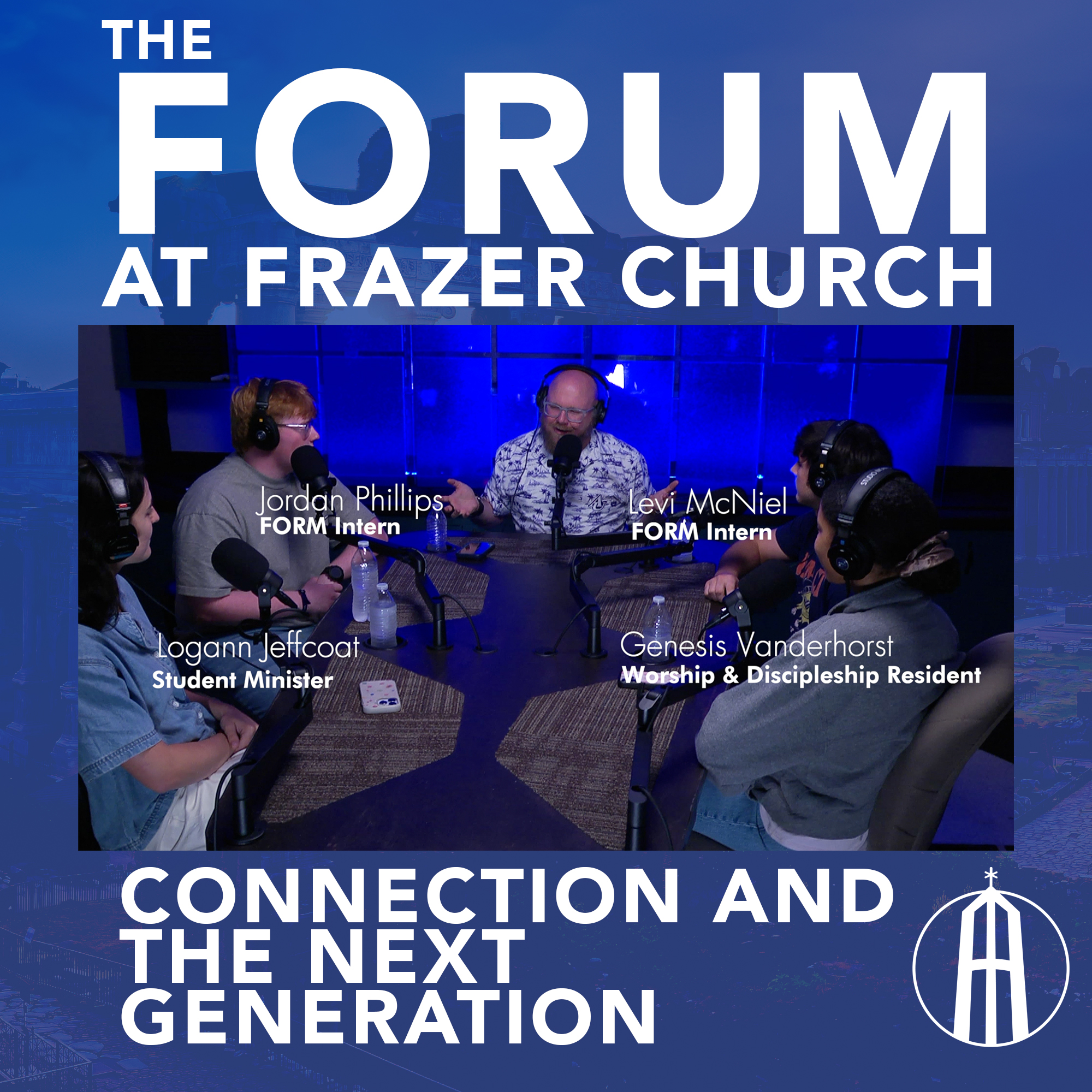
[00:00:02] Speaker A: Hello and welcome to another episode of the Forum at Frazer. All right, Will Adams here, minister of story. And I am excited to be here with some of the youngest members of our team here on staff. We have a couple of our guys that are from the form internship, Levi McNeil and Jordan Phillips, then a few of our staff members, Genesis Vanderhorst and of course Logan Jeffcoat, and excited to be talking a little bit about what connection looks like for the next generation.
So there is a lot of talk about connection when it comes to social media. There's a lot of talk about, you know, just different ways that we're connecting that may be positive, maybe negative. But I'm just curious from you guys if you could answer the question, what does connection to other Christians look like for you? What does it mean to you individually?
[00:01:04] Speaker B: You got the best Gen Z on all of Atlanta highway here with you today. So I hope connection. I was thinking a lot about this question actually, because it's one of the lost arts, I think, with the Gen Z or people like to frame us as not having connections with anybody.
And I have been really thinking about just this idea of maybe suffering is a bold word to say, but like together, like suffering together, like pushing through together, dealing with the hard together. And that has been kind of framing my definition of connection lately. It's just like having a group to suffer, if you want to put it with together. I was recently on a really hard hike up a volcano and this is where I thought about this moment actually is like we were all these random people. I didn't know any of them at the beginning of this hike. And we hiked for five hours crying, like in the freezing cold, below freezing temperatures. And by the end of it, like we were all friends, like hugging and rejoicing and having all this together. And so it shaped this image of faith, I think with me also, because our faith looks like that as well. We spend a lot of time suffering.
[00:02:15] Speaker A: Is this in Wetumpka?
[00:02:16] Speaker B: Yeah, yeah, right down the road actually. Yeah, there's volcanoes where the crater hit.
But, you know, in our faith we have to push through together. And I think making sure connection is at the front of that. Like you can't do it by yourself or you are going to be crying the whole time, you know.
[00:02:33] Speaker A: You guys. Anybody else have another thought on that?
[00:02:36] Speaker C: Yeah, I like to add, I think the word that comes to mind is sacrifice.
I think sometimes we're a little bit us, like focused, self focused. And I think connection, genuine connection is something that you just have to Kind of just surrender and just kind of let go of some sort of aspect that you kind of just hold on to. And it just takes, really sacrifice to make a genuine connection with someone and just get to know more about them. And especially in the faith, like, the faith is all about vulnerability, and making genuine connections really requires that genuine sacrifice. And just. That's the word that comes to my mind when I think of it.
[00:03:14] Speaker A: Awesome. You guys have anything to add before we roll into it?
[00:03:18] Speaker D: I like what they said.
[00:03:20] Speaker A: Well, it really leads into my next question, which is, how do connections with other Christians, other brothers and sisters, how does that foster our connection ultimately to God?
[00:03:34] Speaker E: Yeah. I would just say something that's been on my mind a lot recently is just relationships. I feel like just. I don't know why. It's just stood out to me a lot. Just, like, being able to connect with the people that we are with, no matter what the generation is. I think a lot of times we kind of get categorized, like, by our age, and we kind of get put in, like, these separate places.
And I think that it's, like, the most important thing is to build relationships. Not, like, necessarily cross generation, but just, like, together with everybody. Like, I don't know. I just think there's so much power in getting everybody together.
[00:04:07] Speaker A: Yeah. No, that's awesome.
[00:04:10] Speaker D: Yeah, I just. I definitely agree with that. I feel like just growing up in the church, one of the biggest things that I feel like have kept me wanting to be here are the relationships that I've made with people, the close friendships and just important relationships that have helped, like, build up my faith. Part of the reason why I'm sitting here, and I just. I find that that's so super important. Like, you're saying just, like, sacrificing together and suffering together, it's kind of. It's kind of. I mean, it brings you close.
[00:04:42] Speaker B: Way closer than you expected to.
[00:04:45] Speaker A: Yeah, I think it's. There's kind of a come for the worship, stay for the people aspect of things, particularly at our church. You know, I have been on staff at Frazer for 17 and a half years, which is wild. You guys were asking me how old I was earlier, and you were surprised at.
But my career here is almost old enough to vote, so.
Yeah, by itself.
But one of the things that I've seen over and over again, because we've had a lot of transitions through the years of different things, and I see that the people at Frazer are very connected to one another and very connected to God. And what happens is that regardless of what is happening out, whether it's in our local community, out in the world, or even within our church, that they are very faithful to one another, they're very loving to one another, they're one anothering one another. All those things in scripture that we're told to do for one another. And that really, in a lot of ways, is the strength, I think, of the Frazer family that makes it unique, especially among large churches. I think there's a lot of large churches where you can come and fade into the background, and certainly it's possible if you don't try to connect at all to do that here. But I really think that, like, you guys are saying there's just something that happens where when you come together here with this community of people, there's a really special connection that is occurring that's really, you know, fostering that spiritual growth and everything. Do you guys have any other thoughts about that Genesis?
[00:06:18] Speaker C: Yeah, I mean, like, 17 and a half years, compared to my one year being here, that was like, Frazer was the, like, eye opener of intentional connection making. Like, just being able to connect with so many different people across generations and different backgrounds was such a huge thing that stood out to me. Like, I did the form internship last year, and it was just a huge thing that I noticed was just not only the Southern hospitality, but, like, the faith aspect of genuinely, like, being interested in other people's journeys and getting to know people's backgrounds and testimonies and, like, all these different things that people have gone through. And it's really, truly a genuine factor that really impacts, like, okay, what makes a church so welcoming and inviting and just, you know, somewhere where you can flourish. And so that's definitely an aspect that I've noticed at Frazer 100%.
[00:07:04] Speaker B: Not just connection for surface level connection, but connection for, like, the world's not so small. We're all going through some of the same things or having the same questions and doubts and struggles. Yeah, that's really good.
[00:07:15] Speaker A: Yeah. Well, as I mentioned earlier, I'm in the older generation now, which is wild, because for the longest time here, I was, I think, for like, seven years running. I think I was the youngest person on staff. So it's, like, crazy sitting here with you guys now. And so, yeah, it's. It's crazy. I'm getting. I'm getting up there, for sure. Yeah. Well, I wore my midlife crisis shirt today, so don't worry. It's all. It's all good.
But, you know, my. My question for you guys, and I think it's interesting. You know, Levi, you kind of alluded to the fact that we, we need to come together more generationally. And so having said that, things tend to change from generation to generation, and I'm curious what you guys would say. What's different about connection, connecting with one another?
With Gen Z, maybe from some of the previous generations.
[00:08:11] Speaker D: I mean, I think one of the obvious things is just, you know, technology, social media, and like, just texting in general. Me and Logan were talking about this earlier. It's just like the obvious factor is that the younger generation is more enveloped within all the technology and stuff, but I don't think it's as intentional as maybe it seems, I guess.
[00:08:41] Speaker A: So are you saying like the Gen Z because you guys have kind of just been born into it. It's not exactly a choice in one way.
Like, it's just this is the way things are, I think.
[00:08:54] Speaker D: I mean, a lot of times I find myself just kind of wishing that it wasn't so just into it. But just the way stuff is now, it's almost necessary. I won't go far as to say you can't fully escape it, but it's just with all the things that we do today, I mean, we, you know, we got to check our emails and stuff.
So it's just it. Sometimes it is hard to fully get away from it. And that's, that's definitely something that isn't only for Gen Z, but we are the ones who have grown with it as opposed to it just kind of becoming a part of it.
[00:09:37] Speaker B: I mean, ever since all of us, like all of our first phones were like iPhones as opposed to, you know, like, I don't know what it's like to text by pressing a button three
[00:09:44] Speaker C: times to get to the right letter.
[00:09:46] Speaker A: The Nokia 5000 series, I don't know,
[00:09:48] Speaker B: but I always dreamed of having a BlackBerry. It seems like, fine. I don't know.
[00:09:53] Speaker C: I actually had a flip phone in sixth grade because my mom, I was like middle school and I didn't have a phone yet. Everybody had like the iPhone 6 or something.
[00:10:02] Speaker B: Yeah.
[00:10:02] Speaker C: And. And I had a flip phone to call my mom and I walked a block away from school and then I'd whip it out and then I'd call her finally when I was a block away. But I got a little bit of both.
[00:10:14] Speaker B: But being raised into that lifestyle, I think what he's kind of getting at is we don't.
I think it's very. Put on a lot of Gen Z that like, they love being on their Phones all the time. And it's like the number one Christmas gift this past year was called a brick. And it's like a magnet that stops your phone from working when you tap it. And, like, that's what the Gen Z wants is actually not to be locked into their phone. So I think noticing that difference as a millennial, a boomer, whatever, the forgotten generation, all of these different generations, is not noticing that we have tech and it's our thing, but also knowing, like, just like y' all don't want to be on your phones, so do we. Like, just like y' all want to be with people, so do we.
I mean, I think you could go all the way down to Gen Alpha to say the same.
[00:11:02] Speaker C: It's.
[00:11:03] Speaker B: Yeah, well, desirable.
[00:11:05] Speaker A: I really do think that there is a degree to which, I mean, like, you're saying, jordan, it's inescapable.
It's part of life.
At the same time, I think the idea that just because it is inescapable, particularly the younger you go, it becomes more inescapable because if you take it away, then you're essentially saying, you can't talk to your friends. Right.
And so now that's seen more as more of an essential than, like, a driver's license. You guys still find that to be true? I remember hearing that a few years
[00:11:37] Speaker B: ago, like, having your phones and stuff.
[00:11:40] Speaker A: I mean, yeah, it was more about the time that you were in high school, which has been a few years now. But I remember hearing it said, like, there. There are a lot of kids that were forgoing even, like, bothering with their license.
[00:11:54] Speaker C: That's true. That is true.
[00:11:56] Speaker A: Yeah. And see that?
[00:11:58] Speaker B: They just didn't care.
[00:11:59] Speaker A: Like, that was. That was definitely not a thing, like Gen X especially.
But, like, I can remember the, like, age 15, it was like, morning of your birthday, you would skip school and go to the dmv. That's how big a deal it was.
And so, like. But that's not the, like, the thing anymore, because the freedom that you got from having a car, really, you can get a lot of that same stuff from having a phone.
[00:12:24] Speaker B: Why drive across town when you could just exactly.
[00:12:26] Speaker C: FaceTime or.
[00:12:27] Speaker A: Yeah, the paradigm is really different.
[00:12:29] Speaker C: Yeah.
[00:12:29] Speaker A: Yeah. You know, and it's funny because even as you're talking about, like, how Gen Z, they may not actually want it, but they have it and they can't really get rid of it. Yeah, we have a very different paradigm, I think, in the millennial generation, partially because we were the generation trying to kind of bring it all in while it was new and having to convince people constantly, no, it's not bad. It's just new and different at the same time.
We can also look at some of the most famous millennials, like Mark Zuckerberg, and say, maybe it was bad, maybe
[00:13:05] Speaker B: they went a little too far.
[00:13:06] Speaker A: Maybe they did.
But at the same time it's just, it becomes kind of a different paradigm because after a while you look at it and you go, yeah. I mean, there is such a thing as too much.
[00:13:18] Speaker C: Yeah. And like, I mean, I was talking to Jordan about this, is that like, there is like, Gen Z is not oblivious to the amount of like how dependent they are on their phones. And it's something that like they want to address and like they like the number one thing that they look for is just connectivity and like stopping doom scrolling and just getting off and being like how we used to be, like in the streets and playing with the neighborhood kids and like being outside more. And like we, we do recognize that that is an issue. Like we are looking for that genuine connection that once was. But also like, at the same time, we just are so used to it. Like, how do you break a habit? It's with you, in your pocket, wherever you go, all day, every day you wake up, your alarm is on it, your life just depends on it. And so breaking those things, we understand it is effortful and you have to really break habits. But I guess when you also have pushback from other generations, it also makes it kind of like a.
[00:14:12] Speaker B: Well, it makes it worse.
[00:14:13] Speaker C: Yeah.
[00:14:13] Speaker B: I mean, when like growing up, and I hear it now from younger teenagers, like with that are living with their parents still. They're just like, I hate when my parents are telling me to get off my phone. And like, why are you always on that phone? Why are you always on that phone? And it's like, I'm trying. I don't want to be on my phone either.
[00:14:27] Speaker C: So. Yeah, which is interesting also because I've noticed that like, especially with TikTok, if you notice with social media, it used to be typically like Gen Z. Like, I mean, obviously it probably started more with the millennials, but like now it's like, even boomers are using social media.
[00:14:41] Speaker B: My dad's on like real.
[00:14:43] Speaker C: Like there's, there is really no generation that is excluded from social media and technology now. Which is kind of funny because it's all pointed to Gen Z. But I mean, across generations it's being used. Like, I mean, and it has its positives. I mean it has its positives and negatives But I just find it interesting that, you know, the finger gets pointed at Gen Z, but it's also become other generations.
[00:15:03] Speaker A: Yeah, well, and it's. In that sense, it's also not new. That new media has always been addicting and interesting to. To the younger generation. When I was a kid and the Internet was brand new, people barely knew about it yet people were still complaining about TV and how bad broadcast television and cable television, how people were just sitting in front of it all day and it was rotting their brain. That was a major talking point that was still going on in the early 90s. You don't hear about that that much.
[00:15:32] Speaker B: That's true. I was gonna say, I never hear anybody complain about the tv.
[00:15:35] Speaker A: But that's what's funny. I mean, like, people are more about the phone now. There's still, like, particularly, like you're saying, boomers, Gen X, millennials, we will binge watch the heck out of some office.
And, like, it's like, that's not healthy either, y'.
[00:15:49] Speaker C: All.
[00:15:50] Speaker A: So there. There is kind of a thing that when you look. Look at the pattern. And by the way, there's tons of research on this. It'll depress you if you look it up. That just less time on whatever screen it is that you're staring at all the time is healthier for you. It's. There's no doubt of that.
[00:16:08] Speaker B: So we all crave connection.
[00:16:09] Speaker C: Yeah.
[00:16:10] Speaker B: Away from the phone.
[00:16:11] Speaker C: I mean, it's just like what the Bible says. Nothing's new under the sun.
[00:16:13] Speaker A: I mean, absolutely.
[00:16:15] Speaker C: It's the same thing. There's something in every generation.
[00:16:17] Speaker A: Yeah, no, I mean, that really is true. Of course. Solomon makes a great point and goes on to talk about all the different seasons that take place in people's lives. And in that sense, when you're talking about, like, different generations, one of the things that I think is funny, like, you look at that Bible verse, that's there's nothing new under the sun. And he lists off all these different kinds of things that are going to happen. They happen in everyone's life. Like, if you look at it, there's this cyclical thing that happens that I think that we can all learn from each other if we're willing to. I think the tendency is to be like, you know, young people look at old people and say, you don't know what you're talking about. Old people look at young people and say, you don't know what you're talking about. And so to that end, one of my major questions is from your Perspective, you guys as Gen Z, how can we do a better job in the church of fostering intergenerational connection with each other for the sake of discipleship, for the sake of learning from each other and how to be a better follower of Christ?
[00:17:18] Speaker B: I love this question because I think especially within the year that I've been in this job, so many people say, like, I can never talk to teenagers. I can never do what you're doing because teenagers are scary and teenagers are mean and teenagers have bad attitudes and blah, blah, blah. Like the list goes on and on. And I'm always like, yeah, but I don't think you realize like the teenagers want to talk to you too. And sure, we've all in Gen Z got like this face going on where maybe it doesn't seem like it, but I think the number one thing to take note of any generation doesn't matter what to the next is like, they do want to connect with you. We also are thinking you don't want to connect. So I think we just need to like break the assumption and just go, we're all people. Doesn't matter. Like Levi was talking about, it's not an age thing. It doesn't have to be a gender thing. It doesn't have to be a generation thing.
We aren't against you. Y' all don't have to be against us, whatever. We don't have to be against each other. It's. Yeah, we had like an impact one time a few years ago. I don't know if you all remember where we actually brought like some of the older small groups and it was like talked about for weeks, like the sixth graders.
[00:18:28] Speaker A: I heard about it.
I can't go to stuff because I'm in other like parts. I heard about it from multiple people. It was like the talk of the church.
[00:18:37] Speaker B: It was so fun. And we had like middle schoolers being like, I love playing that game with the older adults in the gathering place. Like we want that connection also. Just like they want it with us. And I think seeing and hearing that from, from Gen Z is probably our part is to say like we do like we would love to sit down and play games. Like you know, some kind of face to face thing without. You don't have to be scared.
[00:19:03] Speaker C: Right.
[00:19:03] Speaker B: Maybe they look scary, but we're not.
[00:19:06] Speaker C: Yeah.
[00:19:06] Speaker E: I would say like for me, mentorship has been the biggest.
[00:19:10] Speaker C: Yeah.
[00:19:10] Speaker E: And not just like, I think people think about mentorship a lot of times as like the older feeding into the young, but like there's so much exchange you can have, like, both ways, for sure. We all process things and we think about things differently. And so just like, being able to talk and like, make those connections with those people and learn from each other and intercede for each other, that's been like the biggest thing for me personally.
[00:19:32] Speaker B: That's good.
[00:19:33] Speaker C: Yeah.
[00:19:33] Speaker D: I mean, just like the most influential and important, like, people or things that have in my life have all just been older people that have poured into me.
[00:19:44] Speaker B: They're just willing. Yeah, take a moment.
[00:19:47] Speaker D: It really means so much.
Just.
It just means a lot.
[00:19:51] Speaker C: Yeah. I actually got to bring a message to the Sunday night group that meets and that's with the older people of the church. And I actually got to talk about how. I think it's Paul that talks about being all things to all people and how really, like, goes back to your point and just like, putting down the pride, like, we might think that some things in our generation are better than other generations, and then other generations think that there's some things better than our generation. And if we just all put our pride aside and just say, like, hey, like, we all went through the same thing. I mean, maybe it's not the exact same thing or the same, like, era of what we went through, but we all share the same struggles. But if we, like, become all things to all people, not like, like changing ourselves to people, please. But generally trying to meet people where they are, like Christ did with all the people in the. In the New Testament and the ones that were not stated in the Bible. Like, just putting that down and just like, meeting with people and just saying, hey, like, what can I learn from you? What can you learn from me? And just really taking advantage of getting to talk with other generations is. Has been my favorite thing about being here. Like, I got to.
I'm more on the introverted side in some aspects. And so, like, meeting new people can be intimidating. But I've really come to enjoy getting to know people's testimonies and stories. Like the veterans and like, all the different things and topics that people have gone through have been so life changing for me. And it's actually my favorite thing to learn about. Like, hey, like, what's. What's there to learn about you? Like, just putting that pride aside and like, not being so us focused, but looking to others to get to know about them. So.
[00:21:22] Speaker A: Yeah. Well, that's awesome.
I think one of the things in all this that I think is an interesting thing to talk about is that need for connection, even transcending what might be the phone addiction. Which, by the way, I'm just going to call out my own parents who are awesome spiritual people.
I'm always having to get their attention from the phone. So that's not just like a Gen Z thing or even millennial Gen Z, Gen X thing. I mean, like, it's everywhere.
[00:21:50] Speaker B: I know somebody out there is on level 1000. Candy Crush. Absolutely.
[00:21:53] Speaker A: Yeah.
[00:21:54] Speaker C: Panda Pop.
[00:21:56] Speaker A: So, I mean, kind of a follow up question I have for that, and this you may have to think about, because I didn't give this one to you, is what kind of tips would you have for current parents of children that are either about to get their phone first phone or have a phone?
How do you help them navigate that? Because in addition to all the things we could say about the Internet being a scary place, which I'm not even talking about that, I'm just talking about the activity of spending that time on your phone when there are people here in the room. What do we say? What can we say? How can we be helpful to one another intergenerationally? How can parents be helpful to their children?
Logan, you were kind of mentioning how it's frustrating when they just come out and it's like, why are you on your phone all the time? And I mean, I don't know if you guys feel this way. In Gen Z, there was something that was happening a lot with millennials where we were constantly being blamed for everything.
If you Google a list of all the things that millennials have destroyed, it's a joke. It's headlines that are like, millennials are destroying the napkin industry or something like that. No joke. That's a real one.
But there's a whole long list. It's like 72 things that millennials are destroying. And so there's a tendency to blame the generation. It was. Yeah, there's just always that. And then everybody kind of will pause and go, okay, but wait, who raised these kids?
Exactly. You know, it's not the five year old's fault.
Yeah, I mean, like your parents are forgotten generation or Gen X probably. And so with, with that, in one way I can't even blame them because they didn't grow up with smartphones or really even the Internet.
[00:23:43] Speaker B: Every time it's something new.
[00:23:44] Speaker A: Yeah, right. And so, I mean, I can remember having, I was in my early 20s, having somebody say, like, hey, these parents that are coming along now, you got to have a digital footprint conversation with your kids. I mean, that's something that like older generations have no concept of. They just had no understanding about. So that's something all new. So all that to say, what would you guys suggest? How do we go about managing that? Helping with that?
[00:24:10] Speaker B: I don't know if they agree with me. Maybe this is. It sounds simple, but I don't think it's the norm. I wish, like, I think back to all my time with a phone in middle school, high school. Like, I wish my parents took it away more like. And not even in a way where it's like, oh, you're in trouble. Like we're taking this as a punishment, but just like this is our family time or whatever. Like we're at the dinner table or it's eight o'.
[00:24:34] Speaker A: Clock.
[00:24:34] Speaker B: Like you don't get to be on your phone after 8 in your room scrolling because you need to sleep or these kind of things. I see so much life when I take away their phones at youth events all the time. Like every retreat we go on, they put it in a bucket when they hop off the bus.
[00:24:46] Speaker D: Yeah.
[00:24:47] Speaker B: And they come to life immediately after. And I think it's the assumption of like, oh, my kids will hate me or my grandkids will hate me if I take away their phone or tell them we need to limit things. But like, sure, for a second they'll be like, what? That's new. But it's like life just flourishes immediately after. Like they want it gone. Because then you can't argue and be like, well, I didn't answer your text because, you know, like, there's a reason. There's a reason you didn't have time to scroll all day or text all day or whatnot. I don't know if they would agree,
[00:25:17] Speaker D: but yeah, I completely agree with that. I think just like we were saying earlier, the. With just with relationships, all the best stuff, all the stuff we remember and care about, it doesn't come from the phones, you know, that. That's good to have. And sure, like we, we're able to contact people more maybe, but all the, all the most important things, most important relationships are in person, you know, like, like you're saying this past d now was the first time we ever had no phones. And it was super awesome. It was, it was great. It was amazing.
And just, it's really like, it's useful, but it's a distraction a lot of the time and there are just times where you don't need it, I think. So I think just re. Rework the idea around it instead of just, instead of it being taken away. It's just, it's given.
[00:26:10] Speaker B: It doesn't have to be Only for punishment. And if you have younger kids too, like, start not even little littles, but like elementary age, starting with them and saying like, well, from 5 to 8, we don't do technology. And like, at this time we, we're gonna do a family Bible study, like showing them the reason they think they don't have time is because of this. Like, the reason they think they don't have time to pray or read their Bible or whatever. It's not because of homework or school or sports. It's because they want to fill the rest of it. We all want to fill the rest of it with anything on here or the TV or the computer. Fill in the blank with whatever text. So like, as the parent, as the one who is hopefully has enough discipline to do it, saying, all right, this 30 minutes of time, we're not going to have this. Because I want you to see as a fit fifth grader, this is how you can fit time with God in, you know, it doesn't have to be waking up at 4 in the morning because not everybody likes to do that. I don't.
[00:27:06] Speaker C: Yeah, I think it takes like a couple things. And the first thing is, especially as a parent, if you're looking into like, okay, should I give my kid a phone? Is not giving into peer pressure just because all the other kids have that or just because they're peer pressuring you. Like, all my other friends have phones. Like, why can't I have one? And I think it's also important to not be oblivious to the fact that there are some harsh things that are just like, that come with the phone. And it's just something that takes a really wise decision. And of course not being oblivious to the fact that like, we live in an age where you don't, when you're a kid, you don't drive. Like, not everything's closed, so you probably need to, like, if they're going to school, you probably need, they need a phone or, you know, something like that. And so I think it definitely, I really admire parents who take the, they don't mind the backlash of like, well, my kid's not getting social media until they're 18 or, well, my kid's not having a phone until they're in high school or, you know, something along that, that line.
[00:27:58] Speaker B: I wish mine did that.
[00:27:59] Speaker C: And honestly, I think it helps to shape the minds in a great way. Like, I know some people who are, they don't have social media right now and they're in high school and they're like, I don't Want to change a thing like that, maybe I might get it later down the road and maybe that might instill a FOMO fear of missing out. But, I mean, I'd rather have FOMO than, you know, just all a lot of the cons that come with having a phone young and shaping your mentality of, you know, insecurity and all that stuff. And so I would agree with both of you guys in saying that.
[00:28:26] Speaker D: Yeah, yeah, I can.
[00:28:28] Speaker E: I can go back and think, like, I remember it being so hard because all my friends, you know, I was. I was the family, like, where my parents did not let me get it until later. And so I can go back and remember, like, all my friends having that stuff and I didn't have it. And I remember being so, like, upset and, like, pushing up against my parents on it. And, like, now I can sit here and thank them for that because I see now, like, how that impacted me. But when you're in that moment, it's like, you don't. You don't see it yet. And so, like, as a parent, I see, like, it's.
[00:28:57] Speaker D: It.
[00:28:57] Speaker E: That's a very difficult thing to kind of navigate.
But like I said, like, I can sit here now and thank my parent. Like, I mean, we've had these conversations. Like, I say thank you for, like, doing that. And even throughout all that, just, like, my parents always had an answer for it. Like, there was always a reason. And so, like, it helped me kind of, like, think through it. So I think, like, yeah, being able to have a reason for what you're doing, that kind of helps because you can as a kid. You can.
[00:29:21] Speaker B: Yeah, the young. The young mind doesn't know.
It's just a loss.
[00:29:25] Speaker E: Yeah, exactly.
[00:29:25] Speaker C: And it just takes being intentional, too, because, I mean, you tell a kid, like, no, you don't get a phone. I mean, they're feel like they're missing out on something. So replacing that with, like, some activity, like, okay, we're going to get books or we're going to do something, like activities outside or whatever, but also being intentional about not being the parent, where it's like, okay, well, how come you get to be on your phone all day and I don't get to do anything on my. On a phone? And so, like, being that example for them really helps.
[00:29:48] Speaker A: Ooh, you're meddling now.
[00:29:50] Speaker C: I know.
Like, I like you. I mean, you mentioned your parents, too. Like, my parents also. I mean, like, it truly is crazy how social media works. Like, especially with TikTok, it was embarrassing to have TikTok like when you first got it, you were doing TikTok dances in public, maybe not Covid. I was. It was a really dark time in Covid.
And like, and I remember, like, even with Gen Z, like older Gen Gen Z, they were like, you have TikTok. Like, that's so embarrassing to be doing TikTok dances. And now it's like you get to do get ready with me's with people and you get to eat with them and asmr and like, go shopping with me and spend a day with me. Like, all these different things that it's like, like it really, truly blows up. But I mean, like, just again, being that example for others. Like, okay, don't pull the ladder up from.
[00:30:32] Speaker B: That's the case for anything.
[00:30:33] Speaker C: Yeah, yeah.
[00:30:34] Speaker B: But if you're in the thick of it with the Gen Z right now, I don't know where the camera is. If you're in the thick of it with a Gen Z who's arguing with you about a phone, just know they will come around. Like, we all I. All the Gen Z people, all of my friends like that are my age, we always are. Just like, relating over the fact. Like, I get it now. Like, I wanted a phone so bad. I wanted Instagram so bad when I was 13. Like, we didn't get into crimes or anything bad, but it's just like it messes with your brain and it makes you think this is all you have time for. And so they will come around.
[00:31:03] Speaker C: And can I just say, disposable cameras are making a comeback.
[00:31:06] Speaker B: Yes, they are.
[00:31:07] Speaker C: That's true. Actually.
[00:31:08] Speaker B: Buy camera and they'll be satisfied.
[00:31:10] Speaker A: Honestly, y', all, we. So we had disposable cameras on D Now this past year.
[00:31:15] Speaker C: And D Now's a retreat.
[00:31:17] Speaker A: Yes. Thank you.
As. As a millennial who. And again, elder millennial. We. We had them. We always took every trip, whatever. We would always buy. If I was going on a camp, if I was going on a retreat, I'd always buy one and sometimes two if it was going to be.
[00:31:34] Speaker B: Yeah, you know you need a lot of photo, right?
[00:31:37] Speaker A: And they made them. They made some underwater ones too, that were covered in plastic, like take out and put in the pool and everything. It was really cool. And so I always had those everywhere I went. And so it was kind of funny watching because you had them sitting on the seats when all, all of the kids came in. And for me, I. I felt like I aged a thousand years watching all of them come in. Didn't know how to do it, have no idea how to use it.
[00:32:01] Speaker B: Those sixth graders are like, what do we do?
[00:32:04] Speaker A: That was. That was downright entertaining. So, again, I mean, you know, if you. If you participate in intergenerational ministry like that, you'll have opportunities.
[00:32:14] Speaker C: Yes.
[00:32:15] Speaker B: There is always something to teach.
It might age you, but to be
[00:32:19] Speaker A: a part of that. Yeah. Well, you know what I'm hearing, and you guys can still add in if you have any other thoughts, but is that technology?
And, you know, I think to my generation, we still saw it as exceptional because it was. Everything was new.
And in some ways, it sounds like it still needs to be treated as exceptional, as something that isn't normal. Like, I think the tendency is to think, oh, well, this is just part of our lives and there's nothing we can do about it. But that in one sense, we really need to see it as. No, it is. It is kind of an intruding factor that we have to grapple with. It's not going away.
[00:32:57] Speaker B: Right.
[00:32:57] Speaker A: But at the same time, we don't need to treat it like it's a given that.
[00:33:01] Speaker B: I feel like you're describing the plot of the Toy Story 5 movie.
[00:33:03] Speaker A: Oh, yeah.
I haven't gotten to see it.
[00:33:06] Speaker C: I haven't.
[00:33:07] Speaker B: That's the plot right there.
[00:33:08] Speaker A: Yeah.
[00:33:09] Speaker E: You got to go watch it.
[00:33:10] Speaker B: It's not leaving. Let's have it all.
[00:33:12] Speaker C: You know, I actually think, like, an important thing that I like to kind of live by is that just because something is normalized does not mean it's normal. And, like, it goes across not only just a technology, but maybe it's TVs for other generations or whatever it is.
Just. Just because something seems normalized and is championed does not mean that it's something that is normal. And maybe normal doesn't always have to mean good or something to aim for, but. But, I mean, it's just. It's a balance that needs to be maintained, and it can just always teeter between good and bad. I mean, it's just something to be aware of.
[00:33:45] Speaker A: So, yeah, no, that's a great phrase to live by. I think something to always question is like, hey, this is normal. But it to me. But does that mean that it needs to be normal to me? Do I need to make this something that is strange in my mind so that I can move it off to the side and put it where it really belongs and treat it as such?
Thanks for joining us again. We hope that you enjoyed this episode of the Forum at Frazer. Check out the last couple of episodes, and wherever you get your podcasts make sure to subscribe. Leave us a review that helps other people find us. Share this with your friends. Share this with your families. It might be a great way to invite them into our church family to kind of introduce them to what we have going on. So. But thank you for joining us again as we continue to seek to follow the Great Commission by living the Great Commandment.