Episode Transcript
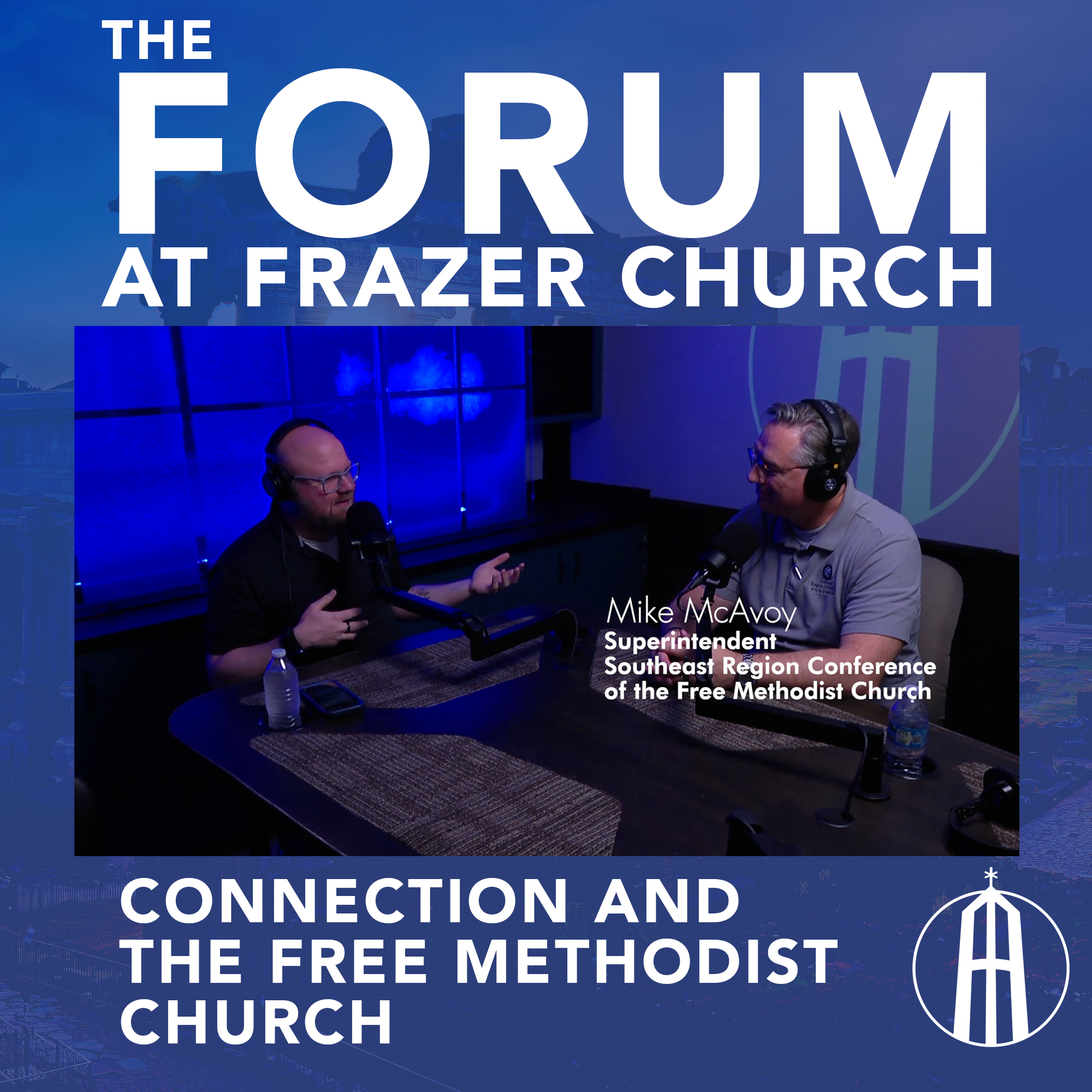
[00:00:04] Speaker A: Well, hello and welcome to another episode of the Forum at Frazer. I'm Will Adams. I'm the minister of Story here at Frazer. And today we have a special treat. Superintendent Mike McAvoy, who is the superintendent of our Southeast Regional Conference for the Free Methodist Church, is here with us. And so we're going to be talking about, as we have been the last few weeks, what connection looks like, but kind of in a larger context than we have before.
So, Mike, if you don't mind, for those who may not know, because some of our church members, particularly new folks, some of them may not even be totally aware of what the Free Methodist Church is, we try to. We make sure that they have some awareness when they come in as members. But from your perspective, how would you define your job in the Free Methodist Church?
[00:00:58] Speaker B: Right.
That's a great question. And to be honest with you, I think that the Free Methodist Church has wrestled with it itself. Yeah, it's kind of like asking the question, you know, what's the job of the pastor?
[00:01:11] Speaker A: Sure, yeah.
[00:01:13] Speaker B: If you ask 10 people, you probably get 10 different answers.
[00:01:17] Speaker A: Right.
[00:01:17] Speaker B: Because to some of them, the pastor is strictly a spiritual leader or he's a preacher or he's a teacher, and those two things aren't even the same.
[00:01:28] Speaker A: Right. Yeah.
[00:01:29] Speaker B: The old classic phrase is that, you know, pastors are jack of all trades and master of none. So, you know, but they're counselors and they're. They clean restrooms sometimes.
[00:01:41] Speaker A: Yeah.
[00:01:41] Speaker B: Mow the lawn. So they're organizational leaders.
[00:01:45] Speaker A: Yeah.
[00:01:45] Speaker B: Right. Like, there's. There are legal aspects to the organizing of God's people.
So what do I do as a superintendent is really very much the same, just at a different level of responsibility and scope. But so I would say, you know, first and foremost, I would say that my primary role is to champion the cause of Christ and keep that. The center thing. Right.
It's easy for people who are involved, giving themselves fully to the work of the Lord, to become so consumed with the work that, number one, they forget the Lord of the work, so their own relationship with God suffers. And secondly, they get so consumed with that work that it just becomes work.
And so I would say that, you know, I champion the cause of Christ and keep that center, but I serve as a spiritual advisor, you know, just helping people stay oriented to the lordship of Jesus. Like, what's the why behind everything we do? Like, let's make sure that we're keeping the main thing. The main thing, and that everything we do, whether it's administrative, whether it's you know, actual hands on stuff that it's actually still connected to and serving that purpose of the kingdom of God.
So spiritual advisor, but I also will serve as a spiritual authority.
So there are times where we have problems within the church and those are sad days, but they're realities. And so I have to be part of those conversations and dealing with those issues.
I serve as a mobilizer, you know, so I not only work with those existing leaders and churches, but help recruit, develop and deploy new leaders and launch new ministries and churches. And.
And then of course, one of the unique things about the Free Methodist Church is like other denominations or movements is that we're not limited to just a local church or a few local churches, but we cover a lot of local churches. And we're actually a conference, simply put. And it might be an oversimplification, but it is a church of churches, if you will.
And the conference isn't an organization unto itself. It doesn't exist for itself. It's really a bunch of people who felt God called them into a particular movement called the Free Methodist Church. They landed in a particular geography and as a result connected with those brothers and sisters on mission and felt that we were stronger, smarter, safer, happier and healthier together than we are by ourselves. And. And so they united into what we call a conference. And so I serve as basically like the pastor of the churches. Plural of the pastors.
[00:04:56] Speaker A: Right? Pastor of pastors.
[00:04:57] Speaker B: Yeah, that's a common phrase, although it doesn't really translate well.
[00:05:02] Speaker A: Yeah, yeah.
[00:05:03] Speaker B: And so, but yeah, and then with that, though, we're organized and incorporated. And so there are those administrative and legal aspects of conference operations that I also have to navigate.
[00:05:17] Speaker A: Yeah. So, you know, I think from the perspective of someone who, you know, some of the folks in the Frazer family know that I'm working on a degree in mental health right now and I'm doing seeing clients. And one of the aspects of that is having to have supervision where you go back to your supervisor, you talk about what you're seeing and get advice and things like that. And it is, of course, just reminding me of how we're repeatedly told in Scripture, wise counsel. Wise counsel. Wise counsel.
[00:05:46] Speaker B: Yeah. And so that's part of. And I know we'll get to another question on benefits of being connected, but you know, part of my role, I serve as that spiritual advisor, but also more of just a practitioner, a fellow practitioner. And so I get asked to basically what you would call consulting. Right. Like they want to know, hey, what are your thoughts on this? And so having an outside set of eyes and ears to process things, it just makes us all better, you know, and so that's part of having the conference level of leadership, which we don't see it as a top down, but bottom up, you know, servant leadership approach. But having just those folks that we can lean into and say, hey, I think I'd like to have somebody else, you know, process this with, with me.
[00:06:36] Speaker A: Yeah, well, and that does get into the next question that, as you alluded, that I wanted to tackle. And that is kind of in the current climate in the church, denominations tend to get a bit of a bad rap.
[00:06:48] Speaker B: Sure.
[00:06:49] Speaker A: And sometimes not for the wrong reasons.
[00:06:53] Speaker B: Right.
[00:06:54] Speaker A: So what would you say are the advantages, what are the good things about being part of a denomination? Being connected to one another through a denomination.
[00:07:04] Speaker B: Yeah. So there's, there's a lot to that.
The first thing that I would want to preface with is that a, I didn't come from a Christian background, so I didn't join a religious club. You know, I had an encounter with God. So it was a very real and meaningful thing. Thing between. With the Lord. Right.
And church to me was a bit of a mystery. Like I didn't understand its connection with God as an outsider. And when I became a Christian and really started walking with the Lord, you know, I struggled with the disparity between what I was reading in the pages of scripture and what I was seeing when you open up the doors to the church.
[00:07:52] Speaker A: Yeah.
[00:07:53] Speaker B: And you know, I've grown up spiritually and Lord called me into ministry against my will and I ended up, you know, planting churches and doing different things. For the first 13 years, I was primarily doing non denominational work. So it was independent.
And there's a beautiful thing, there's a great freedom in doing independent, non denominational stuff. And the great thing is there's nobody there to hold you back.
[00:08:23] Speaker A: Yeah.
[00:08:25] Speaker B: The downside is there's nobody there to hold you back.
[00:08:27] Speaker A: Yeah.
[00:08:28] Speaker B: You know, and I, I tell people like, I'm full of ideas and I've got all these great ideas and I think they're all great, you know, and there's nobody just talk me off the cliff and say, no, that's not a good idea.
But the value that we have come to experience, first of all, when it comes to denominations, it is something that, you know, as a brand new baby Christian, I really had a negative attitude and perspective about denominations, you know, and I chalk it up as, oh, that's man made. And I don't want, I just follow Jesus, you know, and. And there's a degree of truth to that. Like when a denomination becomes about the denomination and not Jesus, it has disconnected from the head. Something's wrong.
[00:09:11] Speaker A: Yeah.
[00:09:13] Speaker B: When it starts to define and conform God to their image, rather than allowing him to be the authority that defines and directs them and conforming them to his image, then there's something wrong. Right, right.
But, you know, the denomination, first of all, the word, you know, comes from where everything. Usually it's like either, okay, Hebrew, Greek, or Latin. Right. And so this is Latin, and it simply means to give it a name.
[00:09:40] Speaker A: Yeah.
[00:09:40] Speaker B: And I think subconsciously, over time, because we utilize that term with money, there's a degree of added addition to that definition, that there's a value.
[00:09:53] Speaker A: Right.
[00:09:54] Speaker B: And when it comes to being connected and being part of a denomination, what's the value? That's a lot of times the question like, okay, so we're going to give this a name. We're going to articulate and say, okay, we're uniting because we agree on these things. We believe these things. And there's usually these distinctives. Right.
Between one group of Christians and another. And I don't believe there used to be a time where I felt like those distinctives were wrong.
Like we should just all be one. We're all Christians. Right. And the Scripture talks about unity, but it's not uniformity. And that's where in my youthful ignorance, you know, I was expecting everybody to just agree on everything, you know. Well, doesn't the Bible say it? Well, it does say that, and it says in this way that gives a new. A little bit of a different flavor. Right. And so I became much more understanding that, yes, we're all part of the body, and we may even have many that are fingers, but they don't all fall, function exactly the same, you know, and do the same role. And so when it comes to these. The value of being part of a denomination, I think that there are obviously the same strengths that you get by being part of a local church that you can't escape. Like, you know, scripture does teach that there's a personal faith, but the Bible never teaches a private faith.
[00:11:27] Speaker A: Right.
[00:11:28] Speaker B: We are meant to do the journey together. It's a collective journey.
And similarly, as churches, you know, when you. You go back all the way into Scripture at the birth of the church, well, the Jerusalem church was kind of the hub for a long time, but then Antioch became a hub. And notice that when the churches were facing different trials, they leaned on one another and supported and helped one Another and really that is part of the value.
And here's the funny thing is that for the 13 years that I did non denominational work, guess what we did connected with other churches, right. To do different things. Why? Because we do need. You're never going to escape the fact that this is a shared journey and we need one another. And, and, and there's the obvious things of support, encouragement, comforting and, and helping one another, accountability, you know, all those things that are the obvious. But there is one thing I think that there's strength in partnering with people where you. Do you have like mindedness, right?
[00:12:42] Speaker A: Yeah.
[00:12:43] Speaker B: Like it, it is way easier for me to work with fellow free Methodists on projects and things than to be working with my local ministerium where we're trying to do this thing. But we can't all agree on whether we're going to, who's going to hand them the communion elements, who's gonna, you know, baptize these folks? You know, it's like, who can do this, who can do that? And God forbid a lady, you know, step up to the pulpit and say something, you know, like, so for us it's easier to. You're always going to find that things flow smoother when you're dealing with people who are operating in agreement. And Scripture tells us in Amos, right, the Book of Amos, how can two walk together unless they're in agreement? And so, so that's where there's a strength. And why, you know, part of the value of the denominations is. Or, or movements is my, my more preferred word, if they are right. Yeah.
Is that.
And, and this is where I think we fall short. So this is probably more what it ought to be rather than what it actually is. So more aspirational. But there is something where it isn't just that, okay, we created this structure and systems where now we have like a superintendent or regional superintendents and they come along and they'll give spiritual advisement or encouragement to the pastor or they'll consult on different issues that the church is dealing with or they'll remind them, hey, you actually have to pay payroll taxes or you're going to get a visit from a different leader.
So yes, that's all, that's all there and true. But, but being connected is about more than just having these other leaders or authority figures. There is one another, right? And so just as the scripture gives us one another commandments to love one another, serve one another, pray for one another, help one another, we're actually to do that not just as individuals, but collectively as churches. And now we get to do that all the more intentionally and and thoughtfully as we're mindful of. Oh, you know, the church up in, in Birmingham or the church over in Columbus or the church down in Miami, they're going through a tough thing right now and we're going to pray for them as a church, you know, and what if it goes beyond just saying a prayer like the Apostle Paul went around and collected a special offering for the Jerusalem church? Well, that's part of the value of being connected is that we have a very clear network of support, of accountability, of help.
And it isn't though, and I think this is one of the biggest misses when people are explaining the value is that it isn't just about what I get, but I have a very clear opportunity in front of me to contribute.
A lot of churches can become very siloed and very self centered and, and it's all about what they're doing and just them. But the truth is, is that just as we speak to an individual coming into a local church, hey, you're becoming part of something bigger than you and you get to actually not just be ministered to, but you get to minister. Right. And you get to contribute. Well, the same thing is true about local churches in this wider church family that we actually have organized and identified and call it the Southeast Region Conference of the Free Methodist Church.
[00:16:22] Speaker A: Yeah, I mean, it's so cool to look at not just the Free Methodist Church, but all the churches within just the Wesleyan tradition that have come up with so many different expressions of worship, so many different expressions of evangelism. I have a lot of friends and family who come out of the Salvation army, which I think a lot of folks may not be aware of the fact that Salvation army is very closely related to the Methodist churches. And so from that, if you go to a Salvation army corps, you would see, which is what they call their churches by the way, you would see that they are ministering to a whole different crowd than is going to show up in your average Free Methodist church in most cases. And that's when you're talking about that business of some of those different denominations. Sometimes, yes, they do represent division, but quite often it is just we have mobilized in a different direction. And so for the church to be all things to all people, we do have to occasionally have expressions that look a little different from one another.
[00:17:30] Speaker B: Absolutely. And I think, you know, I think there's two sides to what you were just saying.
One is that first off, all of our. So speaking in terms of our conference churches. Right. All of our fellow Free Methodist churches within the conference.
They are not all the same.
[00:17:48] Speaker A: Right.
[00:17:49] Speaker B: And there are things that we can each learn from one another because God is going to move and work in unique ways, and some of them will start something and it's going to do really well. And then some else had felt similarly, but yet there's bombed, you know, and of course, there's the big question of, well, was it not God or did we just not know what we were doing? And so, you know, one of the great things is now, you know, so when I was pastoring, I would take my staff and leadership and we would do field trips to other churches that were, you know, hitting home runs in different aspects of ministry.
And we would learn from them. And, and as a result, guess what? We got better because we were, you know, as iron sharpens iron. Well, the same thing is true with churches. And so there is that aspect where we are able to, you know, learn from one another and grow and mature. But there are those distinctives in ministry expression and how each local church is going to look and do the thing God has called them to do in that community. And from Free Methodist Church to Free Methodist Church, it doesn't all look exactly the same. And that is even more true when you start talking denomination to denomination, movement to movement. You know, they're unique expressions. And again, I still think there's an aspect of we can learn from one another for sure. But at the same time, I also think that this is where it is really important to know, not lose sight of the unique, distinctive part of the body that God has made you to be. Exactly. And so, like using the Salvation army as an example, I mean, everybody can learn from them how to do better at need meeting ministries, right?
And, and that's, you know, mobilizing people and being those hands of Jesus to the marginalized and the hurting and the poor and all of that.
But at the same time, every church and every movement out there has to know this is the specific path God's called me to take to express him into the world. Because, you know, not everybody is a finger.
You know, some are a toad, others are the body of the foot, others are a thigh, you know, in the body of Christ. And, and, and every part matters and is valuable. And the challenge is when we start to look at one another and measure one another by our unique call and those distinctives and versus what is, what is just true of all Christians.
[00:20:37] Speaker A: Right? Yeah. Well, and I think, you know, when you're talking about, hey, we tried this here and it worked. And we tried this here and it seemed to bomb. I think another thing to keep in mind is, of course, success looks different in God's eyes than it does to us. I mean, there's. My dad was a superintendent and we would go to different churches and you would show up at 1 and just have this feeling of like you were attending a funeral, like, and, and there would be tons of people there. I mean, yeah, there would be 200 folks and.
[00:21:04] Speaker B: Yeah.
[00:21:05] Speaker A: In worship and. But then you go to another place that only had five or six, two in the choir, you know, that was the choir. And it would feel like it was just going gangbusters, like the Holy Spirit was just pouring out every Sunday.
[00:21:18] Speaker B: Yeah.
[00:21:19] Speaker A: And so from that standard, it's quite often, I think, you know, when we look at, just to get at your point of what is the calling in your unique, unique expression in your geographic location and that, that may not look like success in the worldly sense sometimes.
[00:21:37] Speaker B: Yeah, I think that's, that is a, that's a whole nother conversation of how to, you know, God definitely seems to have, you know, he, he cares about both, Right, Sure.
We're not going to escape that. Not only did Jesus tell the parable of the, the different talents, right.
And there were good and faithful servants and then there were not.
Right. But then, then he takes it a step further and talks about how he's the vine and we're the branch and that when we abide in him, we'll not only bear fruit, but much fruit.
So fruitful, you know, is something that God does talk about. So what is success? I do think that looks different from one person to the next. You know, Jesus, his success wasn't in building a mega church, Right. His success was to spawn a movement.
And you know, and of course you can play with the numbers, you know. Yes. He had 12 disciples and he additionally had about 120 to or so folks that were regularly following him. And then he had the masses, Right. That he was ministering to on a regular basis. And so what was the real, you know, qualitative number that, that we're looking for? A little bit arguable, but the early church on Pentecost was roughly 120. Right. And out of that comes this, you know, two millennia explosion. Explosion that, you know, was it a success? Yes, it was.
Yeah, it's fruitful. Right.
But at the same time, if it only ever meant that one person would enter eternity, Jesus still would have done it. Right. Like, so we yeah, so. But yeah, I. So that's a different conversation.
[00:23:34] Speaker A: Yeah. Yeah. Well, I just, I think for. For those from other churches that are watching, because we are a church that a lot of people look at and say, like, this is a big church and that's what success looks like. And so I always feel the need to kind of specify it's like, well, it may.
That's one way that that success shows up.
[00:23:54] Speaker B: Yeah. I think, you know, so when you look at. When you look at the principles of Scripture, do we celebrate a church that maybe a thousand people.
Of course, you know, if they're staying true to Jesus as Lord and they're prayerfully pursuing his unique call for the unique mission in their community and perhaps beyond, we celebrate that, but we would also celebrate the initial start of something that might be a group of 10.
Right.
And what if. What if that 10 grows to be 100? Is that a win? Absolutely, that's a win.
And what if that group of 100 spawns 10 groups of 100? Well, they're never going to be a megachurch or a large church, but what they just declared accomplished is the equivalent. Right.
And I would say that it's probably viewed as being fruitful because it's expanding out. Right. And I think that's where a lot of times, you know, when I was pastoring and we had. We planted open arms, community church, and we were growing, and the Lord really put it on my heart, not just focus on growing up, but focus on growing out.
[00:25:21] Speaker A: Yeah.
[00:25:22] Speaker B: Because that's where the Great Commission calls us, is to go, not just gather and stay. And you can't escape gathering. That's the literal word for church. Right. Ecclesia means to gather, so we can't escape that. But he also mobilized us to go.
[00:25:39] Speaker A: Yeah. Well, and I think that's a good lead in to my next question in regards to when we're talking about connection in regards to each other, that in some ways is a little obvious. But what does the word connection mean in regards to this larger church? You know, maybe specifically the Free Methodist Church, but. But also, you know, you've alluded to just kind of that Kingdom Church mindset.
[00:26:04] Speaker B: Yeah. So, I mean, that's the beautiful thing that has really resonated with my heart. When the Lord called, called us into the Free Methodist Church, I came being drug, you know, kicking and screaming. It really wasn't something I wanted to do. I was very happy at that particular season of life. We were doing house churches and I was working, mentoring adjudicated youth. And so I was having a blast. Like, I was feeling like I was right in that sweet spot where, you know, it just. It just clicked for me. But I had no interest in getting into even organized church again, you know, institutional church or denominations. And when the Lord called us to plant with the Free Methodist Church, it was something that wasn't on my radar, and it was just not.
Not of interest to me. But again, you know, the Lord being the Lord, we're surrendered to do his will, not ours. And so we, my wife and I, prayed about it and really felt like God said, green light, like, I want you to go do this thing.
And when he did, you know, we really.
I dealt with it transactionally at first.
So my mentor at the time was so excited because I finally got approved to be a Free Methodist pastor. Right. And he goes, mike, that you were, you know, you're. You're approved to be a pastor in the Free Methodist Church. He goes, you're a Free Methodist. And I go, I work for the Free Methodist.
But after pastoring several years, the Lord really convicted me that I felt like he spoke to me and said, I didn't call you to an organization. I called you to a people.
And it was this rebuke of treating this transactionally instead of relationally.
And so the kingdom of God is about people, not buildings or programs or stuff like that. It's. It's about people, and it's relational. The great commandment could have been anything, but Jesus said, it's love. Love the Lord, your God, love one another. Right. Right.
So you're never going to escape that. That is the operating system of the Kingdom of God, not numbers, not programs.
[00:28:39] Speaker A: Yeah.
[00:28:39] Speaker B: You know, not how big your building is or anything like that. It's, did you, you know, and I don't think God's going to ask us when we get to heaven, you know, how much money did you have in your savings account? How big. How many square foot was your building? How many acres was your property? I think you did you love. Well, did you. Did you love Jesus? Well, did you love your neighbor? Well, did you love your fellow believers? Well, those are going to be huge. And loving well translates in and is expressed into a number of different things. Right.
So as a parent, we know that loving well isn't always saying yes to our children.
It isn't always just a hug. Sometimes it involves a correction.
Right. And discipline. And so this is where I think that the value of being connected in movements or denominations is that we have a very clear family network in place. You know, And I can tell you, being in an independent church, that didn't exist for me.
[00:29:53] Speaker A: Yeah.
[00:29:54] Speaker B: You know, when we went through problems and we did. When I went through problems as a pastor, as a person, and I did.
I was alone.
[00:30:03] Speaker A: Yeah.
[00:30:04] Speaker B: And.
And in addition to that, when things were going well and we wanted to. We wanted to, like, how could we touch another place?
Well, there wasn't a. There was no pathway for that. I had to go knocking on doors. And, you know, Internet was just starting, so I'm starting to, you know, try emails. But. But the beauty is, if you. If you want to support a work of God anywhere in the world, the Free Methodist Church pretty much has missionaries in almost. Almost every country in the world. Right. And if you want to go, we have points of contact. You know, it's like. And again, I think this, this peer learning, peer mentoring, and then the support of one another, which scripture talks about a lot, it isn't just between individuals, but groups. It's funny because when Jesus said, gave us the Great Commission, go and make disciples of all nations. Disciples is plural, and so is the word nations, which in the Greek is ethne.
It's not ethnos.
And ethnos would be that individual group. Yeah, but this is multiple groups of people.
And so we're to make disciples of individuals, but groups of people.
[00:31:26] Speaker A: Yeah.
[00:31:27] Speaker B: And different than us.
But the beautiful thing about all these groups is when they come to Christ, we're then the collective body of Christ. And so we saw this happen when the Hurricane Helene went through the Carolinas and through the Southern states here.
Frazer and Christ Community Church and several other of our churches here in the Deep south states came to the aid of the wider body of Christ.
Okay. So churches and people that were not part of our Free Methodist Church family, you know, but our churches rallied and gathered stuff and sent people to help them. But here's the other thing is we did have Free Methodist churches that were impacted. And so one of them that was devastated was our lake.
What?
I'm having a senior moment. Oh, yeah.
[00:32:31] Speaker A: So down in Florida.
[00:32:32] Speaker B: Lakeland, Florida.
[00:32:33] Speaker A: Yes.
[00:32:33] Speaker B: So Light and Life Church was just pulp pulverized by Hurricane Milton.
And guess what?
Like, it was destroyed.
[00:32:43] Speaker A: Yeah.
[00:32:44] Speaker B: And.
And our churches rallied alongside them. People gave money. Yes. But even sent work crews down, you know, and Frazer Church was one of those to go down there and. And help clean up, help restore homes, you know, and help get people back on their feet. And it was. It was a sad, sad situation. Here's the beauty is that God's love Shined in the darkness. They weren't alone. Not only did they have one another, but what do you do when everybody is living in devastation?
[00:33:18] Speaker A: Yeah.
[00:33:18] Speaker B: And everybody's life has just been, you know, stripped away in this circumstance. And so you're all suffering, you're all hurting. Yeah. You can throw your arm around each other and, and you know, share the misery together. But, but wasn't it awesome that, that we had brothers and sisters from states away that said we're not in that devastation. We can go to them with fresh energy. We can go to them with love, we can go to them with, with resources and we can support them, we can love them and encourage them. Them. We mobilized our chaplains to go in and to just provide that mental health encouragement and spiritual counsel.
You know, it's just, that's just one example where if that had been me as an independent pastor of an independent church, I maybe we would have had some community sympathy. And so people be like, oh, those poor people, they really went through it and they come alongside it, pitch us a $20 bill or something, you know, but, but they, they knew they were loved. Yeah. That, hey, we're family and we're in this together.
[00:34:35] Speaker A: Well, and it's really cool to see because what, and what I hear you saying is people being agents for the grace of God, God, people being Jesus in a very real concrete way. And I think so often when you have people who see the hurt in the world, the destruction that occurs and they ask the question, how can God do this? How can he allow this? At the same time, a lot of the same people aren't willing or able or even thinking about being part of the solution in that sense. And that's where God provides the church as a means by which to help work through that. So that when those tragedies occur, when that destruction occurs, then we get the honor of being a part of walking in and being part of that group
[00:35:31] Speaker B: that gets to say that, you know, so first of all, that's absolutely true. And I do think like the church should be the first responder when, when we see crisis and tragedy like the church, it should be a react, just a knee jerk, reflexive reaction that we just respond quick to be the hands and feet of Jesus into those situations, loving people well, serving to the best of our ability and helping. However, I don't, I don't think that the light of Jesus is going to shine its brightest if the church is only mobilized in those times of crisis. Right. So, so I think that there's, there is Something else. And scripture talks about how we're to do good to all, but especially the household of faith.
[00:36:25] Speaker A: Yeah.
[00:36:26] Speaker B: So part of the great witness in the world today is.
Yes. In those times of crisis when the church rallies and mobilizes and says we're going to invade this dark situation with the light of Jesus and we're going to come in in very practical ways.
[00:36:45] Speaker A: Yeah.
[00:36:46] Speaker B: And care for people and help them in their time of need and hurt.
Absolutely. But the light of Christ is meant to shine all the time. And how that happens is that we're there for one another day in and day out. And so when we love fellow Christians. Well, and this is. The church does not do this well, but this is what we're actually supposed to do is care for one another and love one another, and that it is by this that they will know you are my disciples. That light of Jesus is meant to be shining all the time, not just in times of, of devastation and crisis, but, but day in and day out. And how it happens is because, well, I'm here for you and you're here for me. And so churches have organized and gathered into family units, if you will. And so you have a very large family unit here of Frazer Church. And we've got different, you know, church families throughout.
And in a day to day basis, there's a living witness of how they share life together, how they love one another, care for one another and work through their problems with one another. Because part of being human is we will step on each other's toes. Sure. Right. And so how do we resolve those differences and those hurts and offenses, but loving one another? Well, you know, and so if we were to do that as individuals, we're also supposed to do that collectively as churches with one another.
[00:38:22] Speaker A: Yeah.
[00:38:23] Speaker B: And again, the church doesn't do that well. And so, but, but we've got to get, we've got to get our eyes opened to just that this was never about us. It was never about our organization that we've created as a local church. Like it wasn't about Open Arts Community Church that I pastored. It's not about Frazer Church. It's not about Christ Community Church or Light and Life Church. It's. It's about Jesus. Yeah. And it's about him being Lord and doing life the way that he calls us to as new creatures in Christ Jesus that love one another and show that we're his disciples in that way.
And similarly, it's not about the Free Methodist Church, it's not about the Southern Baptist Church. It's not about the Wesleyan Church or the Salvation Army. It's always about Jesus and, and with him as the head, we each do our part and guess what? We're able to be there for the Salvation army and they're definitely able to be there for us. Right. And, and all around. So I do think that there is this, this great value of being though not just a part of the body in a very general way, but being able to identify specifically that I belong to this family.
[00:39:45] Speaker A: Yeah.
[00:39:46] Speaker B: Right. So that in that time of need, light and life knew. Hey super superintendent, we're hurting over here. We got hit hard and we were able to to alert our church family of the Southeast region conference and say hey everybody, prayers number one. Number two, we're going to need resources and part of that resource is you would any. You know, and people answered and, and in loving one another. Well, and this is what I was saying is when the church loves one another. Well that's that Witness.
[00:40:26] Speaker A: Yeah.
[00:40:27] Speaker B: That the world needs to see day in and day out beyond just oh, you know. Yeah. Late in life's example does involve a crisis of a hurricane. But, but in general when we're helping one another, wasn't that you know, the strategy of the early church and also like in the days of Saint Saint Patrick. Right. Like they would go in, they'd set up Christian community and people would see how well they cared for one another and loved one another. And that Witness stirred the hearts of those who were living in society and weren't being taken care of by their neighbor. Right. They weren't cared for and helped and so they were like, well, that maybe they'd love me. Right. Like can I be it? You know, and, and they did. So yeah, I think there's great value in it.
[00:41:16] Speaker A: I think a great example of the kind of non crisis way in which churches are one anothering each other. Within our conference is the forum internship that Christ Community and we are participating in. We have, you know, interns that often come to us from churches from all over and then we get to help to train them, equip them and they go back into their churches and get to be a part of ministry back in their regular churches and or continue to pursue calling into full time Christian service or whatever that looks like for them.
But that I think is an example of the kind of thing you're talking about in regards to being there, being available. Available, being actively part of the ministry of the church in a way that isn't just crisis management.
[00:42:05] Speaker B: That's right.
[00:42:06] Speaker A: You know that is equipping, kind of getting ahead of the curve, so to speak.
[00:42:10] Speaker B: Sure.
[00:42:11] Speaker A: To be helpful.
[00:42:11] Speaker B: Yeah, absolutely. Which, you know, form internship is. Is a great example of, you know, where a church had started something that
[00:42:21] Speaker A: was really Christ Community.
[00:42:22] Speaker B: Yep. Christ Community Church had started this thing, and. And it was. It was doing really well. They could have just kept doing it themselves.
[00:42:29] Speaker A: Sure.
[00:42:30] Speaker B: But here, you know, here was an opportunity. There was a desire.
And so partnership.
[00:42:38] Speaker A: Right.
[00:42:39] Speaker B: Happened. And. And here's the really cool thing is now it's better. Yeah. You know, it's. And it's stronger. It's growing.
Everybody I've talked to from both locations, Frazer Church and in Christ Community, you said this year's their best year yet. Right. So.
Oh, that is my 1002.
That says pray for laborers. So can we do that?
[00:43:03] Speaker A: Let's do it.
[00:43:04] Speaker B: Father God, we just want to thank you for your faithfulness and the great gift you've given us to be your children. And right now we want to lift up this prayer request of that the Lord of the harvest would send out words, workers into the harvest. And we just pray right now that you would raise up your people throughout the world, but raise up the Southeast region conference. Raise up each of the local churches, Lord. Raise up us and our families and send us all out on your mission. Empower us by your holy Spirit to declare the gospel of your kingdom and word, deed and power, and to be empowered, to be faithful, unwavering to the very end in our commitment, our courage, and our conformity to Christ. And we pray this in Jesus name. Amen.
[00:43:49] Speaker A: Amen. I did want to ask you, you know, the 1002 thing.
[00:43:54] Speaker B: Yeah.
[00:43:56] Speaker A: Some of the folks watching may not maybe just be like, what just happened.
[00:43:59] Speaker B: Yeah, yeah, yeah. So this is again, where we're stronger together and one of the ways that we are inspired and partner together. But so in Luke 10:2, Jesus said, Pray to the Lord of the harvest to send out workers for, you know, the harvest is plentiful, but the laborers are few.
And so part of our free Methodist mobilization for mission is to remind everybody of that. And so we've called our pastors and all of our fellow free Methodists to set their alarms.
[00:44:32] Speaker A: Yeah.
[00:44:32] Speaker B: At 1002. So a lot of church. Church services have been getting interrupted.
[00:44:36] Speaker A: Yeah.
[00:44:36] Speaker B: And it's actually been a really good thing, a cool thing to be reminding us that, you know, our time here on earth is limited.
[00:44:45] Speaker A: Yeah.
[00:44:45] Speaker B: And we're here for a purpose. We're here on mission. And it isn't a mission of acquisition where we get to build our earthly treasures and kingdoms that we'll leave behind.
[00:44:56] Speaker A: Yeah.
[00:44:57] Speaker B: But instead that we're going to contribute and part. Participate in God's work for eternity.
[00:45:03] Speaker A: Yeah.
[00:45:04] Speaker B: And so we've just Invited everyone at 10:02. Set your alarms every day. And it reminds you of why Jesus came and his mission and what our part in that is.
[00:45:14] Speaker A: Yeah. Well. And what a great spiritual practice. I. I would even encourage if. If it's not 1002, if it's, you know, if you wanted to do noon every day or something. My parents went through a long season where they would pray the Lord's Prayer aloud together at noon every day. And what was cool about that. It's just like you're talking about how it interrupts things, and so you pause and you do it. And it often prompts conversations.
In their case, they were still in ministry at the time, and at times they would be out and about with other people.
They were looking for a new house, and their realtor was with them one time. And so it just. They just stopped and said, okay, we're gonna say the Lord's Prayer now. And she was a little bit like, what on earth is going on? And she. And it was a meaningful moment because they got to just very tangibly be like, here's. This is our faith. This is what we do.
[00:46:10] Speaker B: Yeah. I have another one at 108, because Acts 1:8, Jesus talks about how the holy. You will receive power when the Holy Spirit comes upon you to be my witnesses. And. And we just desperately need the empowerment of the Spirit. So every day, 108, it goes off, and I'm reminded, you know, and, you know, sometimes it's a simple thing like Holy Spirit come.
[00:46:32] Speaker A: Yeah.
[00:46:33] Speaker B: Other times it's a little bit more wordy and, you know, a little more desperate.
[00:46:38] Speaker A: Yeah.
[00:46:39] Speaker B: But. Yeah. So I think it's a great spiritual practice to have little alarms that remind you that everything that you're busy with.
[00:46:48] Speaker A: Yeah.
[00:46:49] Speaker B: It's not always the main thing, so.
[00:46:51] Speaker A: Yeah. Well, you know, we've talked about a lot of things in kind of the. The bigger sense, I think, just to get real practical for a second for the folks that are listening, whether they're part of Frazer or a free Methodist church, or they're. They're part of any given trust church. How do they take advantage of this kind of connection between. Whether it's other free Methodist churches or just the Kingdom Church.
[00:47:18] Speaker B: Yeah.
You know, and for the broader sense, that's harder, you know, because people who are. Are living in or. And operating within faith communities that are independent, they just tend to have that, that disconnection.
[00:47:36] Speaker A: Sure.
[00:47:36] Speaker B: You know, from the wider body.
But a lot of them have made intentional steps to connect. And so they belong to networks that, that are meaningful to the leadership of the church, but not as much for those that are sitting in the chairs and pews on Sunday morning. So I would say that, you know, it's going to be more challenging.
[00:48:03] Speaker A: Sure.
[00:48:04] Speaker B: But, you know, connecting with fellow believers that share similar passion and vision and, you know, for mission would be a key step. And how you find that it, like I say, it is more. Going to be more challenging because the, the system, the network, the pathways aren't there. But if you pray, God will, will lead you across those divine appointments to connect you with people that will be people for you. And it isn't always going to be that they're, that they're exactly like you. And I think that's part of the, the challenge that we all have is we like to be with people that like the same things as us and see things the same way as us.
[00:48:47] Speaker A: Yeah.
[00:48:48] Speaker B: That's one of the beauties within the Free Methodist Church is the. There's a lot of freedom to, to be you and bring your unique self and expression and contribution in. And that can make people uncomfortable.
[00:49:03] Speaker A: Right.
[00:49:03] Speaker B: Because we want to pal around with people that like what we like and when they, when they see it differently, there's a tendency to, there's an opportunity for chafing.
[00:49:15] Speaker A: Yeah.
[00:49:17] Speaker B: But for those that are in a network, a wider network. Right.
I would say, how is.
Lean into it?
Take advantage. First of all, start with yourself, pray for them.
Right. Like if, you know, because again, and the world's perspective of membership is that membership has its privileges, but the kingdom flips that upside down and says membership isn't about what you consume and get out of this, it's about what you can contribute.
And so start with praying for them and asking God to bless them and then see how the Lord, you know, take advantage. Like, pay attention when bishops share something.
Well, that might be relevant for you to, to hear. Yeah. At annual conference. You know, that isn't just, you know, we've been very intentional that this isn't just come, have a business meeting for the conference and then leave, but that this is a time to connect with God corporately together.
Not just your local church, but your wider church family of free Methodists. And so let's celebrate and worship together.
There are trainings, we have breakout sessions. So, you know, taking advantage of those things, I would say that also like paying attention to what some of the other churches are doing. So for example, right now Christ Community Church and Frazer Church have partnered to do form, but it wasn't always that way. Way. How did that happen?
Well, Frazer heard about it, they had a desire. So they reach out and say, hey, what do you do? How do you do it? Could we be a part of it? Well, what would happen if another church did that? Yeah, right. Like so. And we have it this, I mean, amazing prison ministry down in Florida.
[00:51:22] Speaker A: Right.
[00:51:22] Speaker B: Chaplain Michael Kirk.
[00:51:23] Speaker A: Right.
[00:51:24] Speaker B: The is leading the warrior life and they're doing an incredible job. And here's the thing, a lot of churches talk about wanting to do prison ministry. Well, guess what?
They could. I mean it's plug and play. They could show you how to do it.
And, and it's not just how to get behind the wall and ministering to those that are incarcerated. But here's another question is, okay, so you bring them to Jesus while they're both behind bars, but then when they come out, what. So there's a whole re entry program side of this that they do. And here's the thing, a lot of churches will say, oh, we do prison ministry. Would they just want to get behind that wall and preach? But there's more to it than that. How do you love those, those incarcerated people? Well, is by setting them up for a win when they get out. And that's something that the warrior life does. So guess what? Reach out. Like let's ask questions. You know, do we. We just had a church in Chiefland, that one. It felt like there were no. Well, they knew there were no Spanish churches in their community and the surrounding region for many miles.
So. But there was a large Hispanic population. So they said, we're going to start a Spanish church. So Chiefland Methodist Church, Free Methodist Church there in Chiefland, Florida, started Chiefland Spanish Free Methodist Church in their building. Right. So they get to use the space and. But how did they do it? Well, they didn't have a Spanish pastor, so we partnered them with our Spanish church cls and Brandon with pastor Sergio and pastor Pastor Carlos, who was one of his elders there, said I feel like God's saying yes to do this. And so he went up there and now he's pastoring and. And they started the Spanish version of Chiefland Methodist Church. You know, so, yeah, so that's one of the ways that we can just be partnering with one another and leaning into learning from one another and whether we're large or small. All, you know There are things we do well and things that God's doing in us that we can share with others.
[00:53:39] Speaker A: Yeah. Awesome. Well, thank you so much for your time. And this is a busy week.
We'll have this release a couple weeks after. So just so our folks watching know, this is during annual conference week. So this time is at a premium right now. So I really do appreciate you spending this time to have this conversation.
So something that I think I would be remiss if I didn't mention because you talked about Annual Conference and taking advantage of listening to the talks and things like that.
Those should still be available on the southeast region conference, YouTube channel, Facebook page. So if you haven't already, you may want to go back. I'm also, I guess, doing a little shameless plug for my work here.
Take advantage of the fact that we have volunteers who have put in a lot of hours to make that available to do that. So.
[00:54:31] Speaker B: Yeah. And if I can just, you know, say that there's another example, Will, of us, you know, we're all better because of one another. And the truth is the annual conference is what it is today because of all the different people, people yourself being one of them.
[00:54:51] Speaker A: Thank you.
[00:54:52] Speaker B: Contributing to make it what it is. And so like the fact that we're going to have these, the videos that are going to be available on YouTube, Facebook and on the. Frazer you know, that's all because other people are involved. I couldn't make that happen. The conference didn't make that happen in the past. You know, it's just this is, this is what happens when the body comes, comes together and works together. And so great things are happening and, and there's going to be videos available. And those are examples though, too, again, where we're going to hear from different leaders within our conference and some from outside that are going to share during Annual conference to encourage the body in areas of expertise and experience that they have to help make the body better. So. But I want to thank you. I want to thank.
And seriously, for those that are watching, Will does a lot behind the scenes in general. But that's just as true with Annual Conference. I appreciate you and Frazer Church. We just can't say enough about what a blessing they've been to us and all that the Lord has been able to do in our conference through them. So thank you.
[00:56:05] Speaker A: Well, I appreciate that, you know, to whom much is given, much is expected.
The thing that I often remind my volunteers of is we're very blessed with many resources here. And so it is incumbent on us to steward those well. And so I appreciate that encouragement because that's something that we're actively looking to do is to make sure that we're taking advantage of those. And you know, I do just want to say thank you to you and to for your leadership. You know, I really appreciate because I have worked with church leaders, ecumenical leaders who are chiefly administrators or even, dare I say more almost politicians.
That's not you, Mike. I really do think that the pastor to pastors role exists in you in a very clear way. And I see that. I appreciate that. We're grateful for it at Frazer for your leadership, for your encouragement, for your genuine desire to chase after Christ and everything you do.
For your willingness to challenge, but also to comfort and be encouragement to not just us, but all the churches in the Southeast Region Conference. So thank you for that. Oh, thank you.
[00:57:25] Speaker B: It's a privilege and a pleasure.
[00:57:26] Speaker A: Well, and thank you to everyone who has been joining us.
As always, I just want to remind you that if you haven't subscribed, you can do that wherever you get your podcasts. Leave a Comment Leave a review Share it with some folks. I think this is particularly a good one. If you have friends in other free Methodist churches, particularly in our region, this may be one that might be fun to share with them. So take advantage of that. But thank you for joining us again as we continue to seek to follow the Great Commission by living the Great Commandment.