Episode Transcript
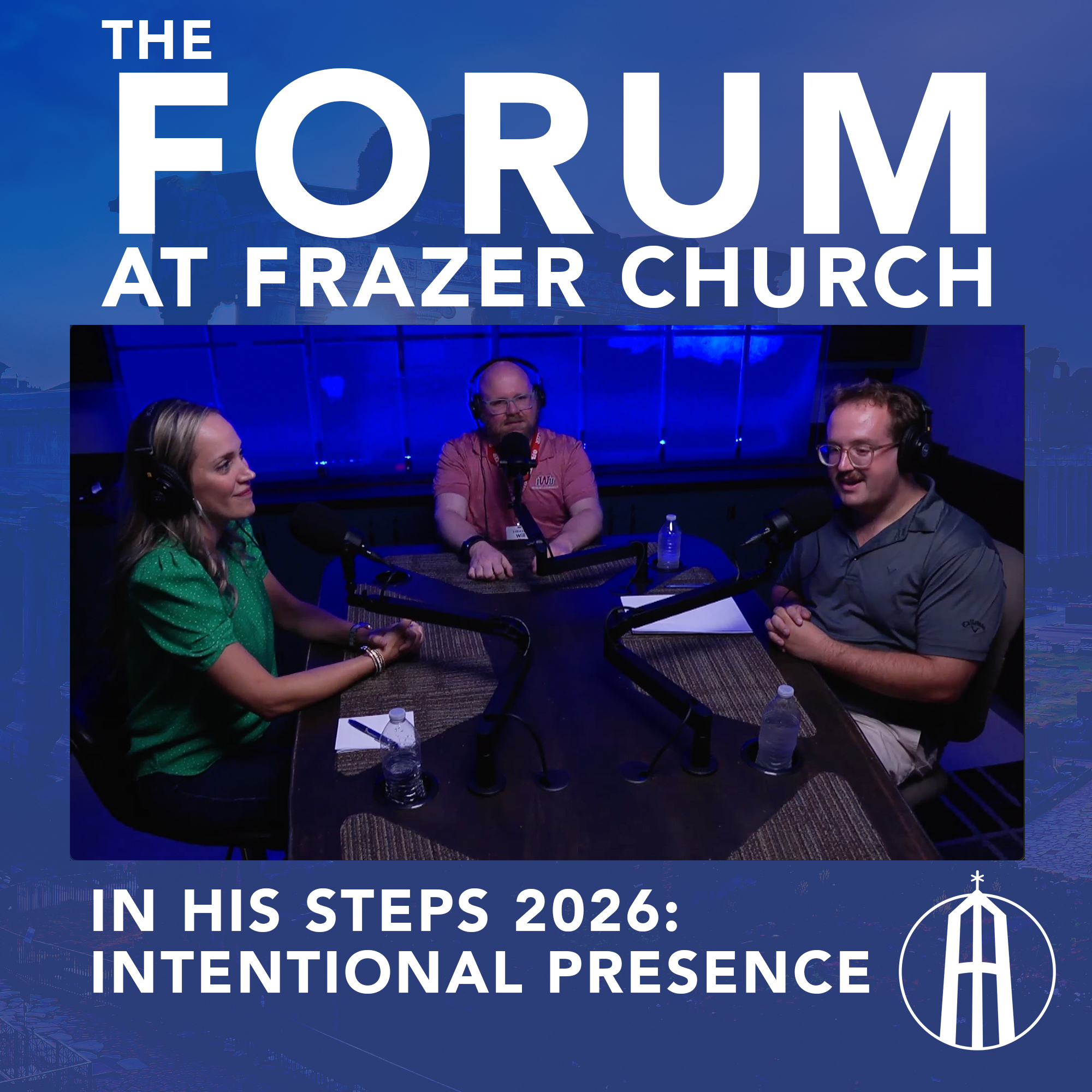
[00:00:05] Speaker A: Well, grace, mercy, and peace. In the name of God, our Father and the Lord Jesus Christ. And welcome to the forum at Frazer. I am here with two of our staff folks. Today we're talking about intentional presence. So if you don't mind, introduce yourself and tell us what you do here at Frazer. Zach, why don't you kick us off? Okay.
[00:00:27] Speaker B: I am Zach Jeffcoat. I am our Deacon of operations, which basically means that the church leadership has approved me to do specialized ministry in the operations area. I am also one of our worship leaders here at Frazer.
[00:00:43] Speaker A: Awesome. Kelly, why don't you.
[00:00:45] Speaker C: Yeah. Hey, I'm Kelly Slover. I am our minister of groups. I oversee Sunday schools, small groups, our military ministry, and our Frazer young adult ministry.
[00:00:55] Speaker A: Awesome.
Now, today, we're talking about intentional presence. So the word presence means different things to different people. But when we're talking about intentional presence as a value that we want to have here in our church family, what does that look like in your respective ministry areas?
[00:01:15] Speaker C: So what I really like about that question was the word intentional. Because a lot of times I think when we hear present, we just think, like, present and accounted for, like, that we're just in a space or attending a worship gathering or a group.
But it means so much more than that. It means being, like, fully engaged.
Like, your head, your thoughts, your emotions are where your feet are. You're not wondering what's for lunch or what to do on your to do list.
And I think it also means not just being intentionally there and present, but I think it means intentionality over time.
Because being present with people takes time. It takes, like, over the course of many meetings to really get to know somebody and to be present with them and to build a relationship. So when we have groups, I want people to attend. I want them to come to groups, I want them to join a group, but I want them to be fully engaged and really looking and seeking for maybe what the Lord would have them say to somebody or somebody that might need a friend, and then sticking with it.
[00:02:13] Speaker A: Yeah. One of my favorite conferences that I've gone to over the years is the Catalyst Conference that is held in Atlanta. And one of the themes one year was just be present.
And it was really focused in on what does it mean to be fully engaged in the moment? How do we make sure that we are present in that moment? I think there's a lot of ways in which today's culture, it really almost endorses not being fully present the way that we're making ourselves available to people all over the world at any given moment. In some ways that we're kind of getting torn in every direction and intentional presence.
I think part of what it gets at is saying, like, this isn't something that happens on accident. This is something that we have to make sure that we are choosing to do in every moment when we're together with each other, is to have that fully present kind of mindset.
[00:03:15] Speaker C: I am not naturally very extroverted, so sometimes being intentionally present with people can be a challenge because my comfort is kind of to just, like, be small, I guess, in a space. And I remember once when I was pretty on. In, like, discipleship and in leading ministry, I was at a ministry event, and I didn't know a lot of people. I had been very brave just to get there. And I remember sitting, we were about to start, and, like, there were no friendly faces. I didn't know anybody. And I remember thinking, lord, I wish somebody would just come and talk to me and, like, be present with me and, like, notice me and.
And one of the times I almost feel like I heard an olive voice with the Lord and he was like, you do it. There's somebody here praying the same prayer. You do it. And for me, even in my introverted way, that was such a shift in how I approached these moments of discipleship, of worship, of group, of being present with people, was to look for those opportunities and not wait for somebody to do it. For you to be the one to start the connection, to be present with people.
[00:04:22] Speaker A: Yes. I think sometimes when you're. When. I'll say, when I am in a social situation, and maybe this is a guy thing, but I'm like, what is my role here? I don't know what I'm supposed to be doing. And the tendency is to be like, okay, well, I'm going to sit back and be passive because I'm not sure if I'm not hosting or if I'm not in charge, I just might kind of just sit there. And I think one of the things that I've tried to shift in my paradigm over the years is really going towards my role being to find those folks in. In the room that maybe are on the fringes or just someone who needs someone to talk to and go to that person and be available for them, so.
Well, Zach, in. In worship, which, you know, you are obviously involved in. What.
What does the word presence mean? Or what kind of things do that conjure up for you?
[00:05:21] Speaker B: Yeah, it brings a lot of words to mind. I appreciate what y' all are saying. About, you know, intentionality, about kind of showing up for other people.
And of course, like, at its baseline, part of worship is showing up for the Lord at an appointed time and a place.
I think that worship is about being not just generally present, you know, having a way about yourself or, you know, an awareness around you, but being specially aware and specially present.
Not to our own individual things necessarily, though they have a place, but actually finding ourselves and our place in the broader picture and story that God is telling.
So I think a key part of worship is actually orienting us to both God's presence. So what's going on with God? Not just, you know, Holy Spirit vibe. We often talk about it in extremely loose, spiritual, you know, terms, but actually going, okay, God has been doing real things throughout time. We have a book that tells us about them, and that story has more meaning for me than what's actually been going on in every other general context that I've been present in this week. So I'm gonna try to bring my attention to a point of focus, to find myself there.
And that's. That's kind of the aim, I think, of worship in certain terms.
[00:06:55] Speaker A: Yeah. Yeah. I mean, I love pointing out that it's not just our presence in worship, it's God's presence. And, of course, we're consistently told throughout Scripture that God is with us in so many different ways that where two more are gathered, there he is in our midst, and Jesus says there at his ascension that, surely I'm with you even to the end of the age.
And so God's presence being with us is a major theme we see in Scripture. And from that sense, in the way that we're made in his image and the way that we're supposed to be imitators of Him.
[00:07:28] Speaker B: We.
[00:07:28] Speaker A: What does that mean for being present? That is something that perhaps we. I haven't really thought that much about of, like, how do we be Christlike in that sense? So that's just kind of an interesting thing to bring back around.
[00:07:43] Speaker B: I like what you're just saying about, you know, finding out how to be present in that context. You know, going back to the personal kind of realm of things, you know, are. We brings up all kinds of emotions and struggles and troubles. And part of the most impactful part of worship is that we are bringing all of that to a point of meeting with God and others. It's actually a place where I can search, you know, that I think of that passage, search me and know me.
You know, I can say, I've had xyz this week, and I'm coming in overloaded with this emotion. Positive or negative?
[00:08:21] Speaker A: Yeah.
[00:08:21] Speaker B: Lord, where does that fit into this? A lot of times we find, at least in this culture, this generation, music helps us to kind of channel those feelings towards God. And when we sincerely do that, I think he also helps us sort ourselves out a little bit too.
[00:08:38] Speaker C: I think another key part for me when I consider, like you were saying, God is present with us always. He'll never leave you, never forsake you.
But it's us practicing our awareness and intentionally being present with Him.
And there's a mentor I have who would just constantly say, immediate repentance. Immediate repentance. And so many people I know really don't like the word repentance, because it's like, you gotta admit you failed and you've done wrong. But I feel like repentance is such a gift because it takes the believer who has strayed and who feels lack of presence, who feels separated from God, and it brings them back into a close relationship where you're truly abiding closely in the presence of the Lord. And when you do that, you're such a conduit of his presence for other people.
So immediate repentance is a gift. It's a gift because you can remain present with him, abide with him, remain in Him. He is the vine where the branches.
[00:09:37] Speaker A: Yeah. Awesome.
Well, my next question is kind of about the interplay between groups and worship.
And I think one of the things that we can kind of emphasize, like discipleship over the worship aspect, but the question is, how does being present in worship enhance our discipleship?
And how does consistent discipleship and fellowship with other believers. How does that enhance our worship experience when we come together as a body to worship?
[00:10:15] Speaker B: Well, I think I can speak to that, you know, from the perspective of worship.
While there are elements other than music, you know, the proclamation of the Word, the reading of scripture together, emphasizing music for a second. You know, a lot of times we kind of naturally assume that the Bible was happening back then or, you know, something like that, where it doesn't feel present to us. It doesn't feel like a present reality and part of what we actually can do in worship. Because music, you know, has this innate ability to sync up people's heartbeats, to slow down our attention span or spend. Speed it up even. But it creates a context for us to actually process and be in the Word of God in a different way. That's why it's so important that we sing scripture, that we sing stories that are oriented to God's truth and his story. It's that we can, you know, I think of that verse in him we live and move and have our being. We can find our being in God in music sometimes because it allows us to have a more like body level interaction with these truths.
[00:11:34] Speaker C: Yeah, I would say they need each other. I think the early church models, both acts has examples of both large gatherings and then small church community gatherings. And I think if you're only doing one or the other, if you only come to worship and you miss groups, you're missing out on such a key part of what it is to like live the biblical community life. We are given so many of those one another verses in scripture and if you're not one anothering, it's really hard to one another with people. I know that sounds silly, but like if you are not known by anybody and you don't truly know anybody in a real like meaningful way, more than just like a hello and a shake when everyone's like awkward in the greeting moment, you don't get to one another. You don't get to pray with one another. You don't get to abide and just remain in relationship. You don't get to bear one another's burdens. You don't get to practice forgiveness sometimes if you don't let anybody close enough to you to sometimes let you down, which they will.
And I think also when we are growing in discipleship with people, when we're one anothering with our church family, we get to see how God is moving. We get to see how prayers are answered not only for ourselves, but we're invested in the lives of the people we've grown in relationship with. We get to see God work. And when we bring that experience into worship, it just makes it more profound, it makes it more exciting. You're praising him for, you know, things he answered that week for your friend or for you? You're praising him for the, you know, the discussion you had in Bible study and how it made clear something that you'd been wrestling with for a long time. You're bringing all that faith building into worship and it just makes it even richer. But if you don't go to worship too, you kind of miss that corporate that. You know, we're all in this together and we're part of bigger. Something bigger than ourselves too.
[00:13:35] Speaker A: Yeah. You know, I think of it much like a relationship, a marriage relationship.
There are parts of the relationship that are just the small little things that you do for each other that are Loving that very much convey love that are along and along. And they're not big gestures, just the way that you greet each other, the way that you talk to each other, the way that you subtly love one another throughout the day.
And in some ways it's like, that's like the discipleship part of things that just kinds of along and along and then big romantic gestures, going out on a date night or having a weekend getaway. Those are the things that you may think of more. Just like worship is, our big corporate worship services may be the thing that people think of when they think of church, but you need both to have a healthy relationship. And some people are kind of naturally better at one than the other.
I think there's kind of a thing where, you know, some, some guys may be perfectly good at treating their wife sweetly throughout the day, but never make an extra effort to go above and beyond or vice versa. And so I think with that, that is kind of the way that these two aspects of the Christian life kind of have an interplay to some degree or another.
And I mean, and also just kind of flow into one another. I think there's some ways in which we as humans, we like to categorize things and separate them, and sometimes that's helpful for us in our thinking.
But in reality, I think a lot of times God's like, I never meant for these ideas of worship and discipleship to truly be like a. A separate thing, that these are really just a constant, ongoing give and take in and flow into and out of one another.
[00:15:35] Speaker C: I would agree. Not a competition.
[00:15:37] Speaker B: Yeah, absolutely. I was actually kind of thrown back to when Kelly and I were working really closely together on life along the way.
A few years ago, you know, our challenge to the church was to all be reading the same passages and the same devotion at the same time. But oftentimes that also came with kind of an additional challenge of saying, we want you to get in a group of people. We want you to open up the Bible, drop your presumptions, and see what the Lord says to y'.
[00:16:11] Speaker C: All.
[00:16:11] Speaker A: Yeah.
[00:16:12] Speaker B: You know, a lot of times our worship services have been really planned in a detail oriented way because we're trying to give God high praise, we're trying to exalt him here in this city, in this region.
And that's so important. And that requires a type of attention and a type of presence.
But just like you're talking about romantic gestures, sometimes you also need the spontaneous moment in your relationships. And a lot of times in groups, that's actually the place where God chooses to act out spontaneously. Like, sometimes we're looking for, you know, that worship leader to sing a cool thing that no one's ever heard before, which I'm not putting that down in any way.
But how much sweeter is it when we're gathered together around the Holy Scripture and we find that the Word has something personal written just to us with the assistance and the fellowship of fellow believers.
[00:17:11] Speaker C: Yeah, I agree. Groups are not just about, like, information transfer. I mean, we need to know the Word and hide it in our heart. And it is our shield. No, sword.
The Word is our sword.
And I think actually scripture memorization and being in the Word is so important. But groups are more than just that.
It is being with people who can tackle those tough questions with you, who can speak truth to you, that you're giving relational, like, what is it, like, authority to other people to walk through those things with you.
[00:17:45] Speaker A: Yeah. When you. You give other people some access to your life, when you are just vulnerable enough that you're able to both have. Have accountability, but also experience love in a way that. That is really unique.
We're told that we will be known by our love for one another that Christians have. And so really, groups have a unique way in which that we get to execute that particular command.
[00:18:24] Speaker B: I'm even thinking of as we're talking about worship in groups together, maybe the church in general. I think a big part that both functions are meant to do in our lives is to disrupt the stories and the narratives and the thought patterns that we just run with when we're out of community.
You know, I have an upbringing. I have a background with this or that trouble.
And I'm prone to come to the same conclusions about my experiences time after time after time. Maybe I'm a positive person, maybe I'm a negative person. That doesn't mean I'm a truthfully rooted person.
You know, it sometimes takes a worship service pointing us to the Word of God, accountability with a friend and the Word of God to actually orient us to the truth of our lives.
[00:19:18] Speaker C: Yeah, we can all have blind spots 100%. And I think he sends his word and then he sends your brothers and sisters for sure to help you see those.
[00:19:25] Speaker A: Yeah, absolutely.
Well, we've kind of touched on this, but I think we can get just a little bit more specific about the fact that we do have people in our congregation who attend worship that are not plugged into groups or Sunday school classes or whatever. And we also do have people that are in a group, group or Sunday school class and very active who don't actively attend worship.
And I just want to ask this question. What are they missing out on by not consistently engaging in both?
[00:20:02] Speaker C: I think they're missing out on the complete picture of what God has for them. I think the Lord wants to gather us in corporate worship. I think it's. I sometimes just imagine heaven and how one day the whole body of Christ will be together. And our little church service on 6000 Atlanta highway is a little glimpse of that, of us all joining together. Scripture says that the Lord inhabits the praises of his people. It's all about the Lord's presence and just bringing yourself genuinely to him. But you're also missing out on bringing yourself genuinely to other people and then being there for them too. We need each other other. The Bible is full of scriptures about how we are the body of Christ and one part of the body is not more important than the other.
And so if you're not doing both, I think. I think both are such a complete picture of discipleship.
And we don't, we don't want you to miss either part. We want you to have a genuine presence in worship and then genuinely be present with other believers.
[00:21:00] Speaker A: Yeah, yeah. No, I think that's really well put.
[00:21:04] Speaker B: You know, I think that the Word has a lot of instruction for how to live our lives.
And we can't fit that into an hour long program on Sunday mornings, at least for the worship service. So, yes, we may have a call for repentance one Sunday on, you know, I guess Communion Sunday, but then some special Sunday.
But frankly that's not sufficient because we're called to repent all of the time, as Kelly was saying. So. So if we don't have a context of people that we can safely practice that as a life practice, we're probably gonna struggle to live a repentant life in a more broad sense of it.
Especially if we're waiting for the right time. I mean, going back to marriage, like, let's think about that. If we wait for the right time to apologize for our half of a relationship, it's probably never gonna happen. Cause it's too costly.
So we have to choose to show up with our faults and actually do it.
[00:22:06] Speaker A: Yeah.
[00:22:07] Speaker B: So I think the importance of a group in certain ways is that there is a whole lot of Christian living to do, to organize, to participate in, and it's not on one individual person to do it.
[00:22:20] Speaker A: Yeah.
[00:22:21] Speaker B: And it's not on one service a week either.
[00:22:24] Speaker A: Yeah.
[00:22:24] Speaker B: And that relationship, to unpack more things to Help you grow in all of the areas at one time of Christian, you know, discipline.
It's so important.
[00:22:38] Speaker C: And I think, like, we need to be mindful and not forget we have an enemy of our soul. He is out to kill, steal, and destroy. And I do believe one of his favorite strategies is to isolate. Yeah, it is.
I mean, there's a reason Jesus went after the 1 and left the 99 is because when you're isolated and alone, you're in trouble, you're vulnerable.
He would love to bring you back into the fold to be with your brothers and sisters.
There is community and hope and strength. And the Lord has placed people around you to help you not be alone and vulnerable, to speak truth over you when you're feeling weak, when you're going through a hard time, and the enemy's got your mind just like repeating lies, they can speak truth to combat the lies that you might be believing about yourself and others. So you need both.
And, yeah, if you're only coming to worship, I would love to help you find biblical community.
And if you're not joining us in worship, I think it's such a sweet picture of heaven and to be present with the Lord as we praise him.
[00:23:40] Speaker A: Yeah.
[00:23:41] Speaker B: As you're speaking, I was thinking of the verse that said, you know, and everyone did what was right in their own sight. And that's like the big problem of the Old Testament, where the people of God go astray, is that when they get into a place where it's always about my perspective, it's always about how I see things, and it's always about my will, things just start to go really wrong because people become deluded, people become sinful, and relationships become broken. And I think that part of both of these ministry areas is about helping us to see God rightly and not just to see what's right to do vertically. Because, oh, God told me, I need to do this this week. But how am I relating to my brothers and sisters in Christ? How am I relating to my neighbors? I mean, those are the three big relationships, I guess. Maybe also our enemies. I mean, there's a place for the. That question, too.
We have to invite the Lord to be our vision and to be. And to enlighten our eyes, to see clearly what's going on in the kingdom of God.
[00:24:46] Speaker A: Yeah, Yeah. I mean, another major theme throughout Scripture is just that we're not meant to be alone. We're not meant to do this thing alone. And over and over again, we. We see that people, while seeking solitude for the purpose of a spiritual discipline. That's a different story.
[00:25:07] Speaker C: Completely different.
[00:25:08] Speaker A: But you also see examples of people just needing each other over and over again, communities coming together to work together, people reaching out, finding help, finding hope through other believers. And of course, we, as Christians, we believe that we are made for worship.
And so there is so much that you're missing out on.
I think years ago, I interviewed somebody who was talking about their Sunday school class or small group and said that, hey, if you're not plugged into a Sunday school class, if you're only going to worship, then you're missing out on like, 70%, he said, of what there is at Frazer And I think, you know, putting a percentage on it, you know, I don't know, but you are missing out on a lot. And I think in one way, I would even say if you're only going to a small group, you're still missing out on 70% of. Of what there is to do in our church. And so it really is about having a complete walk with Christ, one that has discipleship and worship there at the center.
[00:26:16] Speaker B: I kind of wanted to share a story from something that happened in our staff meeting just today, because it was a moment where God allowed me to experience a different kind of presence.
We were singing Firm foundation, which we sing all the time here at Frazer. You know, it has a chord that says, rain came, wind blew, my house was built on you. You know, Christ is my firm foundation. And I looked in the back, and four of our staff people are from Venezuela. We just shared in the service about how we're raising money and prayer to support people who've been affected by that tragedy. And here we are, we're singing this song, and so often we call our attention to, hey, remember that time that you struggled? God held you through it. But in that moment, as we began to pray, we just started praying about how, you know, some people's lives in a particular place in the world was literally shaken.
The foundations of probably homes, livelihoods, shaken.
[00:27:13] Speaker A: Yeah.
[00:27:14] Speaker B: But Christ is their firm foundation. And we just entered into a time of interceding for the church in Venezuela. You know, that's just kind of a really particular instance of how presence, the presence of the Lord reminding us not just of spiritual truth, but of. Of the truth of people's lives, that the image of God in those staff people inspire something in us to go, wait, there's a bigger picture than my life, and God wants us to participate in it through prayer and worship.
[00:27:44] Speaker A: Yeah. Awesome. Yeah, thanks for sharing that.
[00:27:48] Speaker C: Well, I just. I mean just to close for for you, if you're listening and maybe you've struggled with being present and seeing it more as just attending church and kind of a to do to be done, I would just encourage you to think and pray on how you can change your perspective on that.
That for us at church, our hope and our prayer for you is that being present would not just mean attending that. It would mean first being present with the Lord, immediate repentance and just abiding in his presence and being in worship and being authentically like they are with him and with others in worship, but also being intentionally and authentically present with people, allowing them to know you and then seeking to truly know other people. That is my hope in all of ours here at Frazer.
[00:28:39] Speaker A: Yeah.
Well, thank you guys for joining me here today and thank you for joining us.
Wherever you get your podcast, make sure to subscribe, give us a comment, give us a Like Share this if this has been meaningful to you, maybe with somebody that you want to invite to your small group or to worship this week, so be sure to join us next time as we seek to fulfill the Great Commission by living the Great Commandment.