Episode Transcript
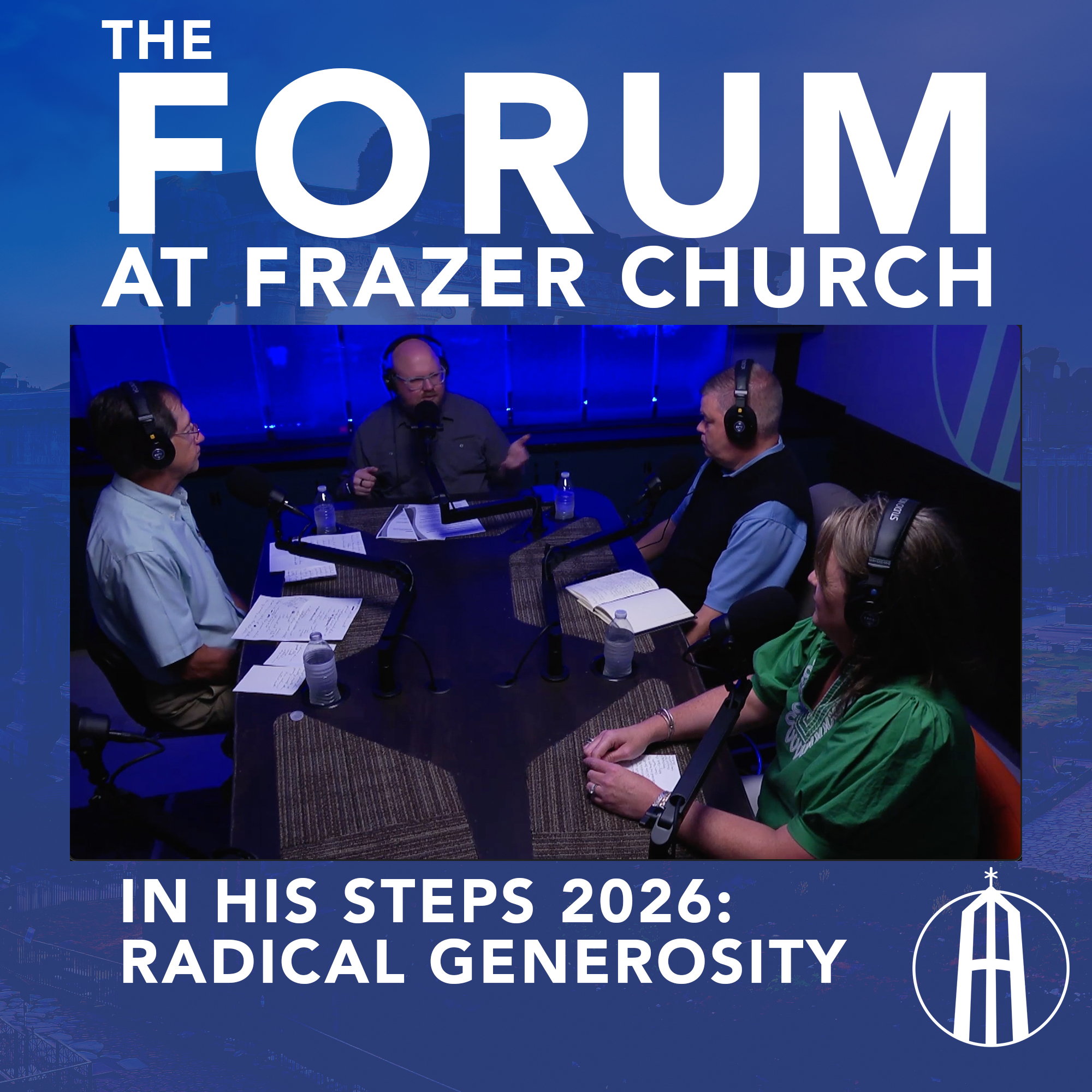
[00:00:05] Speaker A: Grace, mercy and peace from God our Father and the Lord Jesus Christ. And welcome to another episode of the Forum at Frazer. I'm Will Adams, the minister of story here. I'm excited to be here with an awesome panel of guests and I'm going to let them introduce themselves and talk a little bit about their involvement here at Frazer. Jason, why don't you kick us off? Sure.
[00:00:27] Speaker B: Thanks. Will you?
My name is Jason Coker.
I have been at Frazer since 1997 and enjoy being here.
Autumn and I have been active, very active since we were married in 2001.
We've served in a lot of different capacities and really enjoyed our time here and, you know, look forward to things that are coming up. So, Autumn.
[00:01:06] Speaker C: Well, as he said, I'm Autumn Coker. I'm Jason's wife. When I moved here to Montgomery, Jason was already a member here at Frazer So that was an easy plug in here, you know. And then as we've been here in Montgomery, we've always been here at Frazer and found it very easy to find things to do and to serve here.
[00:01:25] Speaker A: Yeah. And Jason, you hold a position.
[00:01:29] Speaker B: Yes, and so this will be my eighth year being on the finance committee, but I'm on the board of directors and the finance chair for the last five years.
[00:01:41] Speaker A: Yeah.
[00:01:42] Speaker B: Since we've changed over to free Methodist and so that, that keeps us busy and you know, we.
It's been a really good thing to be a part of, to get to see how things work, get to be part of the decisions that have gone in where we are now, where we came from and you know, that's an important part of what we do. And in that role as finance chair, you know, what we're talking about today with giving and tithing and you know that that makes up a large part of the lifeblood of the church, you know, so a lot of transparency, a lot of good stewardship, but at the end of the day, you know, making correct decisions and doing what the Lord wants us to do. And that's really important.
[00:02:44] Speaker A: Yeah, yeah. Stewardship. So important. And I'm so glad to have our other guest here. Rusty, you've had an important role here and been here for a long time. You were just sharing with us.
[00:02:56] Speaker D: Yeah, a long time. I came in 1987. My wife Billy and I came with our first child and came serving in the area of local mission and we spent a lot of time with a benevolence ministry. We called him Christ Way. That helped many people. It was interesting. A non budgeted ministry ministry it was strictly based on freewill offerings that people would give over and above what they might give to the church in the way of a tithe. Then it was involved in other local mission work for I guess the first quarter of my time here.
Did a lot of disaster relief work. At one time I had the title of disaster pastor.
We spent time after hurricanes, tornadoes, floods and recovery and restoration was very meaningful work.
And then after that our then administrator, Bob Klein retired. He had said he was going to be here 10 years and when he reached the 10 year mark he decided to retire and he went into supporting his wife.
That was his primary duty. So I was given the wonderful opportunity to become the business administrator.
[00:04:04] Speaker A: Yeah.
Oversaw finances as a part of that
[00:04:08] Speaker D: finances, plant and property, a myriad of things that take place on the business administration side of a church, especially one that's large.
A lot of building campaigns went on during that time.
It was a privilege to be a part of the church too when we became debt free as a part of the work there. And that was something that was very rewarding, meaningful.
[00:04:36] Speaker A: Now you attend in retirement along with your children and grandchildren.
[00:04:41] Speaker D: We do, we do. We have five grandchildren now. And of course my wife still works in the bookstore, the Frazer Bookstore, which is a fun place to go. People enjoy going there and not only for the books but I think the fellowship and the entertaining stories that sometimes happen there. So yeah, it's a good thing. Good thing. And then of course our daughter in law, Alyssa, hear her singing the choir all day. Our son Ty, he's an attorney in town and he's very active here in many facets.
[00:05:09] Speaker A: Yeah, well, been an important part of the Frazer family. Continue to be an important part of the Frazer family. Everyone here.
So my second question is, how have you seen God work through giving in your life and in the lives of those around you and anyone can just jump in whenever you are ready.
[00:05:35] Speaker D: You know I mentioned in Christ's Way, for example. Oh yeah, I remember years we'd go into the latter part of the year. That time we were on a calendar year, fiscal year was a calendar year and we'd go into the latter part of the year and we'd given out more money than I thought or that we thought we were going to have coming in. And because the generous giving of people and God inspiring people, it was so interesting to see at the end of the year that nearly every dollar given out was covered by a dollar given.
[00:06:04] Speaker C: He was always there.
[00:06:05] Speaker D: Yeah, it was really interesting. God's provision and it's Been fun to see other works take place. I think of Transformation Montgomery, for example.
When a former pastor was here, he said, we're going to pick something locally that we can only do through God's provision. And it's been a wonderful work to see a neighborhood that was adopted and houses purchased and renovated for affordable housing and a center for education for young people and just community development. So it's been good to see how God uses his people to support those things that he wants to see fulfilled.
[00:06:42] Speaker A: For those who may not know what kind of things in Christ's way does. Can you tell us just a little bit? Maybe may not be able to talk about anything too specific, but just the types of things that are covered by that benevolence fund.
[00:06:56] Speaker D: Generally speaking, we were trying to help people who had gone through a one time separation from their income, maybe some kind of medical issue or some other thing. And in general, we would try to take care of their funding on a one time basis to try to fill the gap. So it might be a utility bill, it might be a mortgage payment or a rent payment or something such as that. Just something to help.
Oftentimes you might consider them, the working poor. They were, yeah, they were doing fine until this happened and they needed a little support to get to the next step and we would try to fill in that as best we could.
[00:07:35] Speaker A: Yeah, yeah. Well, it's a great ministry and we of course still have it still going on, still providing those funds for people who need it.
[00:07:46] Speaker C: So I guess I'll take this one.
So Jason and I were both blessed to be raised by giving supportive, active parents that are in the church, Jason's parents here at Frazer and then my parents. I was raised in Georgia, so we've always had that example set for us of serving, how important serving is in the church. So I feel like we've tried to instill that with our family.
I remember my dad telling a story many, many times, his testimony of when they were a young couple, they had bought a new house and had mortgage payments and they got a little behind one month from, you know, buying furniture or different things like that. And so it was either write the tithe check or it was right, the mortgage check. And so they had decided that the Lord would understand and they would do the mortgage check. And then on Sunday morning, dad got convicted and he wrote the tithe check. And so mom of course supported him in that. So Monday he was like, well, I'll call the bank and you know, just tell him, you know, what's going on or whatever. And so I guess that afternoon mom had gotten home and she called him and she was like, hey, you don't need to call the bank anymore. There's a letter in the mail that we have money in our escrow account that they didn't know they had from getting the house, and it covered the mortgage payment for that month.
So, you know, taking that and knowing that, like you said, you were saying how the money is always there, you know, God provides and it's really his to start with anyway, you know, and in giving of time, the church so much has supported us and our kids have poured so much into our children that to help them to be the people that they are today.
The church also supports us in, you know, in medical issues when both of us have been in the hospital for different things or our family has. There's just so much that serving provides.
[00:09:28] Speaker A: Yeah, no, there's so many ways in which that when you're faithful and to give, when people step out on faith and giving, there's been so many stories of folks who have taken what feels like a little bit of a risk in that, but in the end, you're investing in something that is a sure bet. It's a very safe way to invest in giving to the Lord.
Now, the next thing that I wanted to bring up, we have upcoming some workshops going on in a few weeks here for charitable estate planning and also retirement. And, you know, I think some people may look at that and go, well, that's kind of odd for a church to offer those kinds of things, but it's a really great service. I've interviewed people before when we've offered these other times. And you know, Rusty, just because of your experience with this, I wanted to ask for those who don't know what legacy giving is, if you can tell us about it and why it's something that church members need to know about and why, you know, these workshops are something that they may want to check out.
[00:10:47] Speaker D: Sure. Legacy giving in general is giving that takes place after our lifetime, after we go to be with the Lord is the giving that takes place then.
Dave Ramsey has a definition. He says it's the intentional transfer of wealth, values and generosity to future generations and community.
So. So it's very forward focused and future focused. It's also designed to help control the distribution of funds that God has entrusted to us beyond our lifetime and to be good stewards and to be effective and efficient in the way that the money is distributed, so that it's controlled by ministries or individuals that you would like to have it controlled by, as opposed to maybe a governmental agency.
It does involve planning and a good bit of planning.
It requires that we step back and purposefully consider what we would like to see assets entrusted to us would go to after our time of managing them on earth. Because we are managers, as you said, we don't own anything. God owns it all. And the scripture is very clear to that. But we are called to be managers and stewards.
It involves clear instruction, really. It's other oriented because it's not only just the money involved, it's the transfer of values and of generosity.
It's also helping the future generation understand what our needs, or I guess what our wants would be in the distribution of funds. It helps eliminate controversy and conflict and confusion and that type of thing.
It also calls us to take a keen accounting of everything that is entrusted to us, whether it be cash or property, stock, life insurance policies. So many things that are out there that sometimes we just need to stop and take an accounting of what God has entrusted to us. Because at times we can get so busy that we don't even realize how blessed we have been through the Lord.
It involves strategies and some of the things that we think about when we think about legacy, giving or wills.
Not me, not you, but wills. And I guess that's the most common way that things are transferred. But there are also more complicated things like trust, charitable remainder trust, and there's all varieties of those things. Life insurance policies.
I know there was a time at which people in the church would buy life insurance policies and leave the church as a beneficiary. Also retirement income, naming beneficiaries of what might be left in a retirement account.
So so many, many things that are involved in it. And it's really more than just giving money.
It's a way to live life simple and with a focus on others and a focus on what God would have his resources to accomplish after our life.
[00:13:51] Speaker A: Yeah, well, scripture has a lot to say about money management, especially proverbs.
And one of those is that a wise man leaves an inheritance for his children.
And that doesn't happen on accident.
[00:14:05] Speaker D: No, it doesn't. And that actually comes from proverbs where a good person leaves an inheritance for his children and his children children. So it's very, very much. And you mentioned about scripture. I think there's more than 2300 scriptural references to finances or possessions. And you've heard it said that Jesus talks about that more than most anything else in the scripture.
[00:14:31] Speaker A: Yeah, being a good steward is A major theme of Jesus ministry. And of course, money, resources are just one of those things that we are given to steward, but it's an important one. And it's also one that we, I think, can be timid to talk about in the church.
Because, you know, there are churches that have histories of not being all that honest or not being that transparent. Which brings me to my next question. You know, Jason, in your role and your unique perspective, you know, that you have, because of being a layperson who's helping to oversee the finances and how we handle things, can you just speak to what makes giving to Frazer a good use of God's resources that have been entrusted to our membership?
[00:15:29] Speaker B: Yeah, well, I mean, it's.
Again, giving is the lifeblood of the church.
And you know, we here at Frazer, we want to be transparent.
We don't want to hide anything. And that's why we have our member of congregation meetings. That is why we try to get as much information out there. I mean, when we walk in here every day on Sundays, everything that we see is part of.
[00:15:57] Speaker A: Yeah.
[00:15:58] Speaker B: Is a result of a product of giving.
[00:16:00] Speaker A: Right.
[00:16:01] Speaker B: You know, so when we were talking earlier about, you know, giving, what, what do you see?
All of it.
When new families coming in, giving plays a role in that.
But I mean, at the end of the day, you've got administrative, you've got building expenses, you've got staff, discipleship, congressional care, as Autumn talked about a minute ago, that's all a product of that. So it's not a.
We talked about local ministries, the local outreach, global outreach missions. We just commissioned the mission group this morning. And you know, you've got disaster relief. I mean, that's. There's so much that goes into it that it's not just, it's just not a one trick pony.
There's so many areas that all of that goes to.
Being able to show all that is terrific because again, we want to be a part as much as we can be.
[00:17:10] Speaker A: Well, and worship by itself is a praise offering poured out to God. You know, we see that illustrated over and over again in scripture, that even just offering something to God, you know, the, the perfume being poured out on Jesus as an example of this as something that he sees as. As pleasing in that moment that might look like something to other people. It's like, oh, how on earth can you spend money on that? But that, that's aspect of our spending too, in all of that is facilitating worship here as well as being able to broadcast it around the world.
[00:17:53] Speaker B: Correct that and Nobody wants to hear me up there singing.
Having good people leading that, having good people, us preaching, the musicians, the instruments that we play, the sound. I mean, it's all encompassing equipment.
To be able to broadcast this, what we're doing, that's a ministry. And all of those things are encompassed in our giving.
[00:18:20] Speaker A: Yeah.
And we're seeking to do it, I'll just say, as staff, in the most efficient way possible, too. Like, to be able to do something like this. We're looking at how do we do that in a way that is honoring of the resources that have been entrusted to this faith community.
[00:18:40] Speaker B: Sure. And it's not us as a board or a finance committee going, well, we need to be prudent and cost saving. It's y' all as a staff. And I see that in numbers.
I know, Pastor Chris, you know, efficiency, cost control, things like that. That is very important. So it's. So it's not a matter of putting out there what all we're doing, but also how we're doing it.
And that's very important. And, you know, the growth, what we see every day, that's all, like I said, it's a product of what we do, and we want to show that. And we want to show that we're doing it in a mindful way.
[00:19:23] Speaker A: Yeah, yeah. Well, and there's aspects of ministry that are kind of less spiritual, that are still necessary. I think Rusty used to talk about no one wants to give specifically for the AC Fund, but if it's not there, we would hear about it. Or the toilet paper in the bathroom, any number of those kinds of things.
[00:19:44] Speaker D: That's exactly right.
I think another aspect of this, the church obviously needs things, ministries need things, nonprofit needs things.
But I think as a part of our spiritual discipline, as individuals, we need the opportunity to give. And I think Scripture indicates that very plainly that it's a part of our walk with the Lord to understand that he has given us all that we have and that returning to him, it's an indication of our faith that he will supply and provide what's needed, and it's just a way to honor him, whether it be in present day giving or in future legacy type giving.
[00:20:25] Speaker A: Yeah. Well, and another one of those kind of phrases that comes out of scripture to the point that it feels cliche to say it is. It's more blessed to give than to receive. And I think on one level, you can be kind of cynical and be like, oh, well, that's. Is that really true? But I believe that not only is it true you, you find it's more and more true the more and more you give. It's just, you know, just that blessing of being able to give just increases over time.
[00:20:58] Speaker D: The professionals in this area that understand how the mind works say that there's something that happens within us emotionally and chemically that is a result of generosity and giving. But I think that's probably secondary to just understanding that God looks with favor on those who are obedient in giving, seeing strokes.
[00:21:20] Speaker A: I think that goes to show you he's designed us for generosity. I mean, when you're talking about a chemical reaction in the brain that says, hey, you did a good thing, that's a God designed reaction to the act of generosity in ourselves is saying like, oh yeah, that is, that's what I'm supposed to do.
[00:21:44] Speaker B: And it's also the giving of the time and it doesn't have to be financially in a serve capacity.
[00:21:52] Speaker A: That's true.
[00:21:53] Speaker B: And then that's important.
[00:21:55] Speaker A: Yeah, no, absolutely it is.
[00:21:57] Speaker D: And just the witness of that, that others look sure. And view that.
I mean, it's not always what we say, but what we do.
[00:22:04] Speaker C: Well, the blessing comes from that too. You know, just the people that we have met here in the church, just in the different ways that we have serv. We've served in a lot of different areas and it's changed over the years where we have found, you know, the place to plug in because there's so many things that Frazer can do. But the people we've met and the blessings we received from that and just be able to learn from that and like I said before, to set those examples for our children too.
You know, our youngest, Gavin serves, he serves every Sunday morning at 8 o'. Clock. He runs the sound for the children's service. And so, you know, it's, it's nice to be able to see that and to help to raise that next generation is important too, that they have that same mindset and attitude of giving back to the church in whatever way that is and receive those blessings too.
[00:22:48] Speaker A: Yeah, well, and I think one of the examples you see in scripture is the widow's mite, of course, the passage where the woman who gives very little actually is said by Jesus to have been giving more than the wealthy men who were putting in much more than her because she was sacrificing much, much more. And I think, you know, to your point about service, it's kind of like we all give out of what we can. Sure. And for, for some, the, the sacrificial thing to do is to serve. And that's the best we can offer. And to that I say amen and hallelujah, do it. And in the same way that it's like unto whom much is given, much is expected, another scripture passage that gives us insight into what God expects of us. And we in the west, most of us in the US Are in that category of people that have received much. And so we kind of have to take a look and say, okay, then what's expected of us?
[00:23:50] Speaker B: Yeah. And we, you know, if you're a new person walking in here, this.
It can be daunting at times. And if we're. The faces that people see rusty for a long time, just, you know, that is.
That's comforting.
[00:24:07] Speaker A: Yeah.
[00:24:08] Speaker B: And it's rewarding because, you know, if they come back or they. Frasier becomes their home, you played a part in that.
[00:24:16] Speaker A: Yeah.
[00:24:16] Speaker B: And it's not, you know, it should be natural and it should be, and it should be rewarding for. To be able to serve in that capacity. So. Yeah, you know, when we. When we work the tugboat now for. For children's check in, and we are seeing so many new people, and that's. That's exciting. Yeah. And we're a part of that.
Outside of tithing and giving, financially, it's just neat to see.
[00:24:44] Speaker A: Yeah, yeah. No, it's. It's cool.
So the last question I have is, how has making room for generosity been a blessing to you personally and spiritually?
[00:24:57] Speaker D: Well, I know our discipline of giving started for me back in the college days, and as we married, Billy and I took it on is tithing is a basic guideline. I know that some people feel that's a more Old Testament concept, and I suppose it is, but I think it's a guideline that gives us at least some structure.
And to understand how God has honored that commitment is very, very meaningful.
Other concepts, you know, like staying out of debt, that type of thing.
I think God's blessing through our obedience to him has enabled us to get out of debt. I think it's allowed this church to get out of debt.
The money that was given toward mission, given outside just the bounds of the church, I think enabled this church to see a stance of being debt free at some point and working toward it now.
And I think just the sense of being in God's will and the peace that comes from that.
[00:26:04] Speaker A: Yeah, I think that's very true
[00:26:09] Speaker B: for us. It's. It's. It's a part of giving back what we were.
We were, you know, have earned but it was. But we're blessed by God because of that. And, you know, also, you know, besides that, the serving, giving back in a serve capacity, I think we could probably say is our, you know, it's our ability to. To do something physically besides just, you know, doing that.
[00:26:44] Speaker C: And also with Jason, we tend to serve together.
[00:26:47] Speaker A: Yeah.
[00:26:47] Speaker C: So for as our marriage, it's something that we, we do together, you know, and so. And that help. I think that strengthens our marriage too, because, you know, we both work separate jobs and, you know, there's different things with that. But, you know, not always have we served together, but we usually is so. And so that's just one thing with our marriage, I think, has made our marriage stronger, that we can serve and do that together, at least for us, because that's time we spend together and that's time that we're doing that together. And so that's ways that I feel like that has strengthened our marriage.
[00:27:16] Speaker A: Yeah.
[00:27:17] Speaker B: Not that the other ones. Not that the other stuff doesn't work, but it's cool to be able to do that together.
[00:27:22] Speaker C: Exactly.
[00:27:24] Speaker B: You know, from, from doing accounting and counting offerings for the 8:30 service and then doing the tugboat and.
[00:27:31] Speaker A: Yeah.
[00:27:31] Speaker C: For years we even did our marriage counseling through Frazer.
[00:27:34] Speaker B: Correct. Yeah.
[00:27:35] Speaker C: So there's all kinds of ministries there.
[00:27:37] Speaker D: Yeah.
[00:27:37] Speaker B: But, you know, we've been in the children's ministry for 15 to 20 years. I did. Worked in the nursery and we've done this and, you know, it. It. I guess it's. It's, you know, whatever helps is good for us.
[00:27:55] Speaker C: Well, Frazer a big church, and if people first come in and they see it's such a big church, how can I make a difference? Every little person makes a difference because it can't function without everybody here. And it is a big church, but there's a lot of facets to that.
So it shouldn't be daunting to find a place to plug in even. It's just as simple as working in the coffee shop, giving somebody that cup of coffee or being a greeter and saying, hey, in the morning, every part of it is what makes Frasier Frazer and all that's important.
[00:28:25] Speaker A: You know, when you're talking about the ways in which being plugged into kind of ministry together is even, even helpful in the spiritual formation of your marriage and everything. I was just thinking about how when you are tithing, when you're giving, which, you know, the tithe, the question of whether that's an Old Testament practice, I think it's A good start. I think ultimately, if we're giving ourselves over to Christ, then it's all his. And so that, then that question becomes, okay, how do we steward all of this?
How, what, what percentage do we hang on to our. For ourselves? Kind of becomes almost more the question, but in that. Because that takes an intentionality of, okay, how much are we going to get give? Like that doesn't. That's not something you do on accident. You don't just, you know, trip and, you know, drop a percentage into the offering plate. Exactly. You have to make plans for that. That forces you to look at your budget. That forces you to kind of look at, okay, well, how much are we spending on X, Y and Z and where might we be needing to cut back and be a little better stewards and save more and better to be able to leave that good inheritance, those kinds of things.
[00:29:42] Speaker D: Well, you know, Paul had a lot to say about giving and in Proverbs 2, I mean, started talking about giving of your first fruits of the priority of giving, giving our best.
It talks about proportionate giving, where we look at our income and a proportion of that. It talks about setting aside. Paul said, set aside a gift for so when I come, it's ready to be collected and to give, to be given in that way, to be systematic. So he talks about it being cheerful that we should not be pushed to give or give reluctantly, but to give cheerfully. So all these are part. And you know, you kind of alluded to it in this legacy giving that we talked about.
You know, as you get into the mindset of legacy giving, you, you begin to change your focus from accumulating wealth to understanding how you're going to pass on wealth. And not only does it indicate how you're going to do it, but it also begins to guide you in the way you spend. Now, are you content? Are we content? Scripture says godliness with contentment is great gain. Do we come to the point in life where we're content?
Scripture talks about staying out of debt. Are the debtors enslaved to the one that they are in debt to? Do we get out of debt during this lifetime? So that in the life to come or in the life after ours, there is.
There are assets available, savings, that kind of thing. So there's so much to it that encompasses every aspect of our life and it does require planning and thoughtfulness.
It does not need to be let to just happen on its own.
[00:31:26] Speaker A: Yeah, I think, I mean, I think a healthy relationship with our finances is something that takes a certain amount of discipline And God knows it's not going to happen on accident. And that's, you know, part of why we also get the love of money is the root of all sorts of evil as, like, understanding that there is a way this relationship can be soured. And so that's, I think, part of the reason why we see so much in scripture about it is, like, here's how you have a healthy relationship to your finances, and it involves generosity, sacrifice, intentionality, saving, and being able to give to future generations, all of those things.
[00:32:09] Speaker D: I think it involves the whole concept of building treasure in heaven.
[00:32:13] Speaker A: Yeah.
[00:32:13] Speaker D: As opposed to wealth on earth. And there's a parable that talks about the farmer who built bigger barns to avoid hoarding and that kind of thing. Saving in preparation is one thing. Hoarding is another.
[00:32:25] Speaker A: Right. Yeah, no, that's. That's a great point, too.
Well, is there anything else before we wrap it up here?
All right, well, thank you guys. So appreciate y', all, and thank you. Thank you for joining us. If you want to hear more or read more about any of these workshops, we've got the charitable estate planning workshop and the retirement workshop coming up. You can see more about that on our app. If you don't have the Frazer app, go to your app store and search for Frazer. That's a great way to stay plugged in and be listening to our devotions and all sorts of things. So make sure to get that. And wherever you get your podcast, go ahead and subscribe. Subscribe to us. Give us a. Like, give us a review.
Maybe share it with some friends. If this has been helpful to you, if this has been a blessing, you might share this with a friend or a family member.
So, yeah, be sure to join us next time as we seek to fulfill the Great Commission by living the Great Commandment.