Episode Transcript
[00:00:00] Speaker A: Foreign.
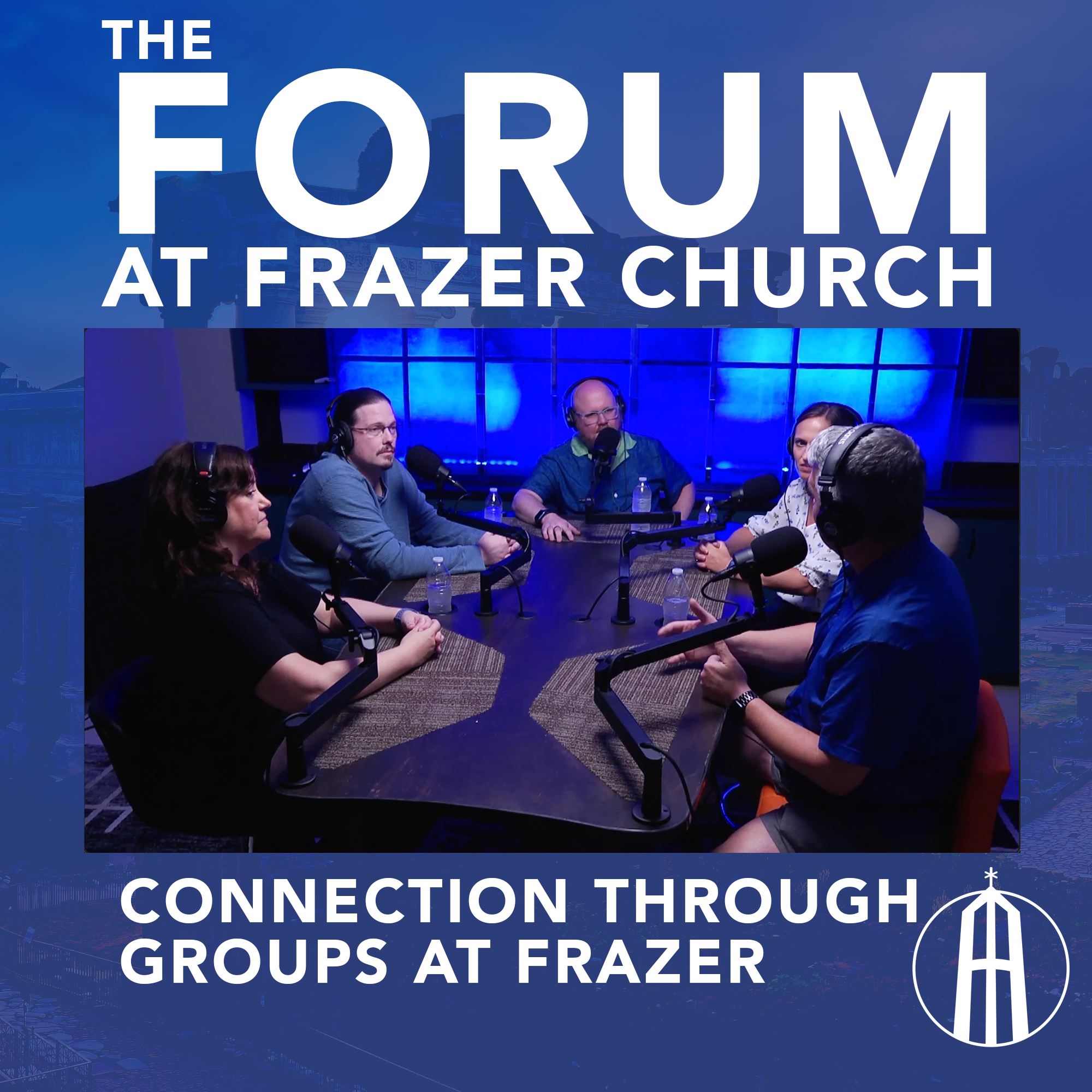
[00:00:05] Speaker B: Grace, mercy, and peace, in the name of our Lord Jesus Christ. And welcome to another episode of the forum at Frazer. I'm here with some awesome Frazer members. I'm going to let them introduce themselves as we go around and answer this first question. We've been talking about connection throughout the last few episodes, and today we're really focusing in on connecting mainly through groups, through discipleship. And so. So my first question is for each of you guys, what does that look like for you right now? What does discipleship. Small groups, what does that look like in your life? So why don't we. Holmes, why don't we start with you, if you don't mind?
[00:00:46] Speaker C: So I'm Holmes King, and have been a member of Frazer about four years. And Mary Margaret, my wife, and I, we're part of the C.S. lewis Book Club.
I run a martial arts program here, which is, strangely enough, a great opportunity for developing discipleship relationship.
[00:01:05] Speaker B: Absolutely.
[00:01:07] Speaker C: We've got probably 15 or 20 folks that sit together every Sunday morning at church, and I think of that as one of the small groups that I'm part of.
And I think there's probably a handful of other. Oh, we have jam sessions over at our house with some of the young guys. We're also starting up a small mentorship group for some of the young folks in the congregation that's sort of focused around the idea of how do you make people feel welcome in a community?
How do you think about being inviting and welcoming?
And so, you know, my hope is that I have a real passion for connecting with people, and I hope that that's an opportunity to pass that on to them.
[00:01:42] Speaker D: Awesome.
[00:01:43] Speaker B: Well, Mary Margaret, you can pick it up from there.
[00:01:45] Speaker A: Yeah. So my name is Mary Margaret King. I go with this guy.
So, yes, we do all of those things.
And I'm also excited that I'll be starting a young women's group for ages 18 to 30 in the fall, and hopefully that'll be an opportunity to learn about how to live in gospel community.
[00:02:05] Speaker B: Yeah. Awesome. Yeah.
[00:02:07] Speaker A: Robert.
[00:02:08] Speaker E: Yeah, My name is Robert Patrick. My wife Jennifer and I have been members of Frazer 15 years now. We moved here from Birmingham in 2011, and Frazer feels really big when you first come and can feel really big. So the first thing we did, we got plugged into the Cornerstone Sunday School group, which is fantastic. You know, the people that were teaching that group poured into us, and then as they moved on to another church, we, Brian Carter and Leslie started running the group as well.
The other thing I got involved with early on In Montgomery was Bible Study Fellowship, which is, I think, been the best discipleship strategy that I've been a part of, an intentional Bible study over the last 14, 15 years. And I know we're going to talk about that as we progress. I think Frazer is trying to partner better with Bible Study Fellowship as well.
[00:02:55] Speaker B: Well, and I guess could you just for people who don't know, explain a little bit of what BSF is, because it's a little different.
[00:03:01] Speaker E: Yeah. Bible Study Fellowship is non denominational. I think right now the men's group has 19 or 20 different local churches that are represented. On a Monday night that we meet here, it's a fourfold method to study the Bible.
You start with independent study. So you'll take 30 weeks over the year we just got done studying from the return of the exile all the way to the end of the Old Testament. Exile and return is what we called it. So that 30 weeks, the next, next study starting in the fall will be Romans. So we'll have a 30 week intensive study in Romans. So it's an independent study. You've got scripture to study and answer questions. Then you meet in a small group of 10 to 12, 15 guys or women and go over those answers to those questions and how the Holy Spirit's taught you from that passage of scripture for the week. Then you sit in a lecture for about 30 or 35 minutes, and then you've got a commentary, some notes that will accompany that. And then you repeat that fourfold method over the next 29 weeks. It's been fantastic. It's really kind of grown my sanctification.
It's not an intellectual pursuit, but it's really kind of helped me unpack the Bible in an intentional way.
[00:04:13] Speaker B: Yeah.
[00:04:14] Speaker E: And then about eight years ago, a group of guys, we started a Wednesday night Bible study as well. So before COVID before we were meeting again on Wednesday nights at church.
That's been a really. That's. I would not consider my Bible study small group as well, that we're a part of.
[00:04:30] Speaker B: Yeah.
Bethany.
[00:04:32] Speaker D: All right. My name is Bethany Garth and I've been a Frazer member. My husband and I joined in 2022 and. And we've been mostly involved in small groups together.
And first we kind of plugged into a Sunday school class. And that was before Wednesday night. Church had kind of resumed on a regular schedule. So we started with that because, you know, we came into, just like Robert said, it's a large church and it can feel somewhat inaccessible maybe because of its size. And so we knew we wanted to kind of connect with people on a smaller level, so we decided to start with Sunday school. And then we were also in a life stage. We had younger children then, and I had just kind of a personal level of tolerance for bedtime that didn't really involve Wednesday night church in my life. I was like, oh, my goodness, I'm so tired.
I don't think we can go out and come back. But then as our kids got a little older, I felt myself kind of getting ready to. To be able to add that to our weekly rhythm. And so a couple years ago, my husband and I started a small group together that was like a prayer cohort, a spiritual authority prayer cohort, kind of a training and study together. And through that, some of the people from our Sunday school class came, but some other people came as well, so we were able to build more relationships there. The next year, we followed that up with a different study.
And then this fall, I'm actually going to start a different small group called Embrace Grace, which is designed to reach women from local pregnancy centers, specifically which I'm connected to, but also just to reach women who are facing unplanned pregnancies and help give them a vehicle to connect to local churches for discipleship. So I'll be launching that with a couple of other team members in the fall.
[00:06:17] Speaker B: Oh, so cool.
Well, I mean, one of the things that I think is really cool listening to all of you guys talk about your groups is that you're not just talking about. Here are the official groups that you're going to find on the list of groups at Frazer that we have discipleship happening in so many different outlets throughout our church and throughout our church family that kind of extend out into the community in different ways. And I think that's an important thing for us to hear on the podcast, is that discipleship and connection, while they happen in kind of those official channels, it's also an opportunity for us to kind of look at how do we employ discipleship, how do we employ connection in all of the assets of our lives and all of the different venues that we're in? And I just. I think it's cool to hear that. My next question is just one that I think some people kind of ask when they come into our worship service, and they see, you know, we have great music, great preaching, all of the things, and they're like, well, do I. What do I. Why do I need a group, a small group, or a Sunday school class?
So why is it. And any of you guys feel free to jump in. Why is it that we still need those smaller groups?
[00:07:34] Speaker E: I don't mind starting again, going back to Frazer feeling really big. I think from a relationship aspect and a spiritual maturity piece of it. If you're sitting in a worship service, you're consuming message other than, you know, worshiping and singing, I think Frazer does a really good job with that. But rather than somebody just lecturing you for 45 minutes, it's really tough to interact and to discuss the passage of scripture. I think that's where you that happens in a more of a small group setting.
[00:08:05] Speaker D: Right.
[00:08:05] Speaker E: Where you can bounce an idea. And Holmes is going to have a little bit different take on it than I would have or Mary Margaret or Bethany. And I think that's where the growth, I think really happens. When you can really unpack a piece of scripture, you can talk about it, you can talk about what you're struggling with and that small group aspect. And the more you're involved with a small group too, I think that relationship, as you build trust with those people that you're meeting with, the veils come off and you're more transparent.
You don't hide behind and the Christianese goes away and you can really be real with people at that point and really kind of help each other out. And in this whole sanctification process, we're all on this journey we're on now.
[00:08:48] Speaker B: That's a great point.
[00:08:49] Speaker A: And from a theological perspective, like I think we were created from community, you know, from the overflow of love of the Trinity.
[00:08:58] Speaker B: Yeah, that's great. Right.
[00:08:59] Speaker A: Which is like the OG community.
[00:09:00] Speaker B: Right.
[00:09:01] Speaker A: And you know, given the directive to be fruitful and multiply. And to me that means that we're supposed to be going out creating being part of communities that reflect the image and the love of God.
And I think when we do that, we experience fruitfulness and we experience spiritual growth in the fruits of the Spirit, in our own lives and then we get to participate in that activity in the lives of others.
[00:09:29] Speaker D: Yeah. And I'll just say too, I mean just theologically speaking, if you think about Jesus ministry model and kind of, kind of what you were saying, you know, the sermon and the lecture style, like that wasn't the bulk of what Jesus did, I think, and I'm not, I heard this the other day, so don't quote me, I could be wrong, but I think we have like four or five long form sermons that Jesus taught recorded in scripture. But you see so much life on life just teaching as you're. But it's not in a lecture style. It's this lifestyle of come along with me, follow me, share life with me and do what I do.
And I think even though, you know, Jesus isn't here embodied on earth with us anymore, that's still the model he left for his followers, is to do this together and share life. And that shapes us, informs us in a way that a teaching that we consume on a Sunday can't. I mean, it's just. It's a different level of formation.
[00:10:33] Speaker B: Yeah, it's true. I think, you know, the. The discussion aspect of things, the fact that we're able to interrupt each other and ask a question for clarification or. Or even at times, you know, disagree and have some back and forth on that to be able to kind of help sharpen each other. And it's the whole as iron sharpens iron aspect of things.
[00:10:56] Speaker C: Yeah. I love what Bethany had to say.
And I think a similar thing. I think that if I want to look more like Jesus, then I should look at what his life looks like and I should try to make my life conform to that. And when I look at the life of Jesus, particularly when he started and to the point where he ended his public ministry, the first thing he does, he goes and grabs a bunch of guys and says, hey, let's go do life together. And then they do life together. And then he lives a life that covered up with going and doing acts of service and healing in people's lives. And then when he comes to the cross and he dies, all of those guys look around and they go, wow, there's so much more work to do. And so when I think about my own life, I want that pattern, and I want to make choices every day that match that pattern, that throughout life I'm grabbing folks and saying, come, come be part of my community so that we can be centered in Christ, in community with each other. And I hope that the product of that is that at the end of my life, when I come to die, that the folks that show up to my funeral shed one tear and they look around and they go, we've got some work we gotta go do.
And that there's.
That God's work through me in the time of my life has a legacy of other people knowing they need to get busy.
[00:12:17] Speaker B: Yeah. Oh, that's awesome. No, I love that.
And I think that can lead us into our third question pretty well in a lot of ways.
What I love is that we're hearing a lot of theological discussion about what the advantage of the small group Is.
And this question, honestly, it can be. Feel kind of almost selfish to talk about. But I think it's really relevant to say, like, it's not just the spiritual aspect. It's also the social, emotional, and kind of mental health aspect of things. So how does being in a group, being discipled support not just our spiritual health, but also the kind of that social, mental part of our lives?
[00:13:00] Speaker D: Well, I have to say that I am an extrovert. So this one is not very hard for me because I enjoy people.
So socially, emotionally, mentally, I do better when there are people around me that I'm engaged with that I have meaningful relationships with. I want to talk to people, I want to hang out. So I think my answer to this one is a bit biased to the extrovert.
And, you know, that's just how God made me. That's how I'm wired. I think even introverts would agree that relationships help us and that they find those engaging and helpful socially, emotionally, mentally. No one wants to go home alone every night and never connect with people. So I would just say, you know, on a very practical level, we all need friends. Might as well make them friends that count for our spiritual life as well.
[00:13:52] Speaker B: Yeah.
[00:13:53] Speaker C: As a lifelong committed introvert in a family of introverts, let's hear it. Who's also in a small group that will's also part of that's full of introverts? Those are my people. And I think everybody that's in our small group would say that that group of people is our people. And in our small group, we've had people that have gone through really difficult times, and the people they call are the people in the small group.
And we've gone. You know, one of my favorite services of the year is the longest night service where we celebrate Christmas, but in a time of also recognizing.
And we've sat through that service with other introverts who had been through really difficult and challenging things. And for our group, I think everybody looks first to the people in the group for support and for love and for just being able to be transparent whether they're rejoicing or they're crying.
[00:14:49] Speaker E: Yeah, I'll add to it. I think y' all are spot on with that. You know, obviously we're trying to impact people spiritually as well, but also practically. And I think, you know, everybody. The old adage, everybody needs a Paul in their life, everybody needs a Timothy, and everybody needs a Barnabas as well. You need to find somebody that is teaching you from not only a spiritual aspect, but hey, this is practically how you handle this as you raise kids, as you navigate a job issue, as you do a career change, things like that, that small group can become that for you. And then you go find somebody that you can pour into as a Timothy. And Paul didn't just teach theology to Timothy. He was talking about how to pastor a church. He was talking about how to handle conflict, things like that. And you need somebody like a Barnabas to serve alongside to go. And so those, those small groups that we've built, and I'm real fortunate, those 12 to 15 guys that we meet on Wednesday, very faithfully, those are the guys that the first people we run to with a prayer request that, hey, I got a need, you know, I need, my son needs help moving, you know, help my mother in law move, those kind of things as well.
And it just, the more, the deeper the relationship and you know, as the veils come off, the more you trust each other, the more you're willing to share with those guys. And when those needs come and the crisis comes, you're not sharing it alone. I think the devil would love to isolate people to get away from, you know, somebody else coming alongside you. And we're not built, what Mary Morgan said earlier, we're not built to live in isolation. We're built to live in community. And I think that that's a big part of being plugged into a small group.
[00:16:26] Speaker D: And can I just actually add to that very practical piece that this popped in my mind as he was talking? But we have some family members who aren't believers who moved to a city where they didn't know anyone and they don't go to church, they don't have that means of connection and they have been lonely and they've looked at us and we had, you know, in a previous stage in our life, we had a small group that was, we would assign children to one of the houses and then everybody else would go to the other house and do a project. You know, just trying to share life and help each other in practical ways. Maybe you need it to move, maybe you need it to paint a room. All these like really practical things that you get when you have friendship and you're sharing life together.
And they looked at that and it was, it was a witness to them of what Christian community is. So there's just this. And they thought, hey, we don't have that. And I thought, man, it's good to be in church and in community with people because just the practicality of having a friend who can watch My kids or, you know, go by my house for something when I'm out of town or whatever. You know, my church community is my go to for that.
[00:17:39] Speaker B: Yeah, yeah.
[00:17:40] Speaker A: And I would also add that walking with people through difficult times like, is one of the ways God redeems your difficulties.
Like it's healing to do that, to find deeper purpose and meaning in what you've struggled with and walked through and the tough things that you've dealt with by being able to serve somebody else who may be experiencing that same thing. So in some ways it's redemption, it's healing that we experience through those relationships.
[00:18:12] Speaker C: You know, when I look at what happened in Genesis with Adam and Eve and the apple, like the first thing that happened when there was sin in this world is that they went and they were ashamed and they hid.
And I know so many people that live a life where all they know is shame and hiding and aloneness is a result of that. And one thing that I've seen with a lot of people that are in my community is that as they are able to build relationships and start to extend trust, particularly about things that they just think nobody could love and they're met with, I do love you and I do accept you. Let's pull that stuff out of the shadows and let's talk about it and stop being afraid of it and confront it.
One of the things that happens in those small communities, and I've seen it in some of my closest friends lives, is that they go from being alone and thinking that that's all they deserve, to realizing that they're an important part of a body that needs them as much as they need it.
And Mary Margaret said the word redemption and restoration. And I think that what God does in our lives is that the ministry he gives us is so often tied to what he redeems and restores. And those broken things that get healed by people who are intimately connected in Christ centered relationships.
Not only is a source of healing for the person who's, who's going through that feeling of loneliness, but it often becomes a thing that God uses in just massively powerful ways in lots of people's lives.
[00:19:51] Speaker B: Yeah, I mean it's the whole you comfort others with the same comfort that you were given kind of principle of things.
There's an important aspect of this that I'm reminded of how in Transformation Montgomery, which is our, one of our local mission partners, one of the things that they teach the folks that they have come into the community and rent houses is about how there's not Just financial poverty that everyone thinks of. There is relational poverty. And in many ways, that is the more devastating form of poverty.
Because I once had a Sunday school teacher that the way that he would ask it is like, okay, if you had a flat tire in the middle of the night, how many people do you have on your list that you could call? And that's one of the great things about having small groups, you know, just groups of friends that, you know that you can call on, is that you have a long list of when you are in trouble, when you need help, you have a great deal of wealth of friendship. I was just thinking about how I. I had an unexpected expense come up as probably a decade ago, and I was talking about it with one of my sisters, and it was just making me really anxious. And she said, okay, let's do worst case scenario. How much would have to happen before you ended up on the street?
And I just kind of laughed and I was like, well, of course that's not going to happen. I mean, there were just. And I realized I'm like, how silly of me to even be slightly anxious about what is. I mean, relatively, in the broad scheme of things, not that big of an expense. When it's like, yeah, okay, at the end of the day, I'm going to be all right. Because even if I didn't have the money right there at the moment, I was like, I've got a dozen people that I can lean on in my life even if I lost my house. And all the worst things happened at once. And that is really the great advantage of connecting in community, is being able to have that. That depth, that deep bench of friends that you can kind of rely on.
[00:22:06] Speaker D: You know, what's interesting, though, Will, just to kind of tie this back to the initial question, is that it is possible to come to church every Sunday, but live in relational poverty. Like, if you don't do the work of connecting, if you just show up, check in and check out, it is possible to have no one to call. Like, church is not enough. Like, just showing up for Sunday church doesn't get you that relational wealth.
[00:22:33] Speaker B: Yeah.
[00:22:33] Speaker A: And I would even add to that if we, as people who are connected, don't do the work of connecting with people who are just showing up.
You know, we're failing them as well.
[00:22:43] Speaker B: Yeah.
[00:22:44] Speaker A: Because sometimes it's really hard to be that person who needs to be connected.
[00:22:50] Speaker B: Yeah, yeah, I know, that's a great point. And I think that's. That, that. That's a good challenge for all of us who are already very connected.
How do we make sure to look out and say, okay, where are the people that are on the fringes? Where are the people that haven't yet fully gotten in?
And I think that's also good. Lead into my last question, which is, what do we say? What do we say to people that are not connected?
Anybody who's listening here, anybody who maybe is attending Frazer, maybe going to church, not being a part of the church. What would we say to encourage them to engage, to really connect?
[00:23:32] Speaker C: You know, I would say if there's anybody at Frazer who's watching this podcast and you're not connected to people and you don't know where to start, come shake my hand. I'd love to know you. I'd love to be your community.
If you don't want to be my community, I'd love to introduce you to my friends because they would love to be your community, too. That's what I would say.
[00:23:53] Speaker E: Yeah, I'll echo that. I think that's the first step is to challenge the Frazer members to get out of their comfort zone to go and shake the hand of the people sitting around you in the worship center on Sunday.
Introduce yourself to them.
Kelly Slover can get you plugged in to people.
Eddie Sullivan, Menrasure Church is a plug for our men's ministry. We can get you plugged in. Cami Culpepper in her new role as the connector. She is the connector of connectors at Frazer as well.
But don't suffer in silence. Don't.
I would encourage somebody that's not plugged in to get out of your comfort zone a little bit. Introduce yourself to somebody you see more than once or twice at Frazer And there's really only 2 degrees of separation from anybody in Montgomery. The whole 6 degree of Kevin Bacon separation. Montgomery is a very big, small town.
[00:24:44] Speaker B: Yeah.
[00:24:45] Speaker E: So if you don't know somebody, I guarantee you know somebody that knows that person.
So introduce yourself, and it will make this church feel a lot smaller and have somebody to go and talk to and. And shake hands and catch up with the next Sunday.
[00:25:00] Speaker A: Now, I would say on the flip side of that, you know, if you're listening and you are a Frazer member, we all typically sit sort of in the same section every Sunday. I mean, if you're like us, we find kind of the same pew, the same section. We have our little favorite spot.
Look around you and see who you don't know. Introduce yourself. Make people feel welcome and make it a point to say, like, okay, for the three Rows in front of me and behind me. I'm going to make a point to know everybody sitting in that row and to make them feel seen and loved.
[00:25:35] Speaker B: Yeah, awesome.
[00:25:37] Speaker D: You know, I could just personally speak to a little bit of. One of the challenges around this for me is that sometimes I think, oh, look at that new person.
And actually, it's somebody that's been at Frazer for 20 years, but I've only been here, and I feel. So that has at times really given me pause.
Well, maybe I shouldn't be trying to meet people. So I would just say across the board, we can all kind of be making that intentional effort and not just to shake their hand, which is what I tend to do. Oh, we're going to shake hands now, you know, greet your neighbor.
But to learn names and to make eye contact and to really connect with people. And that's a challenge for me because I think I've had enough times where either somebody introduced themselves to me and they're like, oh, are you visiting? No, been here a while. And same in both directions. And I think we, you know, we all come into this with a level of grace, knowing that Frazer is a big church, and if you do that, it's okay. We, you know, especially. I'll say what will really throw you for a loop is if you go to a different service, that's when you really go to the 8:30, and then, you know, minds are blown. Who are these people? Oh, you know, we've been here four years. So I just think that that intentionality across the board of saying, we're all just going to work to connect.
And, you know, for those who've been here longer, maybe making more of the effort. For those of us who are newer saying, hey, we don't care if you've been here 20 years. I'm not going to feel insecure about introducing myself to you and welcoming you, because better to do that, right, Than to ignore people and have somebody who has been coming for five years who's never met anybody.
[00:27:17] Speaker B: Yeah. I have a saying, because I know there are people who are very introverted and feel overwhelmed if too many people rush up and talk to them. And I always. I mean, first of all, you always want to match somebody's energy. If they're not, you know, feeling it, then you can. You can back off if you're.
They're not really responding. But I'd rather annoy someone out of the church than ignore them out of the church.
[00:27:44] Speaker D: Amen.
[00:27:46] Speaker B: And that's kind of a saying that I've passed around just say, like, look, I know sometimes we're going to say the wrong thing or just have an awkward moment, that's okay. We'd rather do that than accidentally not talk to somebody. I mean, I've been here going on 18 years soon, and. Which is wild to me. It doesn't feel like it's been that long. And there's plenty of people who I don't know.
There's plenty of people who don't know me, and I'm still meeting new people all the time that have been here for 20 years or more. And I mean, it's. It's really. It's wild considering all that. And it's always safe to ask, how long have you been attending Frazer You know, that's good. That's a good tool. Yeah, good one. Like, if you see somebody and it's like, I don't know if I know you. How long have you been attending Frazer And that's. I mean, I just gave it up. If you hear me ask that, it may be admitting I don't recognize you, in which case I apologize if you've been here for 20 years. But I think it's a good thing to have, like, a few of those things. It's like, this is what I'm going to say if I walk up to people. If you're an introvert that needs to practice in the mirror ahead of time, do it on Sunday morning, whatever it is. So I think that having those things being ready, you know, if you see somebody with a lanyard on, on Sunday morning that says Frazer if it's blue, that's a volunteer, that's somebody who has decided that they're going to dedicate a portion of their time to love their Frazer family. And hopefully, if you just walk up to them and talk to them, they'll be willing to engage you in conversation.
If it's red or black, that's a staff member, and we are red or ready to jump on anything you need. So anybody who's listening that has not plugged in yet, that's my plug. Is come up to somebody that has one of those lanyards on and just start asking questions about how do I get plugged in around here. Connection Point's also a great place to start, hence the name, and so I'd recommend that as well.
All right, well, thank you guys for joining us. And thank you for joining us once again. I just always want to remind you to go ahead and subscribe. We're wherever you get your podcast at a like at a share all of the things that helps it get around, helps the numbers get up and help more people to stumble across us. And if you think this would be helpful to somebody, or if you wanted to invite somebody to church, maybe share this with them. But thanks again for joining us as we continue to fulfill the Great Commission by living the Great Commandment.