Episode Transcript
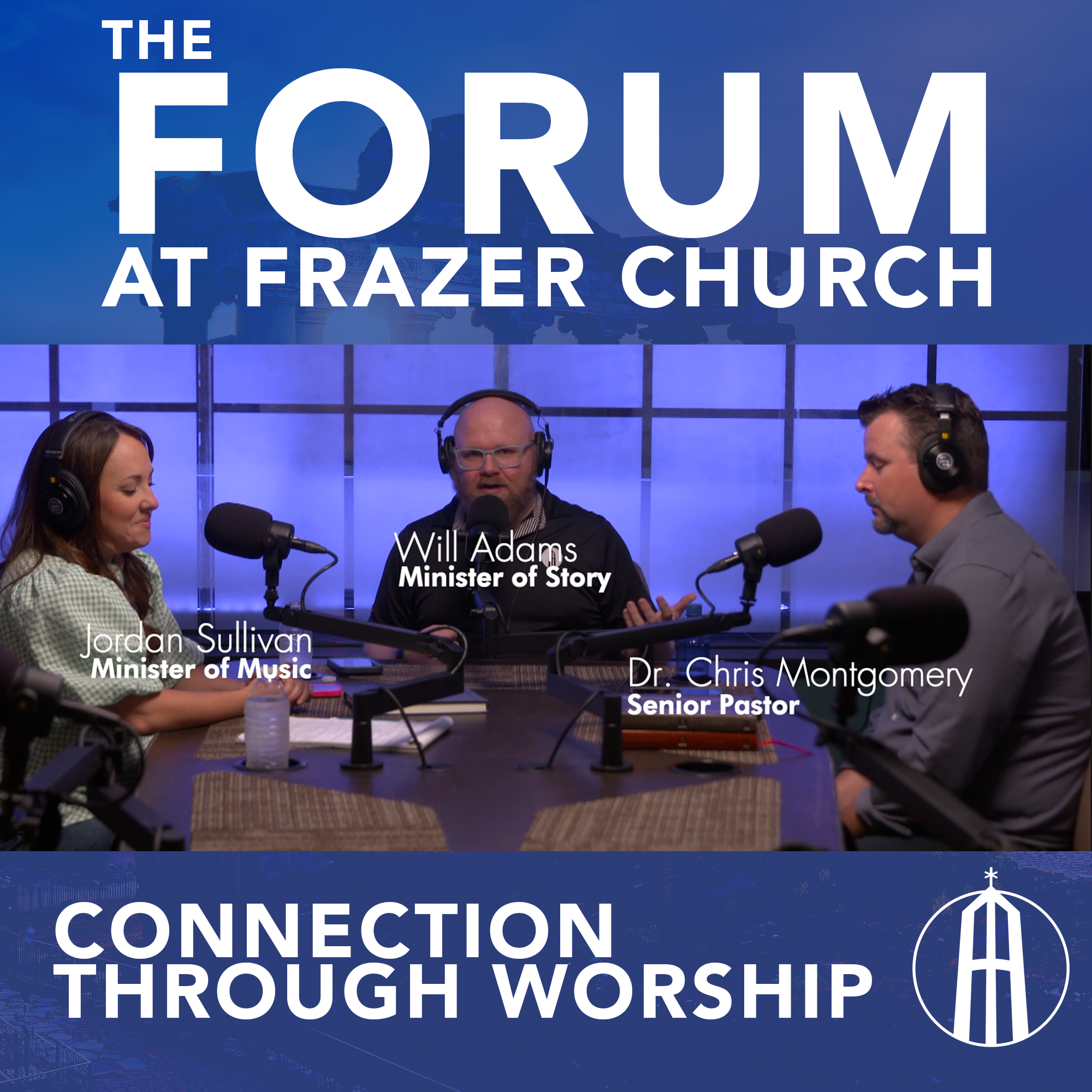
[00:00:02] Speaker A: Well, hello, Frazer family and friends, extended family, thanks for joining us on this, the first episode of the Frazer Forum podcast. I'm Will Adams. I am the minister of Story, Media director here at Frazer. I'm excited to start this off with, of course, Pastor Chris and Jordan. Today we're going to be talking about connection in worship. The Frazer Forum is going to be a podcast with a lot of different topics. We're going to be covering anything that may relate to what's going on with our teaching series and, or anything else that we just want to kind of COVID as kind of an ancillary topic from whatever is, is going on in our church, in our community, in the world. So today we're going to be talking about connection. And I'm just going to ask Chris, kind of, what is connection in relation to the church? How do you define that? What's the theological frame of reference for it?
[00:01:03] Speaker B: For me, and I think if you look at the church throughout history, everything that Jesus was doing in the first century, I mean, God's been doing this with his people since the beginning, but in particular the kingdom, the church, the whole thing is built on relationships from beginning to end. And I think a lot of times in our modern world, we think of church, we think of building, we think of plans, we think of strategy, we think of programs, we think of things like evangelistic effort or, you know, there's a lot of things we tag to the church, you know, and if you're, you know, if your tradition is more socially minded, you know, you're going to have more of a, you know, social action kind of thing. If it's more spiritual formation minded, that's what it's going to be about. If it's more evangelistic minded. So whenever we say the word church, all these things come to our mind and we have to remember what the word church actually meant.
And it's something that, for me, anyway, I spent a lot of time reminding myself and others that whenever we read these words, phrases in the Bible, we, we need to know what they meant then and we don't get to just define them on our own today. And so whenever you're thinking about the church, you're actually thinking about a group of people who are called to be together under the name of Jesus. And so that in and of itself is about connection.
And, you know, the kingdom of God runs off of personal relationships. It's about a personal relationship with God, it's about a personal relationship with other people who are part of God's people. And Then it even plays into our relationships with the world around us.
Because, yes, we as the church, we're about the exaltation of God. That's why we gather. We want to lift his name above every other name.
But then we also do this thing called ministry to believers as well. And we want to edify them, but. But then we do evangelism. But none of that happens without connection, relational connection to people.
And so anytime, you know, people talk about my personality is, you know, well, I'm an introvert or I'm this or I'm that. It doesn't matter what your personality is. It doesn't matter, you know, how much people drain you or give you energy when it comes to the kingdom. All those things may be true, but at the end of the day, it's about connecting with God and with others. That's the great commandment.
[00:03:44] Speaker A: Yeah.
[00:03:45] Speaker B: You know, you can't love God without a connection. You can't love your neighbor without a connection. And so that relational connection is so key and vital. It is the. It's the core of how this thing works.
[00:03:57] Speaker A: And I think, you know, you're making a great point in regards to the word at church sometimes confuses us partially because as I understand it, that that comes from more of a Germanic word which did actually refer to house of God when. When we started using it, Y, which we have come to use that as, you know, we sometimes call the capital C church to kind of clarify what it is we're talking about so that it's clear we're not just referring to a building or something like that.
[00:04:25] Speaker B: Yeah. And even in, like the Old Testament, they. The phrase that's used there is the sacred assembly. Right. It's when. When the people of Israel be called together.
And you see that. You see communion with God from the G. You see it at Mount Sinai, the order of worship, if you will, kind of changes. But there's always this call and response in connecting to God and connecting with God's people. And then by the time you get to the New Testament, you have this idea of the ecclesia there already as well, when Jesus and the apostles are using the Word. And it is a gathering of people, it's a connection of people.
I think a lot of times we, in our very individualistic society, we try to say, well, yeah, I'm the church, and, you know, I can be the church, you know, wherever I'm at by myself. And that's actually not true. You're not the church unless you're gathered in connection with Others, you can be a disciple anywhere in the world. Right, Right. But the church is a gathered thing. Yes.
[00:05:23] Speaker A: Yeah. Well, I think that's a good place to start off from. Now we have Jordan here, who's our minister of music and helps, you know, really determine a lot of what happens in our worship services. And so I think one of the questions that comes out of this is, where does connection come in when it comes to worship?
[00:05:46] Speaker C: Right. So just piggybacking off of what Chris just said.
Our worship, however, is not contained just to the church. Right.
So one thing that we have been talking about, we have a congregational care meeting where we talk about our members who have needs, happy, sad, good, bad in all the things.
And so this is my. I'm almost on year five here.
[00:06:13] Speaker A: Almost.
[00:06:14] Speaker B: You're a veteran.
[00:06:18] Speaker C: So connection in worship for me has changed here. This is just speaking personally, because when I first got here, it was like, learn some names. Learn some names and faces, you know? And so the past couple of weeks, I've been very intentional to look out in the middle of a song, and I'm like, oh, they're going through. They just had a diagnosis that was really hard. And then all of a sudden, that song turns into a prayer over them. And so worship has just really transformed for me the past few months, just. Just getting to know our congregation better.
And I don't know, I'm trying to talk to the choir and the worship team about that, to make it more than just something we do internally and with God, but also with others.
[00:07:10] Speaker A: So one of the images I know gets used a lot in regards to the role of connection is the cross itself.
You have the fact that the cross is.
Has a connection outward, but it also has this connection up and down.
[00:07:25] Speaker B: Yeah.
[00:07:27] Speaker A: And both are important in worship. I think sometimes we think mainly just of it as a connection up and down with. With us and God. And obviously, you know, that's important. Some people even use that metaphor and say, well, the, you know, I beam is longer, so it's more important. Which I think that's stretching that metaphor maybe a little bit. But I do think that there is an aspect of connecting and being in worship together. What's the value of being in worship together when, you know, kind of. Chris was just talking about, you can do it on your own.
So why is it important that we gather as a corporate group that is together?
[00:08:08] Speaker C: We were talking about this yesterday, and I was thinking about how digitally connected we are, and you can be scrolling through Facebook and see people. You live hours away from and feel like you're pretty caught up with them, you know, but then that's just seconds of their life that they have posted that you are seeing highlights. So you are right. That's the highlights. The best picture they took, you know, all year, maybe.
[00:08:35] Speaker B: And it's filtered.
[00:08:36] Speaker A: Yeah.
[00:08:37] Speaker C: And edited. Yes.
[00:08:39] Speaker A: And may even be AI, may not be real to begin with.
[00:08:41] Speaker C: That's so true.
[00:08:42] Speaker A: No.
[00:08:43] Speaker C: So you have no idea. But also, you are not known.
Have you posted lately? Do they know anything about you? Maybe you're just scrolling. You haven't shared yourself.
And we were talking about.
You can be in worship with people that you are familiar with. That means you are also known. And so your church family can look at you and say, is everything okay?
And you're like, oh, maybe not.
And that to me, that's the value. That's why we come to church. We come together as a family and we worship and we're held accountable.
[00:09:23] Speaker B: I love the image that you were using of the cross.
I'm not sure about the I being being longer, but it is the grounding one.
And I do, I do like that image of when, you know, when we are people of worship, individuals, and we're grounded in God in that sense, that's when we have the stability to reach out without everybody else's lives that may be going crazy, making us crazy.
And so there is this vertical relationship when we're on the rock, all these images that the Bible uses.
When we're truly anchored in God, the stretching out then becomes a lot more easy for us. And.
But also, I think it becomes more of a desire for us as well. Because that, you know, being known and knowing others is. Is so, so key. It's so key. It's not even optional.
It's. It's what we do. It's, you know, the over 101 another verses in the Bible kind of thing. Right. It's like he wouldn't. This was not another one, another suggestion. You know, this is just who you are and what you do and that. So that connection piece is huge.
[00:10:34] Speaker A: Yeah, Well, I mean, I think one of the things that we see, I think it's in first Thessalonians that's, you know, kind of this idea of whenever you are praising, whenever you are gathering, there's kind of this assumption like you're. Yeah, it's just, it's an outpouring. It's something you can't even help. And, you know, I've used the image of. It's like a fire hose, like that. It's like it's going to go someplace and you can only direct it. And so that's why I say, like, we're. We're built for worship. We're built for connection, both of those things. And so when we're not reaching out and connecting to other Christians, we're not worshiping God. We're going to find other things that are not worthy of our worship that aren't going to be healthy connections that eventually we're going to kind of latch onto to try to make that work. Right. And ultimately it's not going to for us. You know, one of the things I think we talked about a little bit when we were discussing this podcast, and I'm just curious if you had any thoughts on it, but in regards to connection with our brothers and sisters here at church on Sundays, you know, worship being corporate and all that, one of the things that I think we could talk about a little bit more is worship as a part of home life and both as connection for us to God with our families and also as a. As a fellowship item, as a fellowship option for us with each other among our families.
Do you have anything to add to that kind of thought?
[00:12:06] Speaker C: I hope families are doing that.
For me, personally, I'm loving it. Our kids ministry is so, so good. Our not baby nursery ministry is so, so good. And both kids, one's in nursery ministry, one's in kids ministry. They're both coming home with their own songs every week. Your kids?
My kids.
[00:12:27] Speaker B: Yeah, yeah, yeah.
[00:12:29] Speaker C: They are coming home with their own worship songs every week. So every night before we go to bed, they are singing what they bring home from Sunday. And also we're just. We're a hymns family.
I think about, you know, Christmas Eve, what we did this past year for Christmas Eve. And when Chris was kind of brainstorming for that, he had a very personal story that he shared at Christmas Eve. And we were talking about what does it look like for the family to get together? And we were talking about gathering around your grandmother's piano and singing Christmas hymns. I feel like Christmas is the season where whatever style you prefer, you. You're singing a Christmas hymn at some point.
And just to have that grounding point of worship that your family from all generations can come and say, yeah, we're singing the same story.
[00:13:19] Speaker A: Yeah, well. And I grew up in a. In a family that I know fully know is unusual. But we, we did every. Every road trip was an opportunity to have a little mini worship service. And throughout. And if we were ever traveling on a Sunday we were going to have our own worship service that was before live streaming, so you didn't even have the option of checking out what your church was doing back home or anything like that. So. But we were going to have a full worship service, and let me tell you, Brenda Adams was going to make sure that happened.
And it wasn't even my dad who was the pastor. It was, you know, it was my mom. But having that as a standard of worship isn't something that stays here at this building.
[00:14:07] Speaker B: Right.
[00:14:07] Speaker A: And we leave and then we come back for worship. It's. Worship is something that lives in us, and we take part and we gather up, and it happens as an overflow out of what is inside of us, what is happening in us.
[00:14:24] Speaker B: Yeah, yeah. The. And there are these natural points when it's like, you have a unique opportunity to do this. So, like, Christmas is one of those, you know, it's one of those times when still in our culture, a large portion of the culture are singing the same songs or at least hearing the same songs. You know, you can go to department stores if you do that still, and, you know, you can hear it playing, you know, that kind of thing. And so there are these natural points in which, you know, you just want to seize those opportunities. Now, you can create opportunities for it, too, right? But.
But, like, even going on vacation, it's like, hey, it's Sunday.
This is what we do on Sunday, you know? And I remember sitting in an airport somewhere. I'd been in the Middle east somewhere, and there were three of us there, and it was me and a guy named Jimmy and a guy named Peter. And I just remember Jimmy, who is, you know, like our mentor. He just says, well, guys, you know, like, the sun's coming up or in, you know, sitting there, and there's people everywhere, and we're waiting on the next flight. And he goes, well, it's Sunday.
And I. You know, man, I'm just like, well, yeah, Sunday. He goes, well, we might as well have a worship service. And in my mind, I'm going, right here.
We got a, you know, a couple thousand of our closest friends, you know, sitting around. And he said, yep. He said, well, I tell you what, I'll do this part, and you do this part, and, Peter, you can give us a sermon. And I thought, wow, we're just lacking the offering, you know, at this point. And. But we did. And I remember just sitting there in that moment, we didn't sing out loud. We did pray out loud, but I remember I thought I just had A worship service in an airport with three people, you know, but it was Sunday. That's like. It's what we do. That's who we are.
But there are these natural rhythms in life, too, that come. And that's where I think that book helps you create. The book you got in front of you helps you create moments. You want to say something about that?
[00:16:27] Speaker C: Well, I brought this because I wanted to especially speak to people who are like, look, singing is not my thing. So. And a lot of people, when you say worship, they go to praise and worship in song. But worship can be in scripture, in gratitude, in serving others. It's just a part of you. So, Chris, I wanted you to sort of define worship.
[00:16:52] Speaker A: Good question.
[00:16:53] Speaker B: I think classically, worship is what you ascribe worth to. You mentioned the word worth earlier, and you can do that in a variety of ways.
What is the thing you value that you are now ascribing? Worth to something is an action. It's not just. It's somewhere deep down in my heart, it comes out. It's an expression of who we are.
But you can do that in a lot of ways. Ways like one of the most underutilized ways is in Thanksgiving and just spending time in, you know, prayer, thanking God. Now, we tend to like, again, a natural moment is Thanksgiving a holiday in the US and go around the table. What are you thankful for? But, you know, when you're ascribing that to, I'm thankful for what God has done in this way in my life, that is an act of worship. In fact, it is a prescribed act of worship in First Timothy, chapter two. You know, make sure you do this in the worship services.
And so there are ways in which we do that where we're ascribing worth. It can be praise, but praise does not have to be singing, as you said, it can be spoken. It can be reading scripture out loud, whether it's a psalm or even a portion of Scripture.
And so it's those things we spend time ascribing worth to. That's how I would define worship in that sense. I do think there's a unique way in which the church is called to do that. And there are unique meanings, means, or ways in which the church should do that according to Scripture.
[00:18:17] Speaker A: Right.
[00:18:18] Speaker B: This is what you do when you gather together in the New Testament has a lot to say about that. But worship and a life of worship more broadly in that sense are all those times in which I ascribe worth to God in these different expressions.
And I do that Intentionally.
[00:18:36] Speaker C: All right, so this book, if you're looking for something, if your dad's not a pastor, giving you orders of worship when you're having family worship.
Winfield Bevins. This is called Living Room Liturgy, and it just says a book of worship for the home. And it has different things. I mean, down to. This is why I think it's great for kids, too, for the whole family to do for daily prayer for ordinary life, down to a new pet for loved ones, a meal blessing.
Just good everyday times of the day that you can sit down with your family and say, let's thank God for this. Let's recognize our blessings in this. So if you don't have this, check it out.
[00:19:19] Speaker B: Yeah. And one of those.
Those other times when there are rhythms and something similar to that is the resource Every Moment Holy. This is a really good resource.
I have two volumes. I pretty sure there's more than that. And those of you listening can go look that up.
But this has liturgies as well. And all the liturgy means is the work of the people, right?
It's the work we're doing, what we're doing and ascribing work to God. And I'm a liturgy person. I like liturgy. Every church has a liturgy, whether it's written down or not. There's a rhythm in which we approach God. But what a good liturgy does is give you language. And so this gives you language for, you know, like, there's liturgies of labor and vocation, you know, things like that about blessing and celebration, petition and provision that there's table blessings in here, but also sorrow and lament.
Now, that's where the second one, Volume two, comes in, of Every Moment Holy. Because volume two is about death, grief, and hope.
And I say, you know, you can use something like this in these natural moments of life where grief is, you know, weighing heavy on a family. Death has occurred, but there's also hope there. And that's the language piece that's important to me, you know, because our faith, we have hope. We have confident expectation that God is actually going to make every wrong right.
But sometimes we as individuals don't have the language for that.
You know, it's just kind of like God, we just. Would you work this out somehow? You know, and so what resources like this do in those moments where you're experiencing sorrow and grief? That can come in a variety of ways. And there are a lot of different, you know, scenarios in which this.
This resource can be used. Obviously, seasons of dying, but seasons of grieving. And it goes through this. Just this litany of different kinds of seasons we go through. But it gives you language in the home to talk about these things.
Because I think a lot of times that's why people hesitate, just even in prayer, because they're just not really sure what to say, you know, or they find themselves saying the same things. And that's where I will spend a lot of time, praying the prayers of saints of old. I love doing that because all of a sudden there's a new frequency phrase that'll stick out to me for a season that someone prayed in the fifth century. And, man, it's just so meaningful. And now I have language to do that. Because, again, if I'm going to connect with God and I'm going to connect with other people, you do that through language. That's one of the primary ways.
There's a reason why Jesus is the word, you know, there's a reason why in the beginning, God spoke, you know.
And so it just helps in those. Whether you're creating the moment of worship because it's Sunday or whatever it may be, or you're just going through those natural seasons. That's where resources like this are helpful just to give you language. And if you've never done it before, you know, it can. It can feel a little awkward sometimes. I get that.
But it's one of those things that it, you know, if you kind of press into it again, you can develop new language both to talk to God and in relating to others. So I'll stop there.
[00:22:44] Speaker A: Well, and you can just try it out.
I was talking the other day in your office. We were talking with some of the interns, and one of the things that came up was hymns.
And one of them said, I just don't prefer hymns. And the question I posed was, well, have you ever been in a situation where you were among a group of people your age who were really just engaged, belting out to him?
And she said, no, she hadn't. She hadn't experienced that and was like, you know, yeah, so that's a good point is kind of what she was saying. And I think one of the things that relates to all of this when we're going to connection, connection to others, connection to God, is that our connection to God is strengthened by our connection to others and their connection to God. So when we're sitting in a Simba, whether that is our family unit at home or that is our church family, then we get that experience of being in concert with other believers, whether it is speaking in liturgy, whether it is sitting in silence.
[00:23:49] Speaker B: That's right.
[00:23:50] Speaker A: And listening or singing together, I think that's where we have that moment of connection. And that's where, you know, because I grew up with hymns, and then as the contemporary movement came along, we welcomed the. Those as well. And so I find both of them very much, you know, conducive to connecting to.
To God, connecting to the body of believers. And as such, that's when I say, you know, to people who is like, well, I just don't. I was like, have you been in a place where you have been part of that group that's really been engaging with that and, you know, pretty much all the time, they're like, well, no, I guess I haven't.
[00:24:31] Speaker B: Right.
[00:24:32] Speaker A: And it's like, well, that's where it's like, give it a try. Like, you might find yourself connecting, you know, in a medium that you thought you never would.
[00:24:39] Speaker B: Yeah, yeah. Absolutely.
Absolutely. Were you going to say something about that?
[00:24:45] Speaker C: I was so glad Will walked in that day because I, you know, this intern has just not experienced traditional worship and. And she's learning about these hymns. And when you said that, I thought, oh, that's such good perspective.
Another thing I was thinking about as you were talking about these books yesterday, you said, you know, when you're in a worship service and you look out and you see someone who is walking through something so hard and their faith is so strong, it strengthens your faith and in song, too, you know.
[00:25:16] Speaker B: Yeah, good. Yeah. When you look at somebody who's walking through something and you, you know, you know them, they know you, you know what they're walking through, and you.
There are moments when I will sit back and I'm thinking, and they're still singing that song, you know, about how good God is, you know, or his faithfulness.
And that's where, you know, whether it, you know, we'll have to do a whole other conversation probably at some point about, you know, what. What we call modern worship and all that, you know, but when you're singing good theology and when the people are singing it like they believe it.
[00:25:52] Speaker C: Yeah.
[00:25:53] Speaker B: There is nothing more lifting. I mean, it's amazing. And. And that's what. That's what you want unbelievers to walk into the worship service and they may not believe, you know, but they go, man, these people do believe. And I think that was the whole Benjamin Franklin, George Whitfield thing. You know, it's like they asked Benjamin Franklin, why are you going to hear George Whitefield, you know, preach? You don't even believe that stuff. And I think it was Franklin who said, you know, no, I don't, but he does, you know, and that's. That's the thing.
So we get really caught up in is it new or, you know, this label contemporary or is it traditional, whatever that means, you know, depending on your tradition.
But I think it's about, you know, singability, number one. You want people to be able to participate in it and sing along, but then when they really do sing from, you know, their heart and even in volume when they sing it out, you're just like, wow.
Wow.
[00:26:53] Speaker A: Yeah.
[00:26:53] Speaker B: So.
[00:26:55] Speaker A: Well, I think that's a good place for us to kind of wrap it up, you know, this week being able to sit and talk about worship. I think it will be a nice lead in to next week when we're. We're going to be talking a little bit more about the discipleship aspect of things with family, kids, a little bit, and what connection looks like in that aspect. So be sure to join us next time wherever you get your podcast. Subscribe. Leave us a review that actually helps it get around. Until next time, we'll see you.