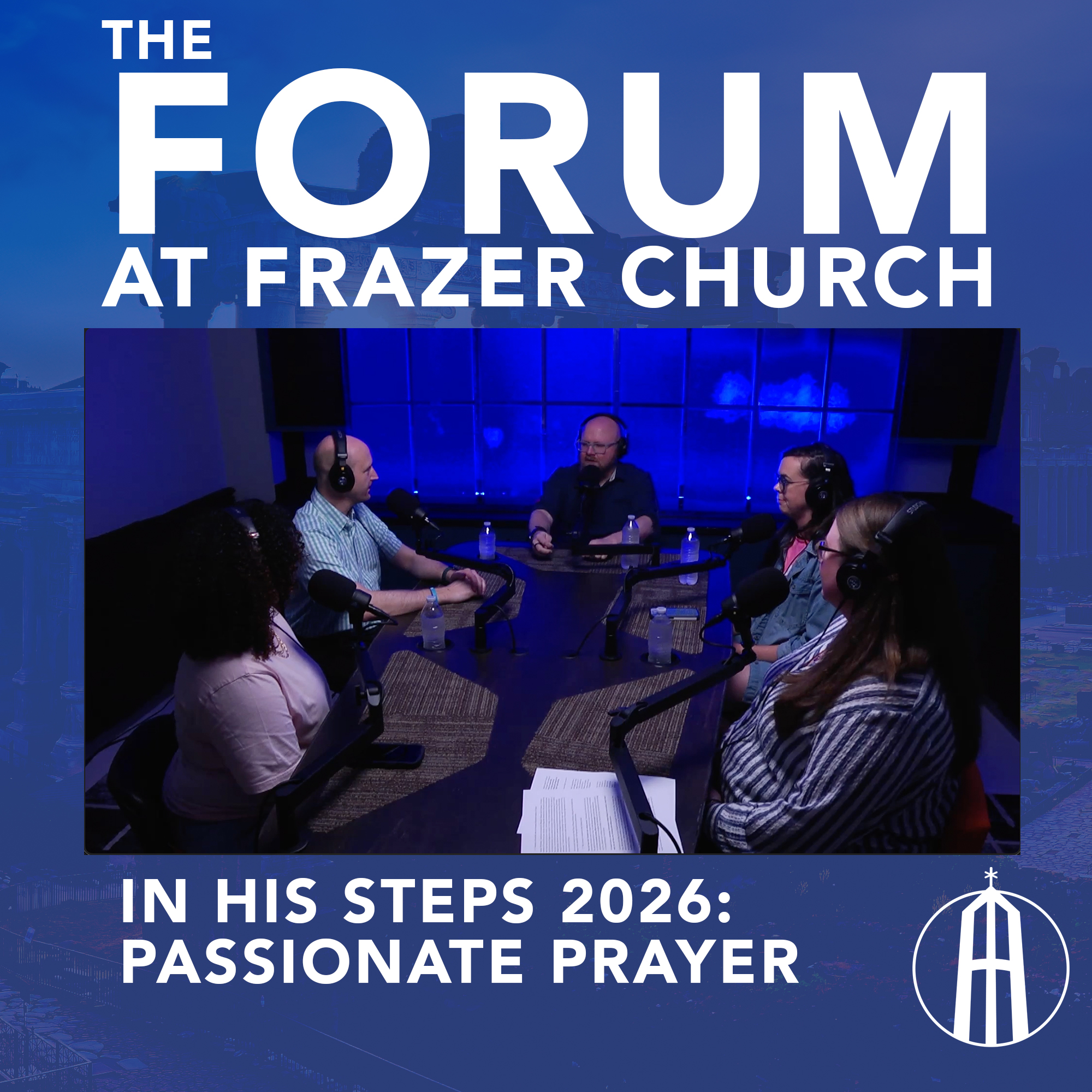
[00:00:00] Speaker A: Foreign.
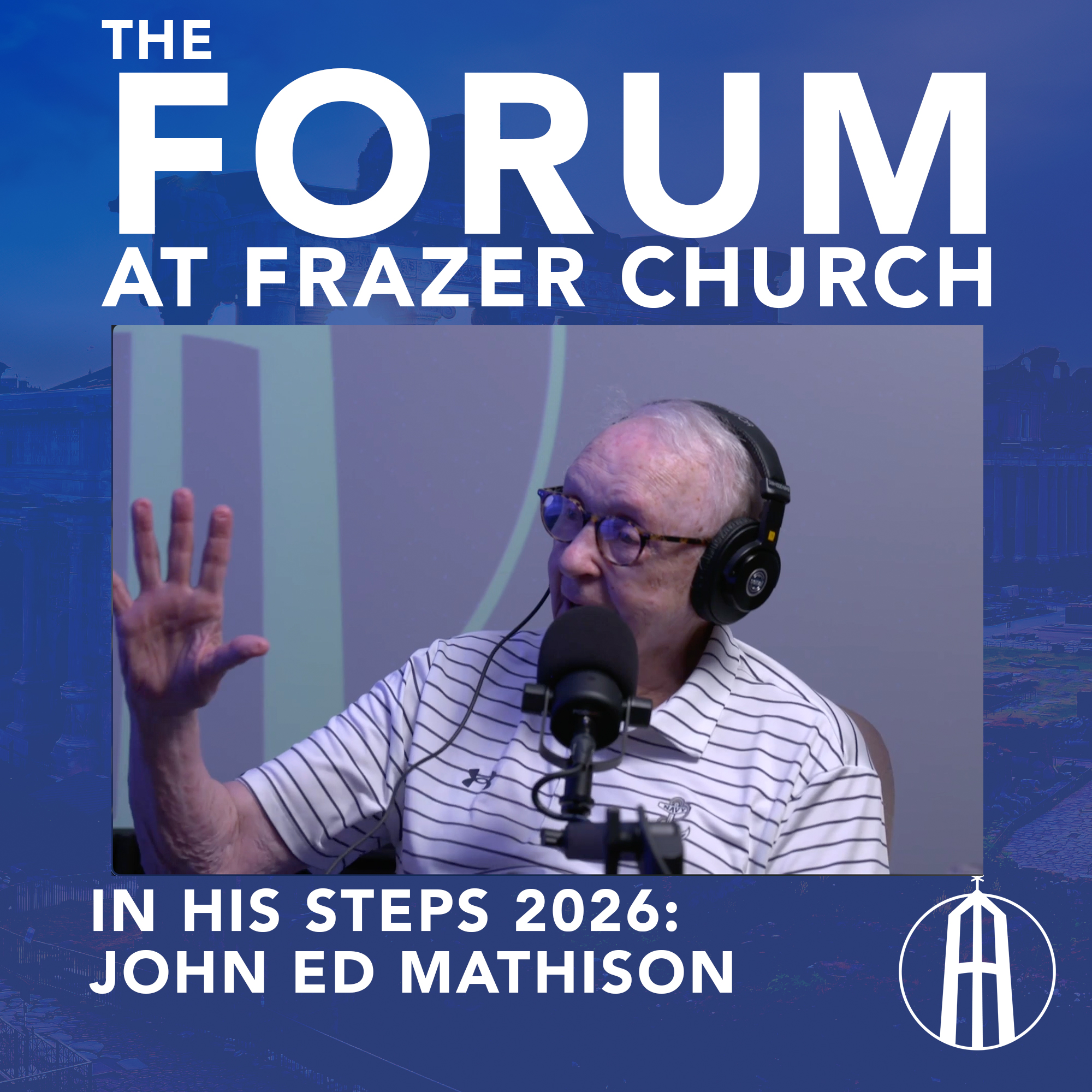
[00:00:05] Speaker B: Mercy and peace. In the name of Jesus Christ our Savior. And welcome to another episode of the Forum podcast. I'm Will Adams. I'm the minister of Story here at Frazer Church, and I am honored and delighted to be here with none other than John Ed Matheson, the pastor emeritus at Frazer. Those that have been part of the Frazer family or even kind of distantly related to us know this man well. He truly needs no introduction. One of the things, though, that I love about John Ed is that he's truly humble. So if I start, like, gushing about him right now and talk about how great he is, he's going to come up with a joke to deflect it or tell me about how it was all actually done by his staff or all of the volunteers and everything. But the basic of it is that John Ed showed up here back in the 60s and stayed through 2008. Was it?
[00:01:00] Speaker A: Right?
[00:01:00] Speaker B: Yeah. And that's when the mandatory retirement age hit and so left at that time. When he came, there were, like, a couple hundred members here at Frazer When he left, there were several thousand, so. And here we are still rocking and rolling today, largely thanks to your continued influence, I would say. And I just want to say I appreciate John Ed so much as.
As a friend and even a bit of a mentor. I feel like everyone feels like if you meet John Ed, you get to be his friend. So just honored to.
Thank you so much.
[00:01:37] Speaker A: Well, thank you. Gosh. Is it. You talking about me?
[00:01:40] Speaker B: Is it? Okay?
[00:01:42] Speaker A: I'm not.
[00:01:42] Speaker B: This is what I'm talking about.
[00:01:43] Speaker A: No, I could not. That's a. And let me tell you, one of the greatest things about the 36 years I spent here was preaching on a camp meeting over in South Georgia and meeting a district superintendent who told me, you know, I've got a son finishing Asbury, and he's quite good in media, and he's actually at the Olympics now, along with other folks. And I said, well, when's he coming in? I said, well, it'll be a day or so. I said, I'm going to stay over a day. I would like to meet him. So I stayed an extra day to meet Will Adams. And then that's where we began talking. And through that, eventually you agreed to come to Frazer.
[00:02:20] Speaker B: Right.
[00:02:21] Speaker A: And that was one of the best things that happened. You know? God, one thing I'm looking at, doing a book next to you, tracing back of how sometimes when you do something in life that you don't really shouldn't be doing, or it's an extra effort or maybe you shouldn't do it all of a sudden. It turns out sometimes to reap the biggest benefits. Yes. Of which this is one. But, you know, to stay there, to meet you and to what you've done here through, I mean, this studio. I mean, I can't believe this. And this was your dream. And.
[00:02:52] Speaker B: Well, you're, you're very sweet to credit me. You know, just this last week, we recorded the episodes of Frazier365 that will been played by the time this airs that where you go through several different important lay members of Frazer who helped to start various ministries. And so Jerry Kemp, I always want to mention him anytime that we're talking about what goes on in here.
A lot of it was his vision. And I, I stand on his shoulders as, as where? Well, as many other great folks and volunteers that have worked here to help make the television and media ministry. I say media ministry now because we do tv, but we also do podcasts and of course, a lot of different Internet video.
And it really goes everywhere now. And a lot of that is thanks to the, the vision of both you and the lay leaders who helped to start the television ministry many years ago now.
[00:03:58] Speaker A: Right. And God opened the door. But the one thing that's characteristic of this church, if a door is open, see it, walk through it, and then do what God's called you to do. And television was just one of those things. And it started out on just a station here in Montgomery, and we had to tape the early service. A guy got in his car and the police led him on the highway and he ran the tape over to the TV station. Had to get it in there. Get it. He had 25 minutes to do that. And then it was shown, quote, live.
[00:04:34] Speaker B: Yeah.
[00:04:34] Speaker A: And then we advanced from that to another station and I mean, it went on to the, the television ministry at one time was reaching people all over the United States and other places.
[00:04:47] Speaker B: Well, and, and I will just say today, and I, I don't know that I. Our congregation is fully aware, but because of Greater Love TV and their expansion, because they've only recently gotten onto DISH Network and which is available all over the world, our reach is very far, both on television.
[00:05:09] Speaker A: It's every week, too. Frazer Message will go out all over the world.
And let me just say, some places missionaries can't go, there's no place the Internet can't go.
[00:05:21] Speaker B: Yeah.
[00:05:22] Speaker A: And this is the great mission field for using it. So I'm glad you're in charge of that. Oh, well, bless you, you're going to move forward.
And thank you for also some of the things I'm doing. We'll talk about later. Yeah, you've been. You are being so very, very helpful there.
[00:05:37] Speaker B: Well, thank you.
Well, I wanted to have you on as kind of the, the closer of our. In his steps month.
So we've talked through kind of what has been the DNA of Frazer for many years, that prayers, presence, gift, service.
And so I wanted to kind of bring it around to kind of asked some questions that I realized as I was thinking through this. I've never asked John Ed this, or at least I've never heard him respond to these specific questions. And the first one is, what does the word church mean to you?
[00:06:15] Speaker A: Well, that's an interesting word because it's thrown away around in a lot of different ways.
[00:06:20] Speaker B: Right.
[00:06:20] Speaker A: And my best definition of church is to spell it C H, U, R.
And church is those two center letters. You are.
People think about a church being a building. People think about a church being a program.
People think about a church identifies with some personality, some pastor. That's not really. The church is the people, the people of God.
And that's what I love that so much. The emphasis here and the hole in his steps.
Every member is so important in the life of the church. And you know, it's like a chain link. It's no stronger than the weakest link because it can break there. So I just appreciate the emphasis of in his steps and giving us all a chance. But church is about people.
And everything about church relates first to Jesus and what God has constructed us to be. But then it has to be people oriented and sometimes we get sort of mixed up. A great thing I learned in seminary when I did a graduate degree at Princeton and heard a man speak one time and he said, if you divided up everything into two categories, people and things, people are to be loved, things are to be used.
And most problems occur when you reverse those and you use people love things.
[00:07:46] Speaker B: Yeah, that's good.
[00:07:46] Speaker A: Now let me say church easily does that. Now, we would say, oh, no, we wouldn't do that. But a lot of times churches use somebody to get somewhere and instead of loving people see them as people that ought to be doing something. But every person and the unique value God loved and created and cared for, he lived and died and rose again for every person. And the church is. You are C H, you are the church.
[00:08:14] Speaker B: Yeah, no, I mean that's, that's a very good, simple way of putting it. Just you're talking about the the church being the people.
That of course, is very biblical for those that have done a word study on what the word that is in the New Testament, that ecclesia or ecclesia, however you want to pronounce it. And, and it just means a gathering in the. Of people. That's really what it gets at more than a particular location or a program or a worship service or anything like that, that most of us in the American church to associate it with an institution or a building.
And it is really intended to just be that. That core group people.
And the way that Pastor Chris puts it, I think that is kind of in the same vein as what you're saying is that the church runs on relationship and that it's about that people in the way that they relate to one another.
So I think.
I think that's a really great way to look at it.
[00:09:18] Speaker A: And I love the. In his steps because in his steps brings the focus down to Jesus. And we, every individual people are going to put our feet in his footprints. We're going to walk in his steps, which brings the whole idea of church down not to buildings and programs, but to people in what each of us do. And let me tell you, Frazer is so blessed today. I couldn't be happier about what's happening here at Frazer The great leadership, Chris and you and all of the staff and to be engaging now this month to get every member to be a part of the church.
If we had this building out here and you had some bricks missing, it would look bad in the church. Nobody ought to be missing. And we're going to talk about that in a little while too.
[00:10:05] Speaker B: Well, I mean, that kind of brings it into. You talk about the way that the leadership. But really the thing that I've seen, because I've been here a little while now, I've. I've been here, you know, it'll be 18 years this November that I've been working at Frazer which is hard for me to believe. But I. One of the things that I would say is very true is that no matter who has been kind of making plans in. In a leadership capacity at Frazer the people have always been really who Frazer is.
It's not just, you know, one individual. As much as it's important to have great leadership, One of the things that I've seen again and again is how much our laypeople are really willing to do the work of the church. And that kind of brings me to that next question, which is what does it mean to be a member of the Church.
[00:11:08] Speaker A: Well, to be a member means a commitment to Jesus.
And the church then becomes the place where you incorporate that commitment with a group of people. And it involves humility.
I'm going to be here, I'm going to serve, I'm going to give and I'm going to be engaged.
And the world is hurting and the church, the task is to meet the needs of people in the name of Jesus so that one day he can say, you saw me hungry, you saw me without clothes, you saw me in prison, all of these things. When did we see you? Inasmuch as you do it to one of the least of these my brethren, you've done it unto me. And that's what the in his steps does. It highlights, it brings to a different level what it means to be a member. And when I'm a member it makes a difference. And hey, I love doing those with you about serving. And there were about seven, I've forgotten how many. Seven different Seven. Yeah. And they were all people. Now listen, every one of those were individuals and there were people and probably when they joined, nobody knew who they were. Nobody would have said, hey, you going? But I shared the unbelievable things. I got to thinking somebody's going to say, well I can't do that.
God can do anything. And each of them is an example of what God can do. When we are a real member and under the inspiration, the prayer and the support of the Holy Spirit through the church, look what can be accomplished.
[00:12:49] Speaker B: Yeah, no, it's incredible because the church coming together as that gathering, there's kind of, I've heard it called Godmath that happens where one plus one equals 10,000 and we're having all the things that we could do separately are just exponentially increased when we are together as the church.
And I'm reminded of the passage where Jesus tells the disciples that they will know that you're Christians by your love. And when I think of church membership, how that loving one another is such a unique and defining trait of membership in the church, such that it creates that, you know, what we call fomo. That fear of missing out. I feel like Christians were the original FOMO creators is like when man, you look at that group of people and they're just so dedicated to loving each other and caring for each other and meeting each other's needs. I want to be a part of that. I need that in my life.
And that is what the church in essence is supposed to be, is, is that to some degree tight knit group of people that is able to love One another to the point that other people want to be a part of it and that it is welcoming to other people in that same sense.
[00:14:23] Speaker A: Darrel. And if I could just use a simple couple of sentences about what it means to be a real member.
Real members get the audio and the video to match.
[00:14:35] Speaker B: Okay.
[00:14:36] Speaker A: And a lot of folks have a lot of audio, but their life doesn't match it.
[00:14:40] Speaker B: Oh, gotcha.
[00:14:41] Speaker A: Yeah. And a lot of folks are saying, well, I want to have this live, but I'm not going to do all it takes. But when the audio and the video match, that's what becomes a disciple who is walking in his steps.
[00:14:54] Speaker B: Yeah, yeah, absolutely. When what we do, our actions are matching our words.
Because a lot of us are good at talking.
Talking the talk, which typically is a little easier than walking the walk.
[00:15:15] Speaker A: That's right. And those have to match. I saw the other day, I thought of this.
Some people have to say something, others have something to say.
And genuine, godly people have something to say and to do.
Again, back to in his steps. This is. This is the thing that brings us all together. So everybody's actions will be different from everybody else's. Yeah, but the theology, the talk, the belief is the same. But then it shows how we match that up in life. And this is an exciting time for
[00:15:53] Speaker B: Frazer Yeah, no, I agree.
I think that kind of. That rolls into the next question nicely, which is in, in what ways, in what practical ways could a member of the Frazer family be a light for Christ in our community? You know, one of the things that we're kind of looking at emphasizing more in the next season is evangelism.
And so an evangelistic standpoint and a service standpoint, how can we practically be a light for Christ?
[00:16:28] Speaker A: Well, let me say this church, calling on and giving people a chance to become real members through. In his steps and making our actions and our.
What we do and say walk and our talk together. Yeah, well, what that really does, it begins to shape in this community.
People look and they see that.
And, you know, one little light can erase a lot of big darkness.
And what this church is doing is forming little lights all over the place. Now, there are different size light bulbs and there are different ways that we light, but when everybody is the light of the world and the salt of the earth, that makes a difference. And let me tell you what I really love about Frazer A lot of times, even in my life, I'd be in places and to be a truly godly, humble person who talks the talk and walks the walk, everybody Says, well, that's abnormal. I don't ever see that. But one thing I love about phrases, you're taking that radical discipleship and making it normal.
And, you know, and many people. One thing that's attractive to people to come to Frazer is, wow, you people are for real.
And I want to be a part of that. And, you know, there's always somebody that can. You don't have to be carrying a Bible under your arm and doing all of this. I used to think you had to do that when you were in school. And there's nothing wrong with that.
[00:17:59] Speaker B: Yeah.
[00:18:00] Speaker A: But the important thing is it becomes normal and radical, radical discipleship becomes normal. And when that does, that is the light.
I mean, that's a bright light. That is the salt of the earth, and that is the witness. And people bring people to Christ. I mean, that's it. The secret of this church is growth. We used to ask people, how did you know about the church? Why did you come?
And, you know, we had television. We had great location, marvelous music, television. I had. Maybe some of them would say the preacher, but nobody ever did. Seriously. I don't know about that, but 90% said, I came because a friend or an acquaintance or a family member, somebody invited me. And people would ask me, what's the secret of how the church grows? It's not a secret.
People bring people, and all you've got to do is read, as we've been doing in his steps. You know, when Andrew became a Christian, wow. He went and got his brother Peter, and then all of a sudden they went and got Nathaniel, and people started getting people. And that's what makes a difference in a church. People become real members. Not when they see the church as a place to come and sit and soak, but a place to go out and serve.
And the church does. Feed me. We don't need to be wearing bibs to church.
A lot of people come. What's in it for me? Feed me. What we really need is an apron where we put it on to go out to serve. And that's where the real joy in life comes. And that's what distinguishes real light and real salt and real genuine discipleship is when we go out in the name of Christ, serve, invite, and bring people to Christ.
[00:19:55] Speaker B: Yeah, well, I know.
I love that. I've heard you say that several times recently. You know, we're written in an apron instead of a bib. And I think that's a great way of putting it.
Another way, I've heard it put by a mutual friend of ours, Jim Cowart, who's over at Harvest church in Warner Robbins, Georgia.
He has a big thing in the culture at that church where he says, harvest is not a cruise ship, and the people will shout back. It's a battles.
And it's the same kind of thing of this is. This isn't just a pleasure voyage. This is a strategic mission that we are on together out here to accomplish certain purposes that we're not just lackadaisical about it.
[00:20:41] Speaker A: Right. Well, you know, if you think about a ship, if it stays in the harbor, it's safe, but it wasn't built for that.
And the church wasn't built for staying in the harbor or going on a cruise.
The church was built to go out and take a risk. And, you know, Indian Steps illustrates this so well. There are three kinds of people in a church. You got risk takers, you got caretakers, and you got undertakers.
And most churches are filled with undertakers. And do you realize that we now have closed more churches in the last few years than we have?
Undertakers are really good. And caretakers don't want to change anything. Let's just take care.
That's not what Jesus called us to do. He called us to take a risk, step out of the boat, be willing to go. And all those missionary journeys that Paul and Silas and all of those guys took, man, they left and they went out and they risked death and everything else, but it's the risk that pays the biggest dividends.
[00:21:48] Speaker B: Yeah, no, that's.
That's a great point. And I. I know that's something that we've been talking about among the staff lately is how do we recapture and. Or better maintain that pioneer spirit that you're talking about that isn't just holding on to what it is that we have or. Or even worse, just killing it outright.
But how do we use it as a point from which we take off? You know, I think of the image of a relay and so much of life where when we take on a role in an existing space, whether it's a role in a church or a role in at work, or even to some degree, from generation to generation within our families, we are passing a baton. And we have to deal with where, wherever we are, when that baton gets passed, if we're ahead or behind in the race, you know, if we're behind, then, hey, we've got some space we got to make up. If we're ahead, then we don't want to blow our lead and mess up what the person right before us worked so hard to do to hand us that baton. But either way, we just got to deal with where we are in the ra, what leg we are. We gotta grab that baton tight and just get moving. And I think, you know, that some of that is. Some people want to look at it and complain about, oh, well, I'm not as far ahead because of, you know, who handed me the baton.
When in reality, it's like, well, there's nothing you can do about that at that point, move forward. And I feel very fortunate in that. We at Frazer we got handed a really great baton in a lot of ways.
[00:23:36] Speaker A: And when I came here, I got handed a great baton.
The people before me, they dared to come out and everybody told them, you can't do it. Let me tell you what godly people do. They don't listen to the folks that say, you can't do it.
If somebody says, you can't do that, that's their opinion, not yours. And in the church, we need to have selective deafness where we don't hear that stuff so much. Young people need to do it. We need to put sales, not handcuffs, on our young people. We need to let folks see, hey, look, what can be. And let me tell you, the greatest danger in the church and in life. I think the greatest danger is to succeed at something that doesn't really matter.
And some churches succeed at something. And the heart of the church is what you were saying is evangelism.
We were commanded. It wasn't a suggestion. It was a command to go into the world and to share the good news. And the church gets away from that so easily.
[00:24:39] Speaker B: Yeah, yeah, I've heard it said, you don't want to climb the ladder of success and realize the whole time it's been leaning against the wrong wall.
I think there's a lot of different ways. It's quite funny because I remember hearing an illustration about that. If you can imagine a situation where somebody set up a factory in a location to build something, and then after a while, they realized they put the factory the completely wrong country.
And then everyone working at the factory might turn around and say, well, we're making progress.
And that's the danger. Right. Of getting so far along kind of in the wrong direction, then realizing, you know, we. We actually. We've put in a lot of effort, but we gotta. We gotta take a step back.
[00:25:26] Speaker A: Yeah. One of the things we have to be careful about in the church is to hear. Want to hear our peers say, hey, good job.
What we really want to hear is our heavenly Father Say, good job.
[00:25:38] Speaker B: Yeah.
[00:25:39] Speaker A: And that's what makes the difference in the world. And that keeps us sharpened on our priorities and where we're going. And, you know, I love in his steps because it brings us together to do something, make a commitment in a specific, just, let's just say service, specific place I'm going to serve. In fact, it's pretty good thing to remember that even if you're on the wrong road, if you sit down, you're going to get run over.
And a lot of churches might say, we're on the right road, but we're going to sit down. And when you get to where you are, where you going to be, you got to always be moving on towards the perfection. As Jesus taught it, that we have to be moving in that direction. And the church, if the church doesn't measure something, it becomes unimportant.
And I love it that this church measures some things. A metric system that really makes a difference. Yeah.
[00:26:41] Speaker B: You know, when you're talking about that moving on towards perfection. And that, of course, is a. It's a Wesleyan term. That is John Wesley, who is the founder of the Methodist movement, and all Methodist and Wesleyan churches can kind of trace their spiritual lineage back to a lot of his insights.
And one of the things that he said, kind of the way he phrased the Christian walk, is that idea of moving on to perfection.
And perfection I think we can shy away from because of course, then it starts to. We start to think of perfectionism in the human sense, but we really mean completion in the biblical sense of perfection in the sense that being the way you are intended by God.
But I just think it's interesting, like you're saying that whole idea of you are constantly moving in toward that.
In some ways you're never fully done. And Wesley recognized that. And that's why he didn't say, are you perfect? It says in this, you know, are you moving on to perfection? That was a big part of the ordination vows in the Methodist Church. And so that idea of, are you moving on to perfection?
[00:28:04] Speaker A: And you know, a lot of us don't want to be graded. I mean, you know, I just saw the other day there are some universities right now that for the freshman year, they won't give grades because it creates bad mental health. Now, I can't relate to that real well. But, you know, if you don't measure it and we're going to be doing something, let's just take the financial part. Everybody will make a financial pledge.
Now a lot of folks say, oh, I don't want to measure that. Well, if you don't measure, that really means you're not doing what you ought to be doing.
Let's take membership. How many members?
Well, that's important because every number is a person.
And I think we need to measure that and report it. And then in his steps, we're going to do that. How am I going to pray? How am I going to serve? How am I going to attend worship? How am I going to serve? That becomes specific. And without specific being specific, sometimes we just don't do anything. Yes.
[00:29:07] Speaker B: Yeah. No, I mean, these things don't happen on accident. I said this in the radical generosity episode a few weeks ago. You don't accidentally trip and have a percentage of your income land in the offering plate.
And it's true of everything. You don't accidentally end up in a habit of prayer. You can actually end up out of a habit of prayer, but you don't up end. You don't, like, accidentally end up in a daily prayer time that requires intentionality. You don't accidentally end up going to worship every week.
[00:29:44] Speaker A: I love the word intentionality. That's what In His Steps, intentionality, about the things that create radical discipleship.
[00:29:51] Speaker B: Yeah, yeah. No, that's. That's a great way of summarizing what our In His Steps ministry gets at. When, you know, we every year come back to the questions of, okay, we've identified these building blocks of discipleship. How are we going to once again surrender to God in these areas of our life in these areas of service, of prayer, of worship, presence, really? Which can be both worship and discipleship and giving and, of course, service.
So I think we are very fortunate in the fact that we have an intentional culture at Frazer that works on those things yearly through the In His Steps ministry every year.
[00:30:40] Speaker A: And you know, what's one of the greatest things being a pastor is when somebody leaves and goes to another church somewhere, a different state. I've had a while. The pastor said, john Head, let me tell you so. And so they came and they joined the church.
And the first thing they ask is, where's my commitment card? I said, I've never heard that. I mean, the people from here, when they went, well, where is my commitment card? That was expected. And I like that word culture because you create a culture where, hey, this is what we're about in making radical disciples.
[00:31:15] Speaker B: Yeah. Oh, yeah. And I don't know who said it first, but I remember years ago hearing somebody say that culture eats vision for breakfast.
It's great to have vision. I mean we have through, you know, have lots of language that we put to our vision and our strategy here at Frazer and have had different ones for the years and they've all had great merit and have helped us move along and I think that's great. But it's the culture. Culture is really what determines the direction you're going in. And that again, that's that intentionality.
The I think the difference between something that's just a vision and something that becomes your culture is intentionality.
It's when it's like, hey, we are doing this actively. We're already doing it on a regular basis. Yeah. I want to ask you one last question and I think there's a lot of different things you could talk about. But just in brief, for those who don't know, can you update us on what you are up to? Because you're always doing a lot of different things and I, I think it's funny that of course there's a lot of folks that are in their retirement that well, they, if they're going to hop on a ship, they're going to hop on a cruise ship, not a battleship. And. But I feel like you are still on a, a battleship that is going in a lot of different missions in a lot of areas. So tell us about those.
[00:32:49] Speaker A: Oh, great. Well, thank you, thank you for giving me that opportunity. When I retired we formed a non profit and had a board of directors. And the people I selected are strong people. Some of my buddies said, man, you don't want get people that are going to let you do what you want to do. I said no, I want board of directors who are strong.
And we joined. First thing we did was join ecfa Evangelical Council for Financial Accountability.
Most many nonprofits. You don't know where the money goes. When I was here at Frazer, we got to the point where if somebody came and wanted us to support them in missions, if they weren't a member of ecfa, we didn't support them because you had no accountability or it took a lot.
It wasn't easily accountable. ECFA does that so we function that way. I got involved with Dr. Bill Bright and starting millions of churches and winning 1 billion people to Christ.
[00:33:45] Speaker B: The Billion Soul Initiative.
[00:33:46] Speaker A: And then that was about 10 years. I went to India and to all South America and to different countries and we reached that goal, starting 5 million churches and a billion new believers. That was very exciting.
But then I write a book every year. Every year. I don't know why I made that statement. I Should have never made it. So people hold it to me. So I just thought, in retirement I'll do that. And I wrote a book on change.
And if you don't change, you go out of business, whether you're talking about sports, business, church or anything.
And so my wife then asked me about a year later, when are you going to read your book on change?
I said, oh, my goodness. Oh, wow. And so rather than traveling so many places and gone and you know, I said digital ministry. And I didn't know how to spell digital, but, you know, just wait and said, why don't you do a film? You know, do a one minute. Got a minute. Yeah, we named it and I said, nobody will watch it. Let's try it. So we did. We had 21,000 people watch it. It blew my mind. I couldn't believe it. So I said, wow, you can reach more people through digital platform ministries. Yeah. So, you know, we now do that every week.
Now it's really sort of geared to Methodist because we got a chance. Short attention span.
It's a minute long. And then I started doing all these radio things. A minute, 58 seconds. So every day I write and produce a new 58 second message on multiple radio stations. But we also let people sign up and anybody can do it on my website and they'll come to your phone every day. And we have thousands of folks that do that. Then I started writing a blog and several newspapers picked it up. And that's been. You don't ever know where that goes. And we have thousands of people we mail out to.
It's just become the thing I dislike most about the ministry was you had to write so much.
And guess what? I'm spending most of my time now writing. And God has a sense of humor.
[00:35:56] Speaker B: Well, we appreciate that, John Ed, though.
[00:35:58] Speaker A: But it reaches a lot of people. And then from there I started doing a job. Great. Good news. It's a short thing. During the pandemic. Here's some good news. And so I intended to stop when the pandemic was over, but we had over a thousand folks every day watching it. So I still do it every day. The good news.
And then I started a podcast. And you've helped me with that so much, and I can't tell you how much I appreciate that. We've done that for a year and a half and that's just. Just a different whole different way.
Like this podcast.
[00:36:32] Speaker B: Yeah, well, and we. That was part of the. The reason why I wanted to create this room is so that we could not Only do this podcast, but also better facilitate the one that you're doing, right?
[00:36:46] Speaker A: Well, you know the one I did recently with Katie Britt, Senator Britt, dynamic Christian coaches, the presidents of three of the universities here, and young people. How do you navigate things? It's just ways to communicate. So I do all of those. Now. Anybody can sign up on the website and they're. They're very briefly done. And if you just go to there, you can do that.
Now the good thing about it is if you don't like it, all you gotta do is hit a button and it's gone. It's gone forever somewhere out there in cyberspace.
[00:37:16] Speaker B: And that one's called Go Getters and Go Givers.
[00:37:19] Speaker A: Yes, Go Getters and Go Givers. That's the podcast, and it's about 30 to 40 minutes long.
But let me tell you, I had a man stop me today and said, hey, I watched that podcast you did with the coach and wow, it's made me become a better coach.
And so, you know, you just reaching a segment of people. And so right now we had to hire. It's very expensive. We had to hire people who know now I write everything, I record everything, but then we give it to people who know how to put it up and out and in the places. And they told me just recently we've had right at 3.8 million people in the last year that have tagged into some part of the ministry. Now think about that. I used to think television, gosh, that's so much. But now here's a different avenue and God's just blessing it. And I'm 88. I'm looking for forward to every day. I look forward to seeing God change lives. And it's just I do a lot of men's conferences. I do a lot with athletes and coaches, but life couldn't be. Couldn't be better. I just am very, very happy and you know about what we're doing. Lynn has a great business. She's a decorator.
[00:38:37] Speaker B: Your wife.
[00:38:38] Speaker A: You're right. And she is just unbelievably good. Yeah, she is very fulfilled in that. Our grandkids are just amazing.
[00:38:46] Speaker B: We could. We could talk about your grandkids.
[00:38:49] Speaker A: Oh, yes.
[00:38:50] Speaker B: Another length of podcast.
[00:38:52] Speaker A: Well, longer than that. Yeah. But God is just.
[00:38:55] Speaker B: You've had some of them on your. On your podcast.
[00:38:58] Speaker A: My granddaughter is, after she finished at Auburn, never made a bee.
I never made many bees, but she made all A's. And now she's finished with master's in theology and wants to get her Doctorate and become a teacher in a seminary Christian school. And she's a great speaker. She and I do some of those things together. And all of our grandkids, they are looking at, where is God going to use me? And that's the best thing that can be.
I'm just excited and I appreciate Frazer and just my eyes become more and more open to things today that are going now it's a real. I have to record something. I record about 40 messages a month that are brief and they're done, and then several videos.
And God's opened so many doors. Yesterday, I just.
On ESPN the Ticket radio.
[00:40:03] Speaker B: Yeah.
[00:40:04] Speaker A: They do Friday night football and then Saturday college football.
Would you do a devotional?
Briefly. And so we'll play it every one of our broadcasts. That's twice a weekend now. That's a whole different audience. Those are sports folks. Sure. But you get a chance to speak. God has just opened doors. And I just asked your folks watching this to pray for me that I would be sure to go ahead and walk through it. Wow. And you know, it's interesting thing I learned too, people always say, financially, how do you analyze?
We don't make any decision based on what it's going to cost. If God's leading us and if God will try, if we can't pay for it, we'll quit doing it.
But a lot of people start out, oh, let me. How much does it cost before I decide? If cost determines what we're going to do, we'll be money driven. But if we're mission driven and there's some things we've had to stop, I mean, we just. But they're different. But God is in charge of that.
[00:41:12] Speaker B: Yeah. Well, I just.
We could talk for a lot longer about things you have done, but I wanted to give a moment to talk about things you all are doing, because that's one of the things that I just so appreciate about you, John, is that as you have continued on in such strong ministry and have encouraged everyone else to do so even far into retirement, that's an inspiration to all of us that are working in the kingdom or attempting to, because I think that's a great example. I think you set a great example.
[00:41:59] Speaker A: Well, I think retirement can be for churches, the biggest area where folks have resources and talents and experience and don't sit down, use it. I got a note this past week from my good friend Derek Johnson, who does all the music stuff did down at Disney, and he sent me a note and he said, I'm 94 years old today. I've determined if I'm not dead yet, God's not through with me yet.
And it doesn't matter if you're 94 or 4 or whatever age you are, God has something for you to do and something to accomplish every day.
[00:42:38] Speaker B: Yeah, well. And every now and then, I'll hear somebody say, retirement's not in the box. And so kind of acting like the whole concept of retirement is not a good thing. Actually, there is a mention of retirement in the Old Testament that I think needs to be brought forth to people. That's when it's talking about the different roles in the tabernacle.
It says those who are now too old to work, and they were, of course, back then, they'd be talking about working in, you know, hunting and gathering, agrarian kind of society. Once you get to the point that you can't contribute in that way now, your job is to assist in the tabernacle.
That is what they said. And so I. I just always thought, no, there is a. There is something about retirement in the Bible, but it's not what you think. It's not. You know, hey, go collect seashells. It is. All right, now you get to work in the worship space.
[00:43:34] Speaker A: Yeah. I like to think of it like a tire.
When you get to that point, you retire, which means you start over and you're doing something that's creative and moving forward.
[00:43:45] Speaker B: Yeah, no, creative is a good word for the way that you've continued to work in ministry, John. Ed. And I appreciate it.
[00:43:53] Speaker A: Well, thank you. And thank you for all the help you give my ministry.
[00:43:55] Speaker B: Oh, I bless you.
[00:43:57] Speaker A: And the best. One of the best nights in my life was an extra night I spent over at the camp meeting in order to get to meet you, and then you come over here and visit and be a part of this. So thank you.
[00:44:11] Speaker B: Thank you. I appreciate that.
And I'll. I'll take that blessing anytime. And I. I am just so grateful to have been able to be a part of your ministry and. And of Frazer now for these many years.
So thank you for that.
Well, is there anything else that you want to say before we wrap up?
[00:44:33] Speaker A: And I'm just grateful for church. I wish everybody could see the studio here and the resources here that Frazer has given to make streaming, digital ministries, television, everything.
Make it just.
You're on the cutting edge and moving forward and reaching millions of people. And that just makes. I'm so happy to be a part of a church that's doing that. And. And someday, when you've got about a four Hour podcast. I'm. I'm emeritus.
Tell me what that means, because I've never figured out, except that normally they tell me to do whatever they don't want to do.
[00:45:14] Speaker B: Yeah, I know you used to joke that it's like you got all the holiday weekends to preach.
[00:45:18] Speaker A: That's right.
[00:45:19] Speaker B: I think we're. I think you're getting some better spots now, but I'm blessed. Well, we appreciate you, and I. I'll also just plug that.
For those who aren't aware, we. We did a documentary that told the story. Told your story. It's called John Had a Pastor's Story, and it's available on the Frazer YouTube channel. You can just look it up.
[00:45:44] Speaker A: And it's all of this stuff to my.
My website and my email address.
All of it's the same as my name. Yeah. So john
[email protected] or john ed Matheson. And that documentary, I think you put it on the website.
[00:46:03] Speaker B: Yeah, I think you guys have it available there, too.
[00:46:05] Speaker A: Yeah. So anything you want to know about the ministry, people can go to that website.
Don't call me, but let them call somebody that knows how to operate it also. And there's a QR code.
[00:46:18] Speaker B: Yep.
[00:46:18] Speaker A: And I don't know how to use it, but it's very simple. It can be used. Right. It's easy. Seriously. To sign up.
[00:46:25] Speaker B: Up. Yeah.
Well, awesome. And I encourage all of our viewers. I think probably a lot of our folks are very familiar with you and all that you're doing, but if you're not, I. I would recommend that you check all of that out. Check out the podcast. Got a minute? All of those things are a big blessing, and thank you so much for joining us.
[00:46:49] Speaker A: Thank you.
[00:46:49] Speaker B: Thank you. And thank you guys for joining us as well. I want to remind you that you can always go to wherever you get your podcast. Give us a. Like a rating, a review.
Share this with somebody. If it's been an encouragement to you, share it via social media. Share it out to your friends and followers. Email it, text it to a friend that you think may benefit from it.
So we just appreciate that that helps get the word out. So be sure to join us next time as we continue to seek to fulfill the Great Commission by living the Great Commandments.
[00:47:26] Speaker A: It.